
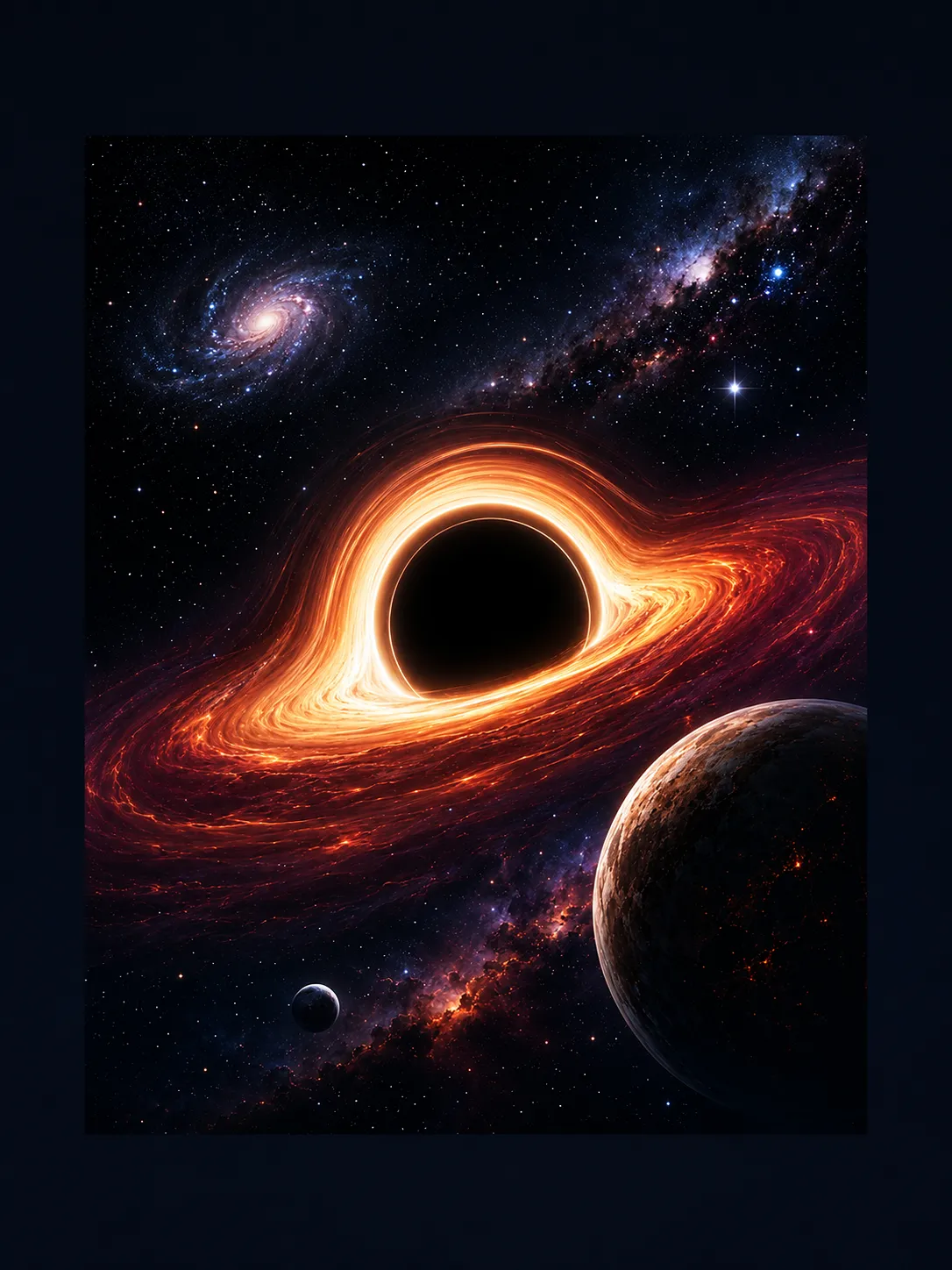
Black holes are among the most fascinating and mysterious objects in the universe. They are invisible, incredibly powerful, and can affect everything around them with their immense gravity. Scientists have spent many years studying black holes, yet many questions remain unanswered.
For children and adults alike, black holes inspire curiosity and wonder. How do they form? Can anything escape from them? What would happen if you got too close? Let’s explore the mysteries of black holes and discover why they are some of the most exciting objects in space.
What Is a Black Hole?
A black hole is a region in space where gravity is so strong that nothing can escape from it, not even light. Because light cannot get out, black holes cannot be seen directly. Instead, scientists detect them by observing their effects on nearby stars, gas, and dust.
Black holes are not giant vacuum cleaners that suck up everything in the universe. Objects far away are not affected by them. A black hole only has a strong pull-on things that come very close to it.
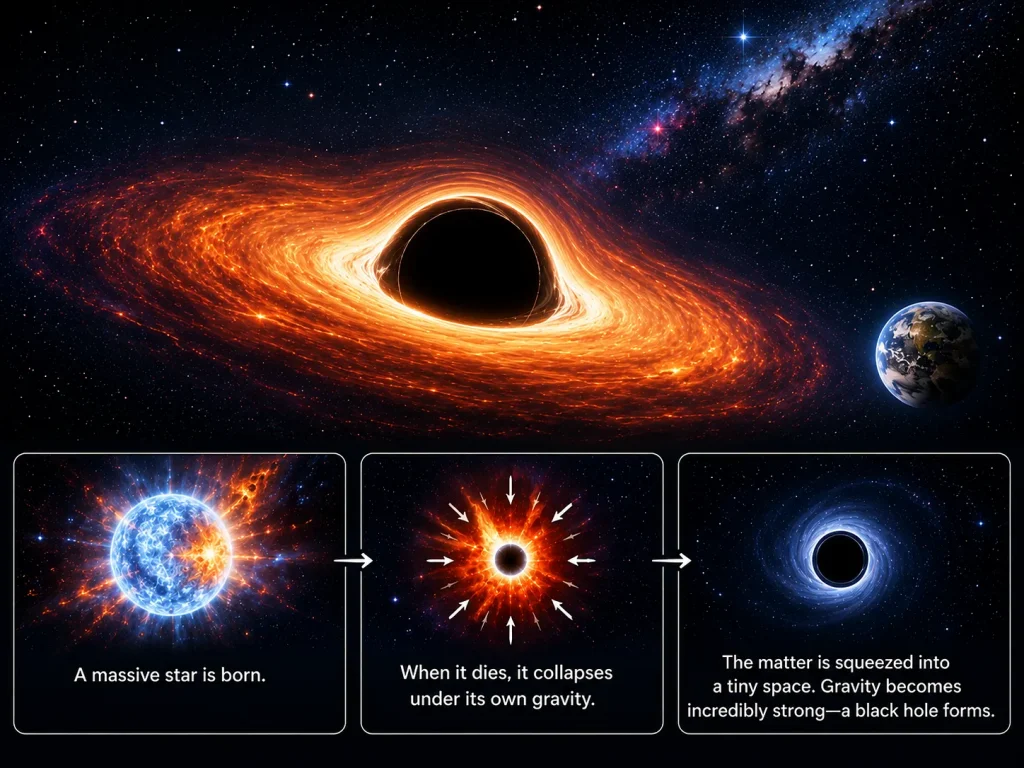
Imagine squeezing a huge amount of matter into a tiny space. The gravity becomes increasingly strong until a black hole forms.
How Do Black Holes Form?
Most black holes form when very massive stars reach the end of their lives.
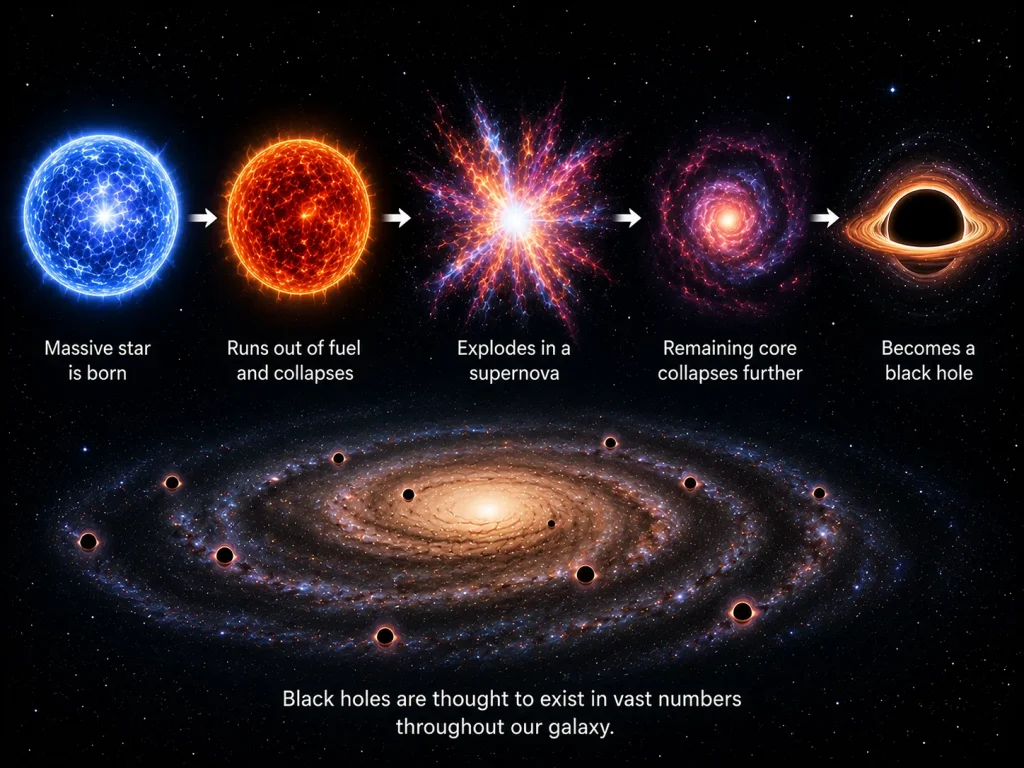
Stars shine because they produce energy in their cores. Eventually, a massive star runs out of fuel. When this happens, it can no longer support itself against gravity. The star collapses inward and may explode in a spectacular event called a supernova.
After the explosion, the remaining core can become a black hole if it is massive enough.
Scientists believe there are millions of black holes scattered throughout our galaxy, the Milky Way.
Different Types of Black Holes
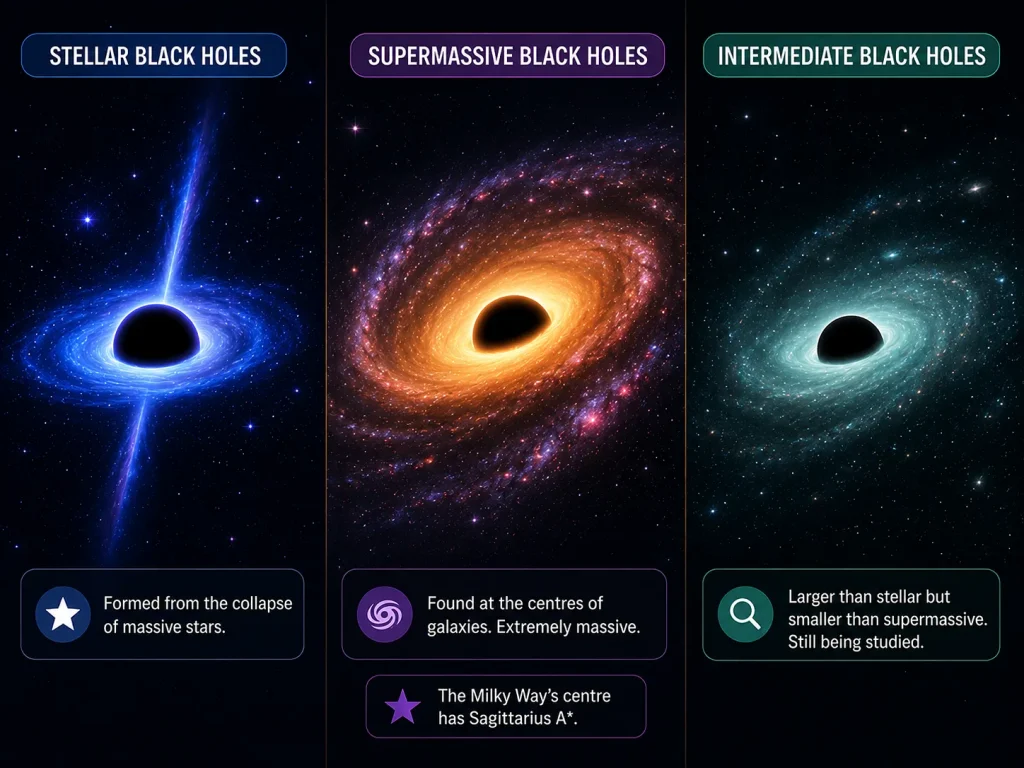
Not all black holes are the same. Scientists have identified several different kinds.
Stellar Black Holes
These are formed from the collapse of massive stars. They can be several times more massive than our Sun.
Supermassive Black Holes
These enormous black holes sit at the centres of many galaxies. They can contain millions or even billions of times the mass of the Sun.
The centre of the Milky Way contains a supermassive black hole known as Sagittarius A*.
Intermediate Black Holes
Scientists think these black holes are larger than stellar black holes but smaller than supermassive ones. They are still being studied because they are difficult to find.
What Is the Event Horizon?
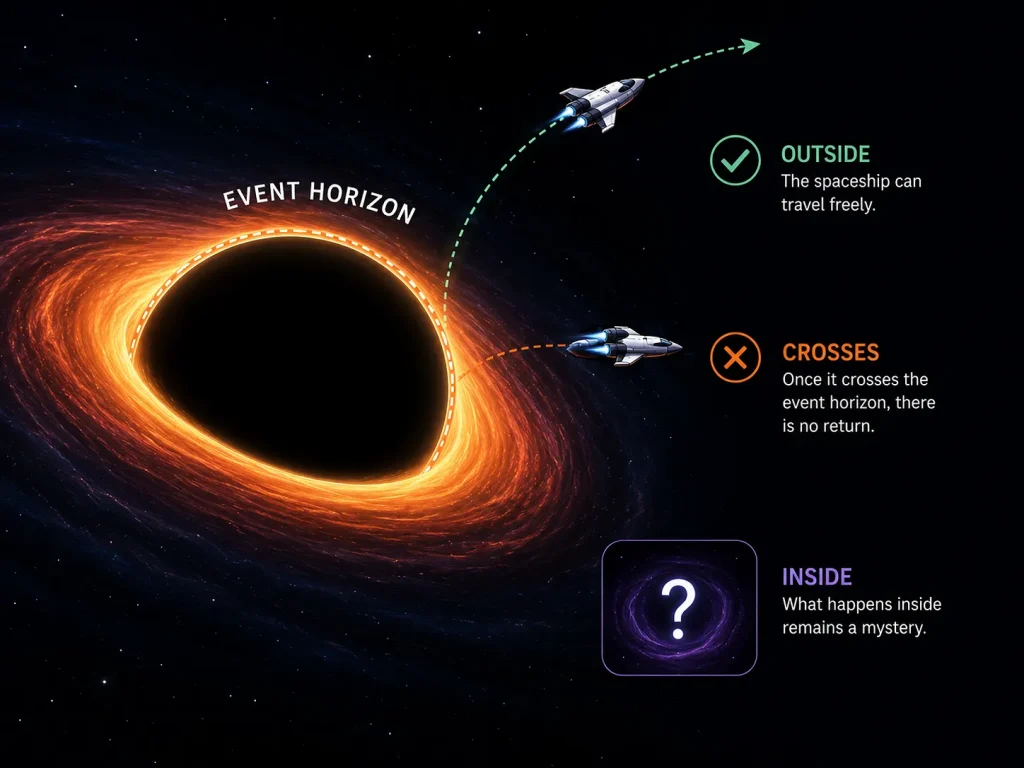
One of the most mysterious parts of a black hole is the event horizon.
The event horizon is often called the “point of no return.” Once anything crosses this boundary, it cannot escape the black hole’s gravity.
If a spaceship stayed safely outside the event horizon, it could continue travelling through space. But if it crossed the event horizon, escaping would become impossible.
Scientists still do not know exactly what happens inside a black hole after something passes through its event horizon.
Can Black Holes Be Seen?
Since black holes do not emit light, you might think they are impossible to observe. However, scientists have found clever ways to study them.
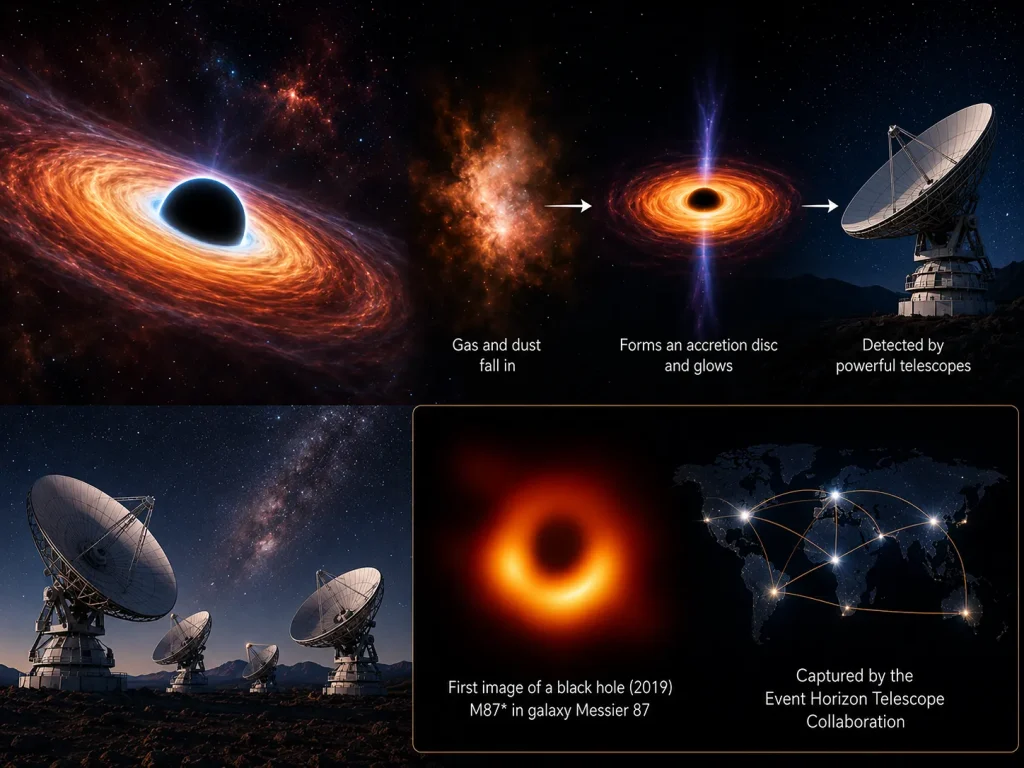
When gas and dust fall towards a black hole, they often form a spinning disc called an accretion disc. As the material spins faster, it becomes extremely hot and glows brightly.
Astronomers can detect this glowing material using powerful telescopes.
In 2019, scientists revealed the first-ever image of a black hole. The picture showed the shadow of a supermassive black hole in the galaxy known as Messier 87. This achievement was made by the Event Horizon Telescope Collaboration and was celebrated around the world.
What Happens Near a Black Hole?
The gravity near a black hole is incredibly strong.
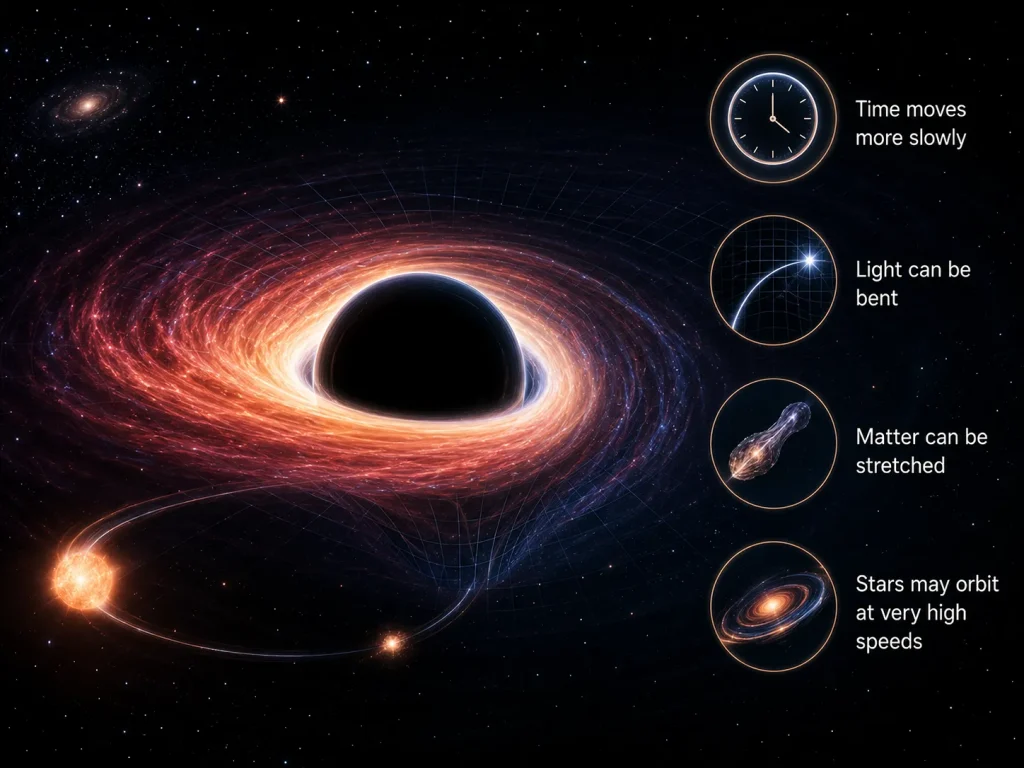
According to Albert Einstein’s theory of gravity, massive objects bend space and time. Black holes bend space and time more than almost anything else in the universe.
Near a black hole:
- Time moves more slowly compared to places farther away.
- Light can be bent around the black hole.
- Matter can be stretched by gravity.
- Stars may orbit at very high speeds.
Scientists sometimes use the term “spaghettification” to describe what could happen if an object gets extremely close to a black hole. The gravity would pull more strongly on one end than the other, stretching the object.
Do Black Holes Last Forever?
For a long time, scientists thought black holes would exist forever. However, some researchers believe black holes can slowly lose energy.
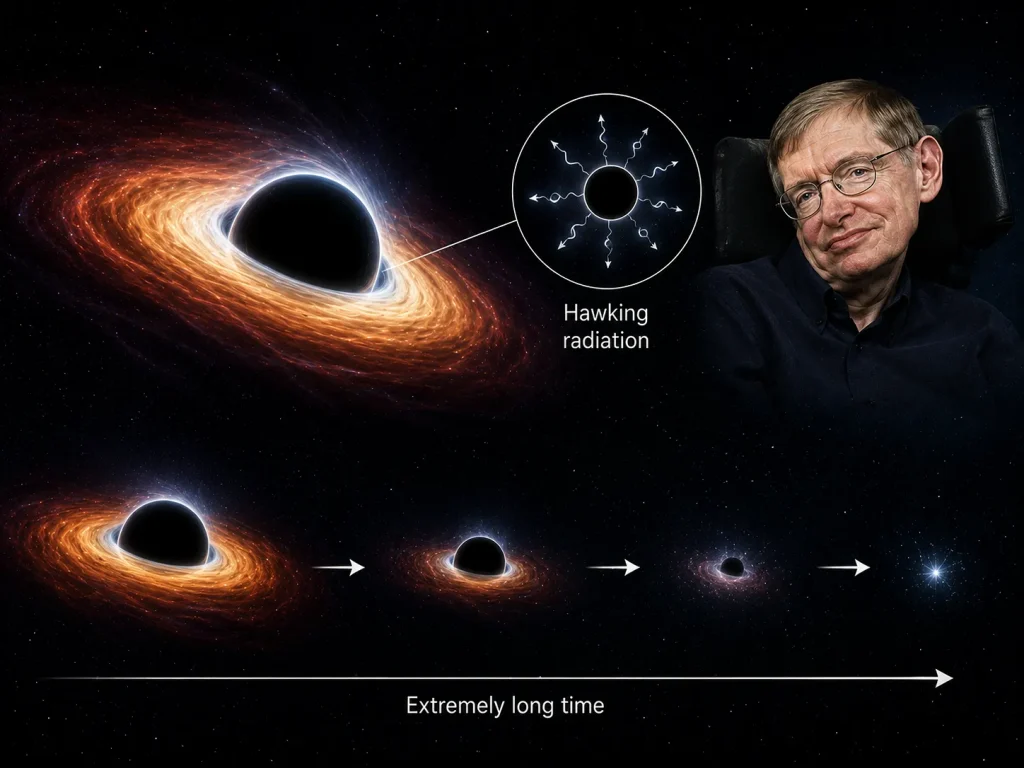
A famous physicist, Stephen Hawking, proposed that black holes may emit a tiny amount of radiation, now called Hawking radiation.
According to this idea, black holes could gradually shrink over extremely long periods. For the largest black holes, this process would take much longer than the current age of the universe.
Scientists are still studying this fascinating possibility.
Could a Black Hole Come Near Earth?
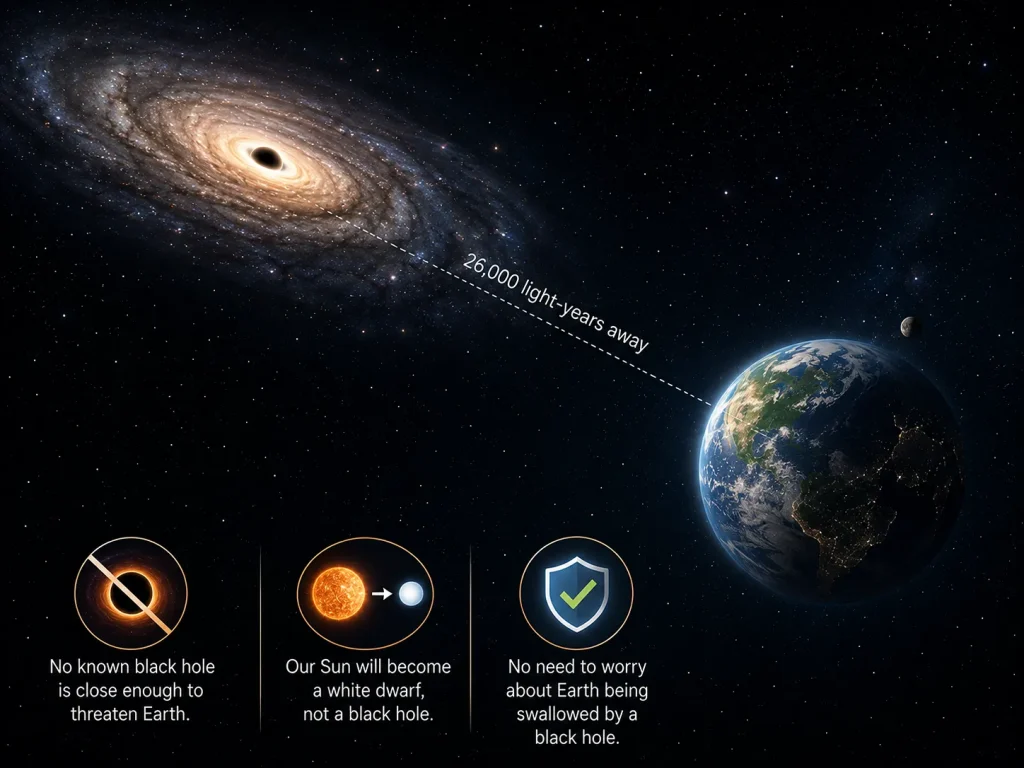
Thankfully, there is no known black hole close enough to threaten Earth.
The supermassive black hole at the centre of our galaxy is about 26,000 light-years away, which is an enormous distance.
Our Sun will not become a black hole when it reaches the end of its life because it is not massive enough. Instead, it will eventually become a different type of stellar remnant called a white dwarf.
So, there is no need to worry about Earth being swallowed by a black hole anytime soon.
Why Are Black Holes Still a Mystery?
Even though scientists have learned a great deal about black holes, many questions remain.
Some mysteries include:
- What happens inside a black hole?
- Can information truly disappear inside one?
- How did supermassive black holes become so enormous?
- Are there tiny black holes hidden throughout space?
- How can black holes help us understand the nature of space and time?
Answering these questions could reveal entirely discoveries about the universe.
The Future of Black Hole Research
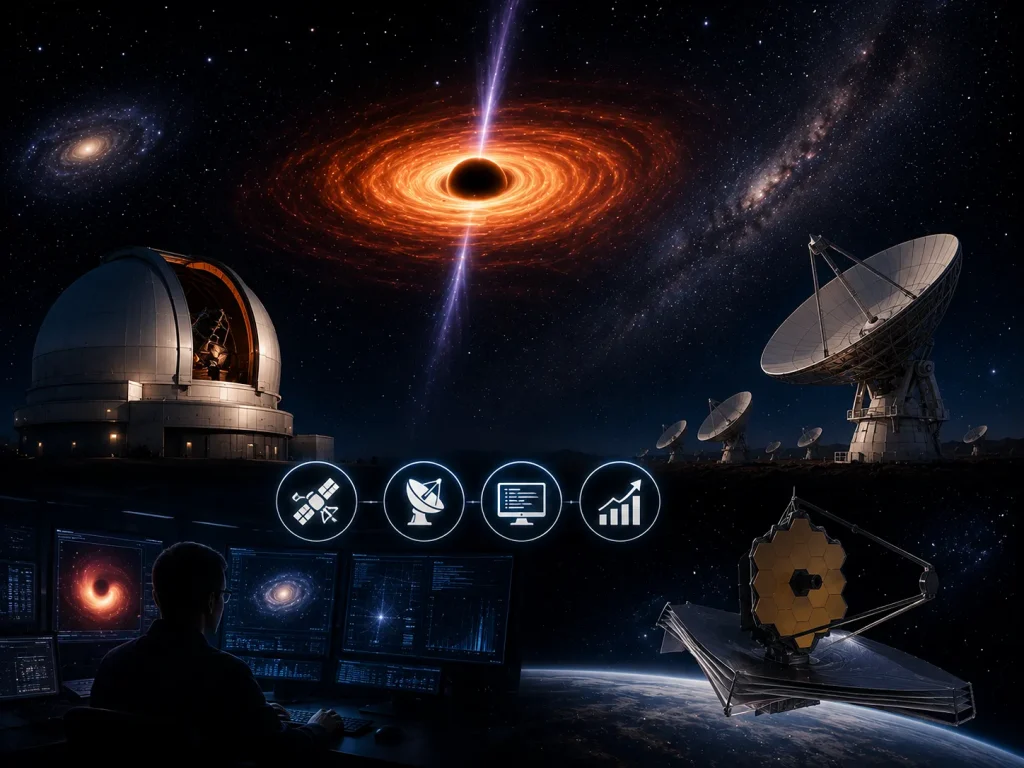
Astronomers continue to build better telescopes and develop new technologies to study black holes.
Space missions, giant observatories, and powerful computers are helping scientists learn more every year. By studying black holes, researchers hope to understand gravity, galaxies, and the origins of the universe itself.
Future discoveries may solve some of the greatest mysteries in science and reveal surprises we have not even imagined yet.
Conclusion
Black holes are some of the strangest and most exciting objects in the universe. They form when massive stars collapse, possess such strong gravity that even light cannot escape, and continue to puzzle scientists around the world.
Although we have learned a great deal about them, many mysteries remain unsolved. Every discovery brings us closer to understanding these incredible cosmic giants. For young explorers who dream of space, black holes remind us that the universe is full of wonders waiting to be discovered.
For more interesting articles, please visit www.kidzherald.com