
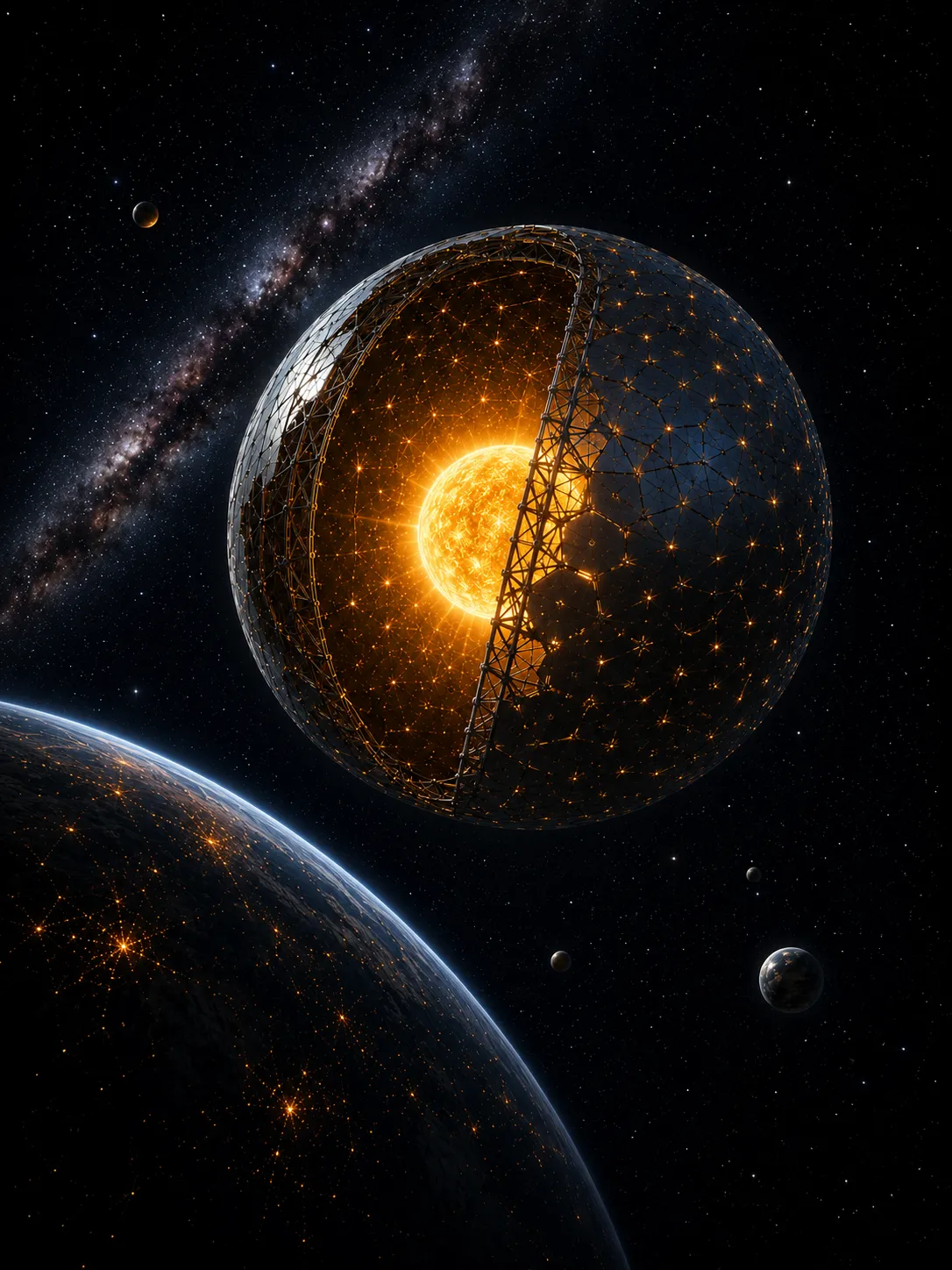
Imagine a world where humans use all the energy from the Sun, not just a tiny fraction. Imagine millions—or even billions—of giant solar-powered structures floating through space, collecting sunlight and sending energy wherever it is needed.
It sounds like science fiction, but scientists have actually thought about this idea for decades. It is called a Dyson Sphere, one of the most fascinating concepts in space science.
But could we really build something the size of a star system? Let’s find out!
What Is a Dyson Sphere?
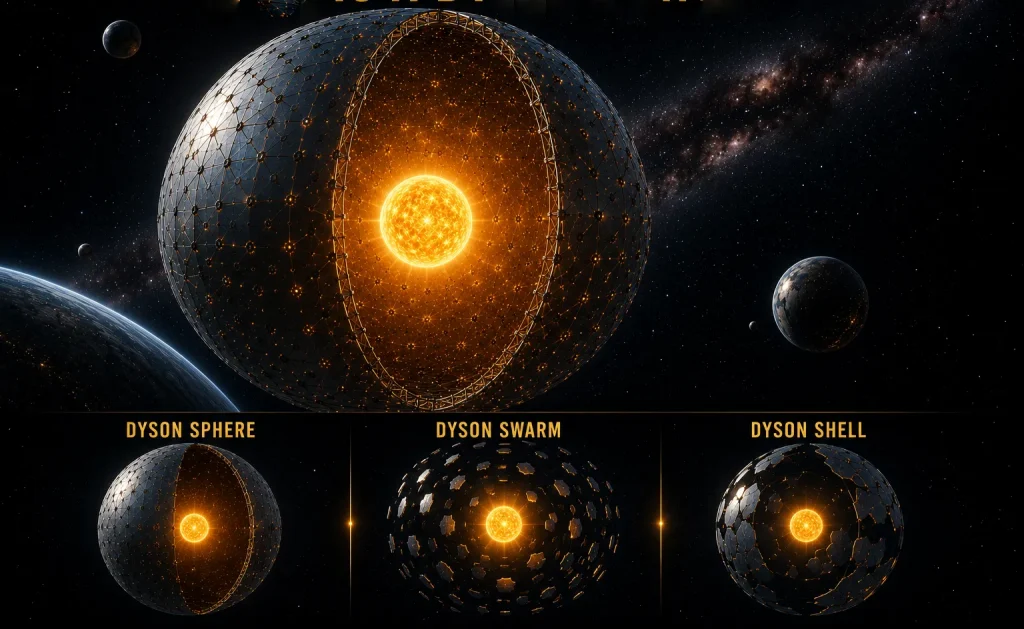
A Dyson Sphere is a hypothetical megastructure designed to capture a large portion of a star’s energy.
The idea was popularised by Freeman Dyson in 1960. He suggested that an advanced civilisation might need so much energy that it would eventually build enormous structures around its star to collect sunlight.
The basic idea is simple:
- Stars produce huge amounts of energy.
- Most of that energy travels into space and is wasted.
- A sufficiently advanced civilisation could capture much more of it.
Our Sun produces enough energy every second to power human civilisation for millions of years!
Why Would Anyone Want to Build One?
Humanity’s energy needs keep growing.
Today we use:
- Electricity
- Solar power
- Wind power
- Nuclear power
But imagine a future civilisation with:
- Giant space cities
- Interplanetary travel
- Factories on the Moon
- Settlements on Mars
Such a civilisation might need far more energy than a single planet can provide.
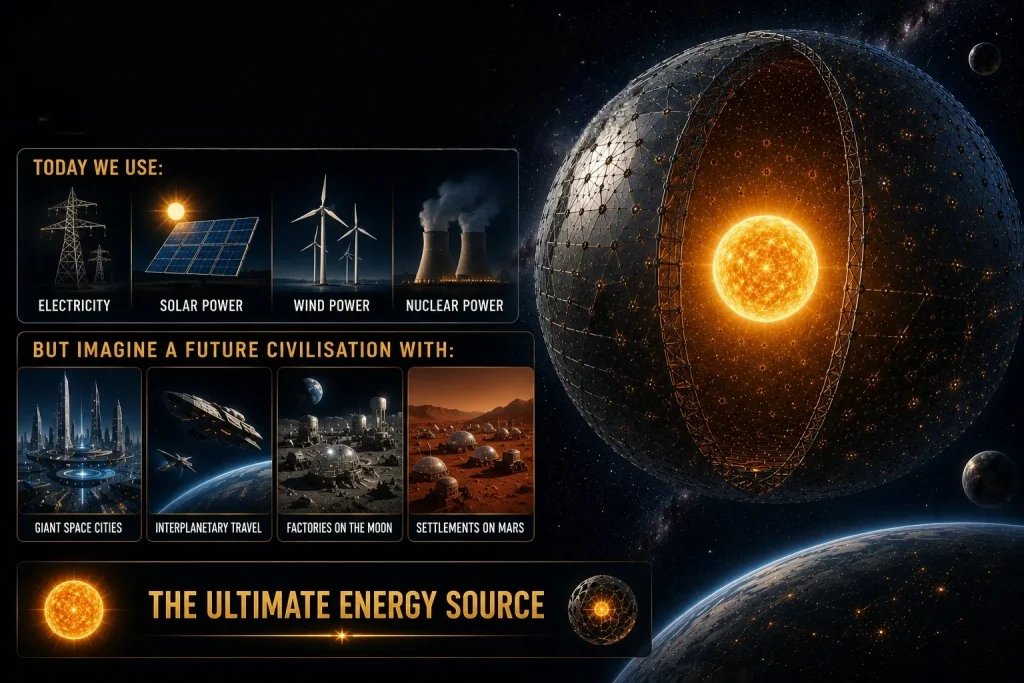
A Dyson Sphere could capture an enormous amount of power directly from a star, making it one of the ultimate energy sources.
Is It Really a Giant Solid Shell?
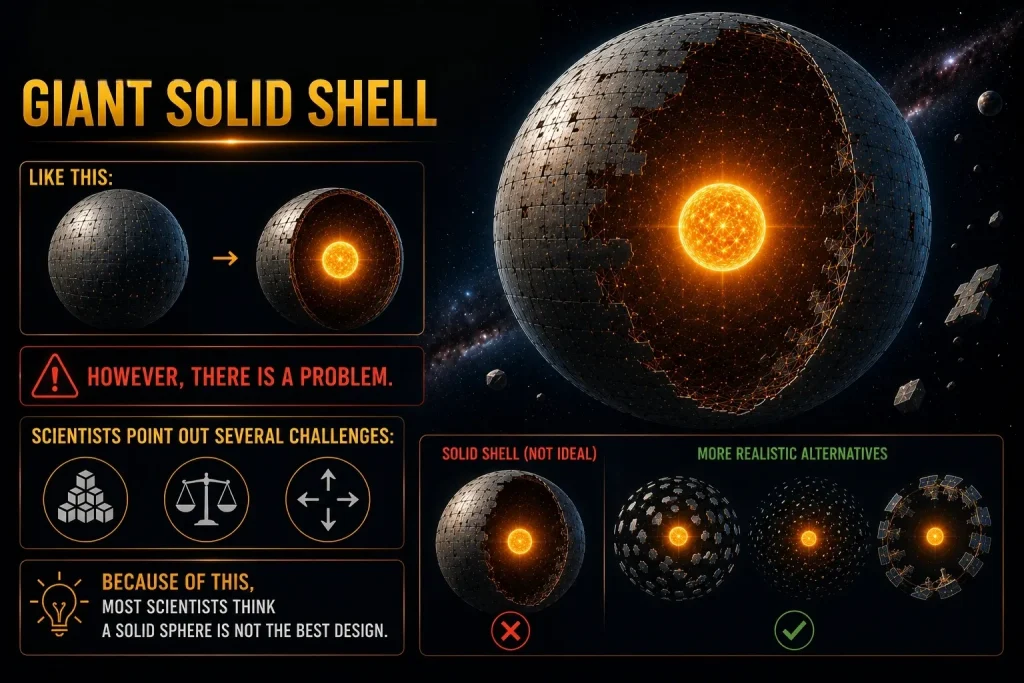
When many people hear “Dyson Sphere”, they imagine a giant hollow ball surrounding a star.
Like this:
inside a huge shell
However, there is a problem.
A solid shell around a star would be incredibly difficult—perhaps impossible—to build.
Scientists point out several challenges:
- It would require an unimaginable amount of material.
- Gravity would not naturally keep the shell stable.
- Small movements could cause the structure to drift dangerously.
Because of this, most scientists think a solid sphere is not the best design.
Meet the Dyson Swarm
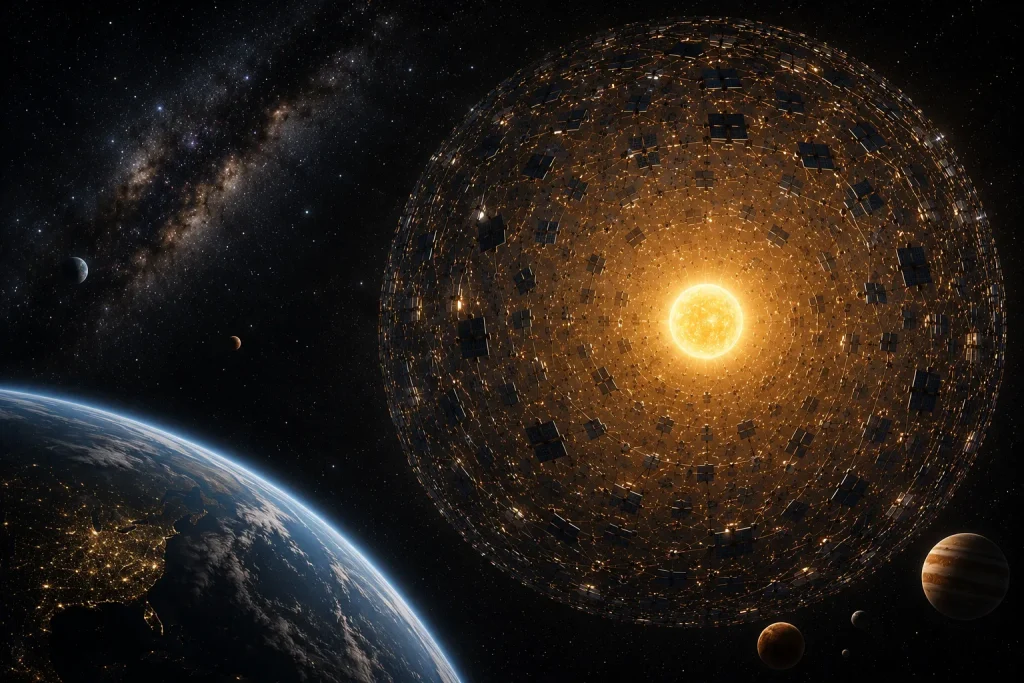
Instead, scientists often talk about a Dyson Swarm.
A Dyson Swarm would consist of:
- Millions or billions of satellites
- Giant solar collectors
- Space habitats
- Power stations
All are orbiting the star independently.
Think of it like a swarm of bees around a flower.
Rather than one giant shell, many smaller structures would work together to collect energy.
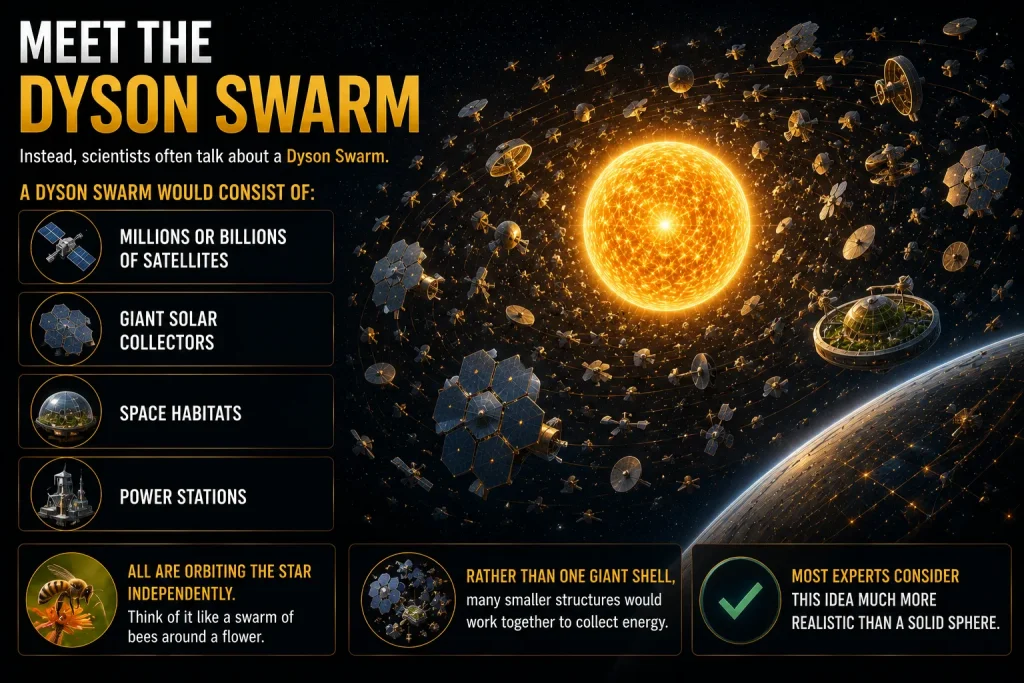
Most experts consider this idea much more realistic than a solid sphere.
How Big Would It Be?
The answer is astonishing.
If a Dyson Swarm surrounded the Sun near Earth’s orbit, it would stretch across an area hundreds of millions of kilometres wide.
To understand just how huge that is:
- Earth’s diameter is about 12,742 kilometres.
- The Sun’s diameter is about 1.39 million kilometres.
- Earth’s orbit around the Sun is about 940 million kilometres long.
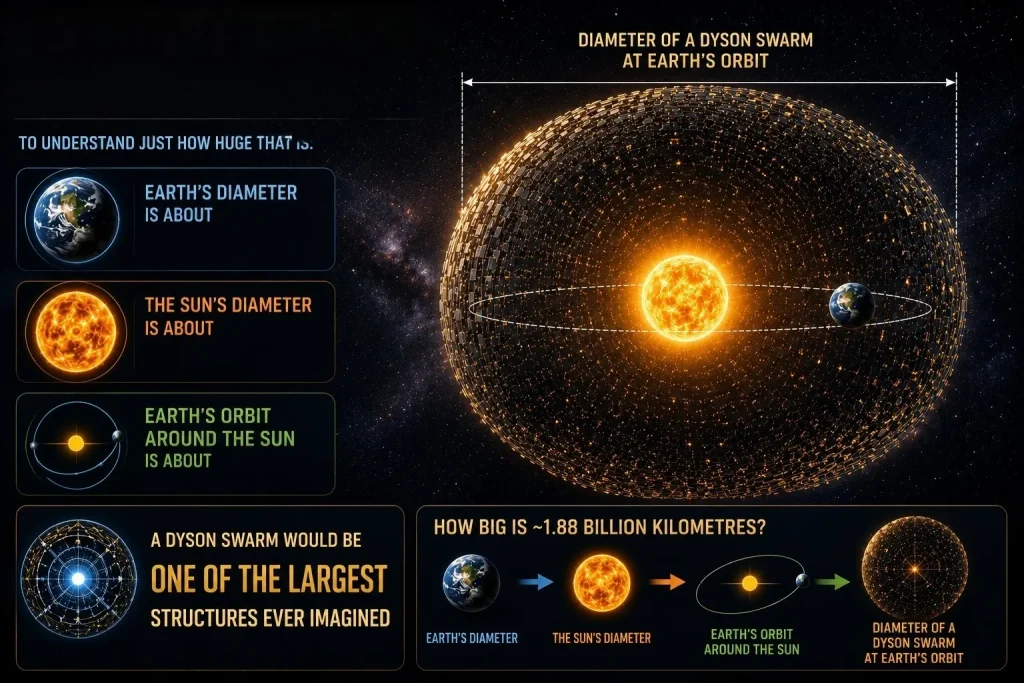
A Dyson Swarm would be one of the largest structures ever imagined.
Where Would We Get the Materials?
Building a Dyson Swarm would require vast amounts of material.
Scientists have suggested that future civilisations might use:
- Asteroids
- Moons
- Small planets
- Space-based factories
Instead of launching everything from Earth, robots could mine resources directly in space.
Some calculations suggest that dismantling a planet like Mercury could provide a huge amount of building material.
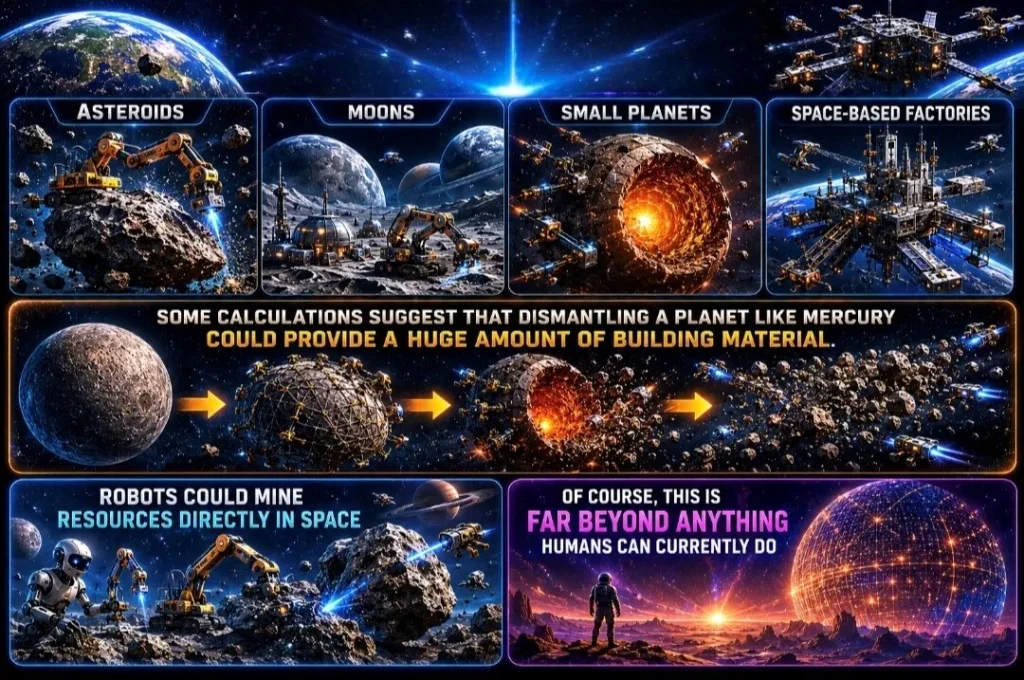
Of course, this is far beyond anything humans can currently do.
Could Robots Build It?
Probably!
A project this enormous would be impossible for humans alone.
Future engineers might create:
- Self-repairing machines
- Autonomous robots
- Space factories
- Artificial intelligence systems
These machines could:
- Mine asteroids.
- Manufacture solar collectors.
- Assemble structures in orbit.
- Expand the swarm over hundreds or thousands of years.
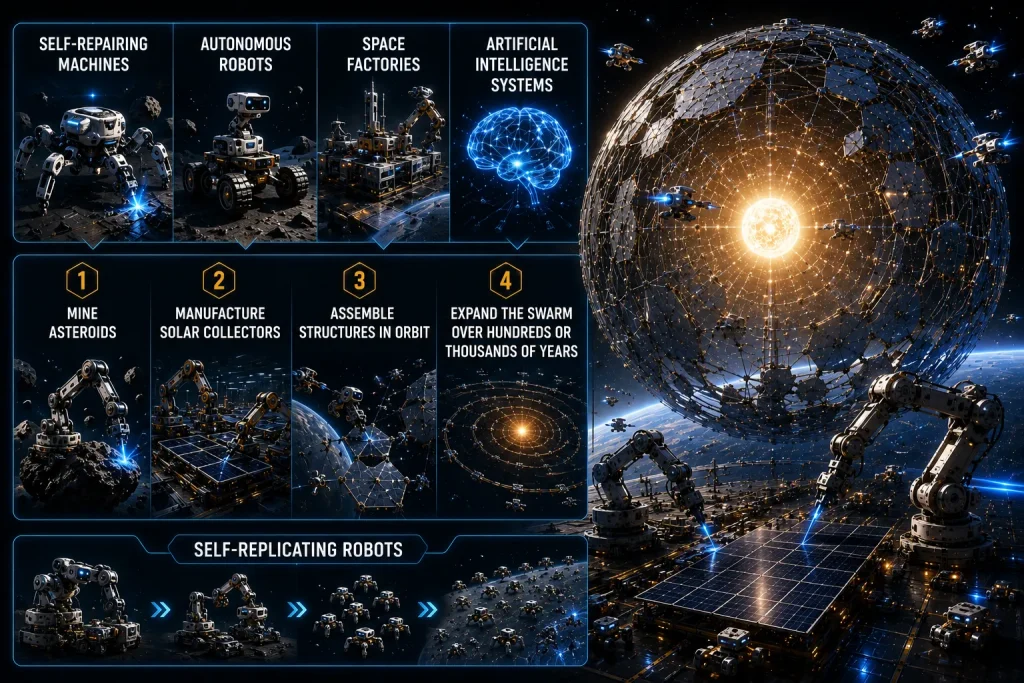
In many science-fiction stories, self-replicating robots help build giant space projects like this.
Could Aliens Have Already Built One?
This is one of the most exciting questions in astronomy!
Scientists searching for intelligent extraterrestrial life sometimes look for signs of Dyson Spheres.
Why?
Because a Dyson Swarm would absorb starlight and then release waste heat.
That heat might be visible to powerful telescopes as unusual infrared radiation.
If astronomers found a star emitting unusual amounts of infrared light, it would be worth investigating.
So far, no confirmed Dyson Sphere has ever been discovered.
But the search continues.
What Makes Building One So Difficult?
Even a Dyson Swarm faces enormous challenges.
1. Materials
We would need more material than humanity has ever used.
2. Cost
The project would cost far more than any construction project in history.
3. Technology
We currently lack:
- Large-scale asteroid mining
- Massive space manufacturing
- Long-term space construction systems
4. Time
Building a Dyson Swarm might take centuries or even thousands of years.
That means many generations would have to work together.
Are We Building Anything Similar Today?
Not exactly, but some modern technologies are small steps in the same direction.
Examples include:
- Solar panels on satellites
- Space stations
- Reusable rockets
- Plans for asteroid mining
- Research into space-based solar power
Companies such as SpaceX and space agencies like NASA are helping humanity become more active in space.
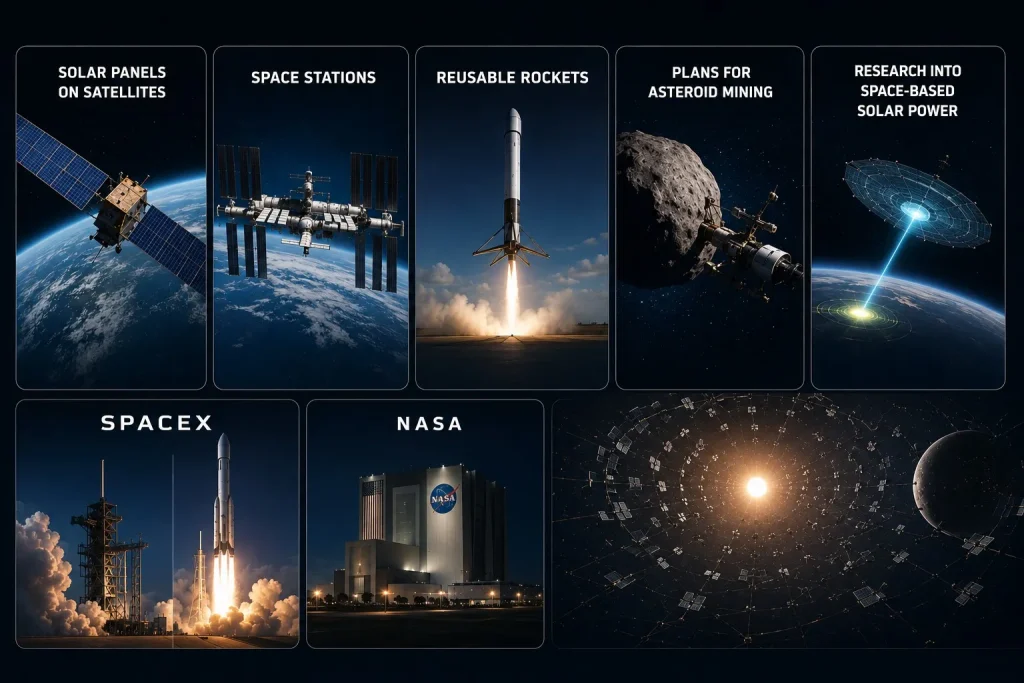
Although a Dyson Swarm remains far in the future, these technologies could one day contribute to similar projects.
What Does a Dyson Sphere Teach Us?
The most important thing about the Dyson Sphere is not whether we build one tomorrow.
It teaches us to think big.
It encourages scientists and engineers to ask questions such as:
- How much energy might future civilisations need?
- What could humanity achieve in thousands of years?
- Are advanced alien civilisations out there?
- What are the limits of technology?
Ideas like Dyson Spheres help expand our imagination and inspire future discoveries.
Fun Fact!
Scientists sometimes classify civilisations by the amount of energy they use.
A civilisation capable of using all the energy from its star is often called a Type II civilisation on the Kardashev Scale, a system created by Nikolai Kardashev.
Humanity is still far below that level—but perhaps one day we will get closer!
Conclusion
A Dyson Sphere is one of the grandest ideas ever imagined. Instead of relying on a small amount of energy from a planet, an advanced civilisation could capture power directly from its star.
While a giant solid shell is unrealistic, a Dyson Swarm made of countless orbiting solar collectors may one day be possible.
At the moment, humanity lacks the technology, materials, or resources to build such a megastructure. Yet every great achievement begins as an idea.
Who knows? Thousands of years from now, our descendants may look up at the Sun and see not just a star, but a vast network of structures collecting its power for worlds across the Solar System.
Until then, the Dyson Sphere remains one of the most exciting possibilities in science and space exploration.
For more interesting articles, please visit www.kidzherald.com