
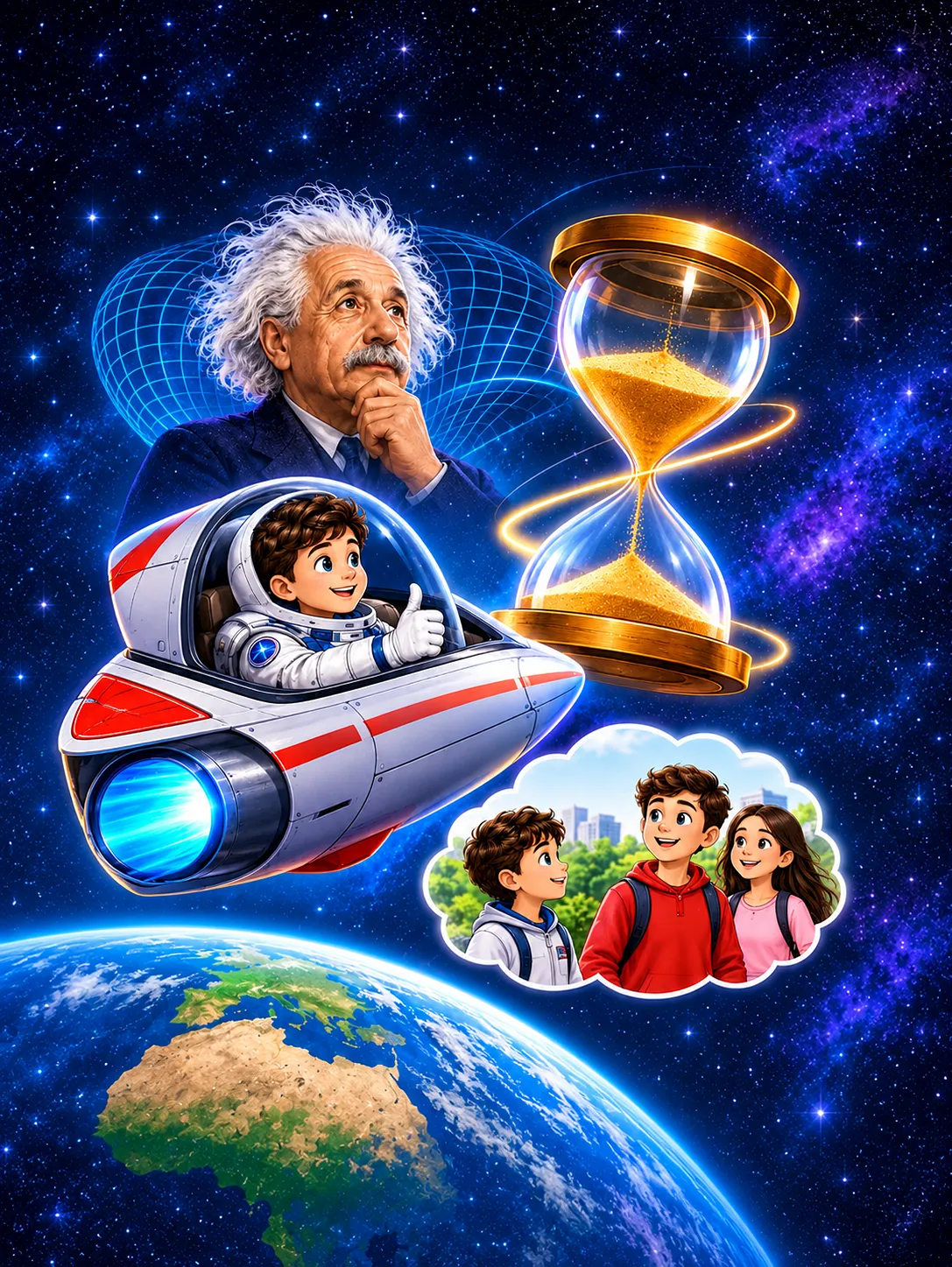
Have you ever imagined travelling through space in a super-fast spaceship and returning to Earth to discover that your friends have grown older than you? It sounds like something from a science-fiction film, doesn’t it?
But believe it or not, this strange idea is based on real science!
Time does not always pass at the same speed everywhere in the Universe. Depending on how fast something is moving and how strong the gravity around it is, time can pass more slowly or more quickly.
This fascinating phenomenon is called Time Dilation. It was predicted by one of the world’s greatest scientists, Albert Einstein.
But why does it happen? Do astronauts really age more slowly? And can we use this discovery to travel into the future?
Let’s explore the amazing science of time!
1. What Is Time Dilation?
Time dilation means that time can pass at different rates for people or objects that are moving differently or experiencing different amounts of gravity.
Normally, we think that one second is the same for everyone. However, Einstein discovered that this is not always true.
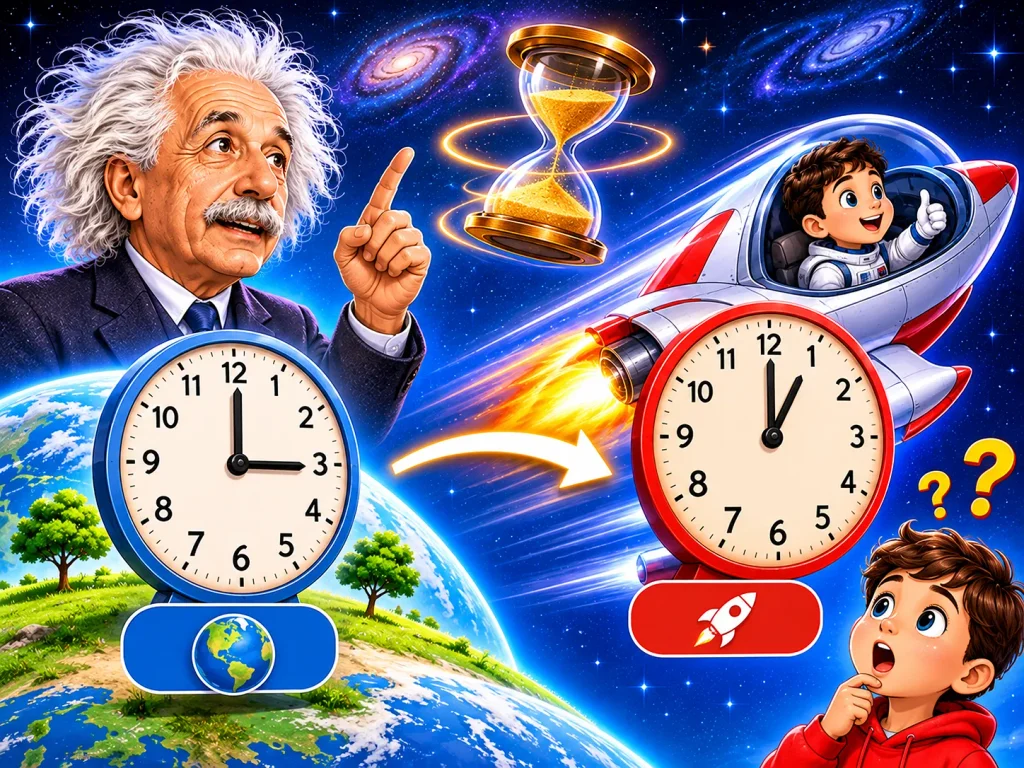
Imagine two identical clocks. One stays on Earth, while the other travels through space in a very fast spaceship. When they are brought together again, they may show different times!
Both clocks are working perfectly. The difference happens because time itself has passed differently for them.
This is one of the most surprising discoveries in modern physics.
2. Albert Einstein’s Amazing Discovery
Albert Einstein was a German-born scientist who changed the way we understand the Universe.
In 1905, he introduced his Special Theory of Relativity. In 1915, he developed his General Theory of Relativity.
These theories explained two important things:
- Speed affects time: The faster you travel compared with another observer, the more slowly your time passes compared with theirs.
- Gravity affects time: Clocks closer to a massive object, where gravity is stronger, tick more slowly than clocks farther away.
Einstein also explained that space and time are connected. Scientists call this combination spacetime.
His discoveries showed that time is much more interesting than we once imagined!
3. How Does Travelling Fast Slow Down Time?
Imagine travelling in a spaceship at an incredible speed.
The speed of light is approximately 300,000 kilometres per second. It is so fast that light could travel around the Earth about seven and a half times in just one second!
According to Einstein’s theory, the closer your spaceship travels to the speed of light, the more slowly time passes for you compared with someone watching from Earth.
For example, imagine two twins:
- One twin stay on Earth.
- The other travels through space in a spaceship moving close to the speed of light.
When the travelling twin returns, they could discover that fewer years have passed for them than for the twin who stayed on Earth.
This is sometimes called the Twin Paradox.
Interestingly, the travelling twin would not feel that their own time was moving slowly. Their heartbeat, watch, and everyday activities would all seem normal.
It is only when the two twins compare their experiences that they discover the difference.

4. Can Gravity Make Time Slower?
Yes! Gravity is another important reason why time passes differently.
According to Einstein’s General Theory of Relativity, massive objects such as planets, stars and black holes affect the shape of spacetime.
The stronger the gravitational field, the more slowly time passes compared with a place where gravity is weaker.
For example:
- Time passes slightly more slowly near Earth’s surface.
- Time passes slightly faster farther away from Earth.
- Near a black hole, the difference can become enormous.
Think of two identical clocks. One is placed near a massive planet, while the other is much farther away. After some time, they will show slightly different readings.
This effect is known as Gravitational Time Dilation.

5. Do Astronauts Age More Slowly in Space?
This is one of the most exciting parts of the story!
Astronauts aboard the International Space Station (ISS) travel around Earth at approximately 28,000 kilometres per hour.
Because they move so quickly, their clocks tick slightly more slowly than clocks on Earth’s surface.
However, the ISS is also farther from Earth’s centre, where Earth’s gravity is slightly weaker. This gravitational effect makes clocks tick faster.
Both effects work together. For astronauts on the ISS, the speed effect is slightly stronger, so they experience a tiny amount less time than people on Earth.
This means astronauts really can age slightly differently from people who stay on our planet!
But don’t expect them to return looking years younger. The difference is incredibly small, generally just a fraction of a second over several months.
6. What Happens to Time Near a Black Hole?
Black holes are among the strangest objects in the Universe.
They have extremely strong gravity, and their gravitational pull is so powerful that even light cannot escape once it passes a boundary called the event horizon.
Imagine an astronaut observing a clock near a black hole from a much safer distance.
Because of the black hole’s powerful gravity, the clock closer to it would appear to tick more slowly compared with the distant observer’s clock.
The closer the clock gets to the event horizon, the greater this difference becomes.
This makes black holes fascinating places for scientists studying gravity and time.

7. How Do Scientists Know Time Dilation Is Real?
You might wonder whether time dilation is just an idea from science-fiction films.
Actually, scientists have tested it using real experiments!
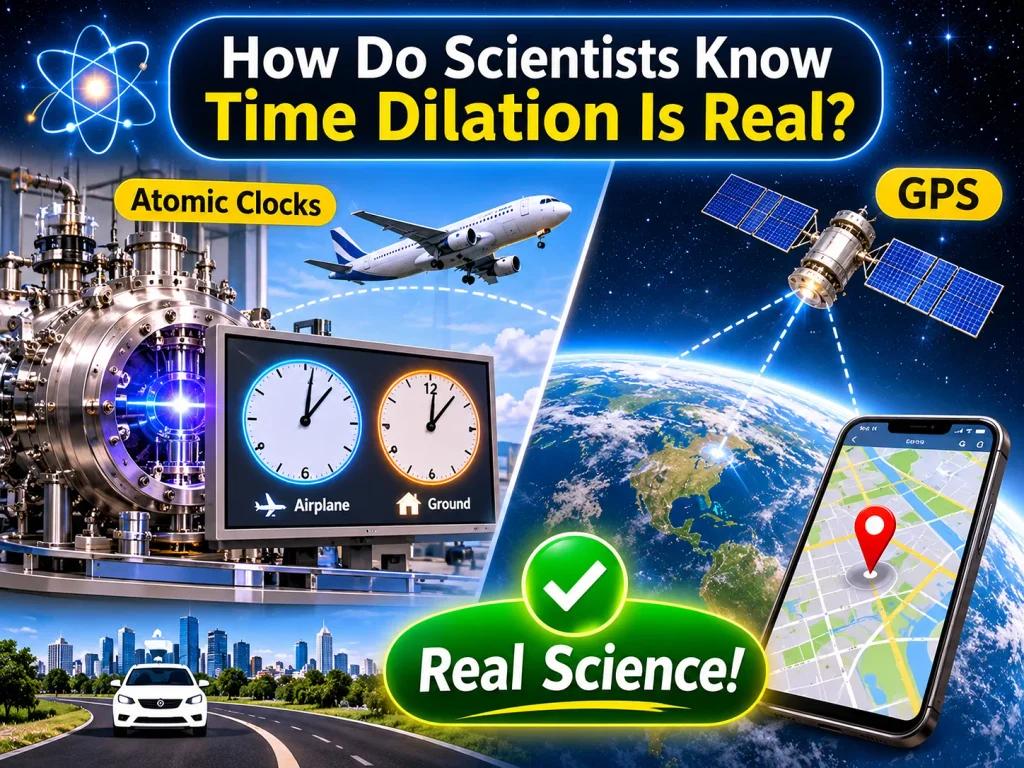
They have used extremely accurate clocks called atomic clocks to measure tiny differences in time.
In one famous experiment, scientists compared clocks that travelled in aeroplanes with clocks that remained on the ground. The clocks showed slightly different times, as Einstein’s theories predicted.
Another everyday example is GPS.
GPS satellites orbit Earth and help us find locations using our phones, cars and other devices.
Their clocks experience different amounts of time dilation because of their speed and their distance from Earth.
Scientists must correct these differences to keep GPS navigation accurate.
Without these corrections, our navigation systems would gradually become less reliable!
8. Can We Travel into the Future?
Could humans really travel into the future?
According to Einstein’s theory, travelling extremely close to the speed of light could allow a person to experience less time than people remaining on Earth.
When the traveller returned, the people on Earth could be much older.
In this sense, travelling into the future is possible according to modern physics.
However, building a spaceship capable of travelling close to the speed of light is far beyond our current technology.
Travelling backwards in time is a much more complicated question, and scientists have not discovered a proven way to do it.

Conclusion: Time Is More Amazing Than We Think!
Time may seem simple in our everyday lives, but the Universe works in some surprising ways.
Albert Einstein showed us that time is not exactly the same for everyone. Moving at extremely high speeds and experiencing strong gravity can both change how quickly time passes.
From astronauts travelling around Earth to mysterious black holes, time dilation helps scientists understand the amazing relationship between space, time and gravity.
And the most exciting part is that this is not just science fiction. It is real science that has been tested through experiments and is even used in modern GPS technology.
So, the next time you look at a clock, remember that somewhere in the Universe, another clock might be ticking at a slightly different speed!
Amazing Facts About Time in Space
- Light travels at approximately 300,000 kilometres per second.
- Einstein introduced his Special Theory of Relativity in 1905.
- Gravity can change how quickly clocks tick.
- Astronauts aboard the ISS experience tiny differences in time compared with people on Earth.
- GPS satellites need Einstein’s theories to help provide accurate navigation.
- Black holes can produce extremely large gravitational time-dilation effects.
For more interesting articles, please visit www.kidzherald.com