

There is something special about getting into a brand-new car. The seats look perfect, the dashboard is shiny, and there is that familiar “new car smell”.
Many people enjoy the smell because it makes a car feel fresh and unused. But have you ever wondered what creates that smell?
Is it simply the smell of new materials, or could it contain harmful chemicals?
The answer is a little more complicated than a simple “yes” or “no”. The smell comes from gases released by materials inside the car, and some of these chemicals can be harmful at high enough concentrations or after prolonged exposure. However, smelling a new car does not automatically mean that you are being poisoned.
Let’s explore the science behind this interesting smell.
What Creates the New Car Smell?
A new car contains lots of different materials.
These can include:
- Plastics
- Foam
- Synthetic fabrics
- Glues and adhesives
- Paints and coatings
- Dashboard materials
- Floor coverings
- Seat materials
As these materials are new, some of the chemicals inside them slowly escape into the air. Scientists call this process off gassing.
The gases released can include volatile organic compounds, commonly abbreviated as VOCs.
VOCs are chemicals that can easily evaporate into the air. They are found in many everyday products, not just cars.
The mixture of different VOCs and other chemicals helps create the smell that people recognise as a new car smell.

Why Does It Smell So Strong?
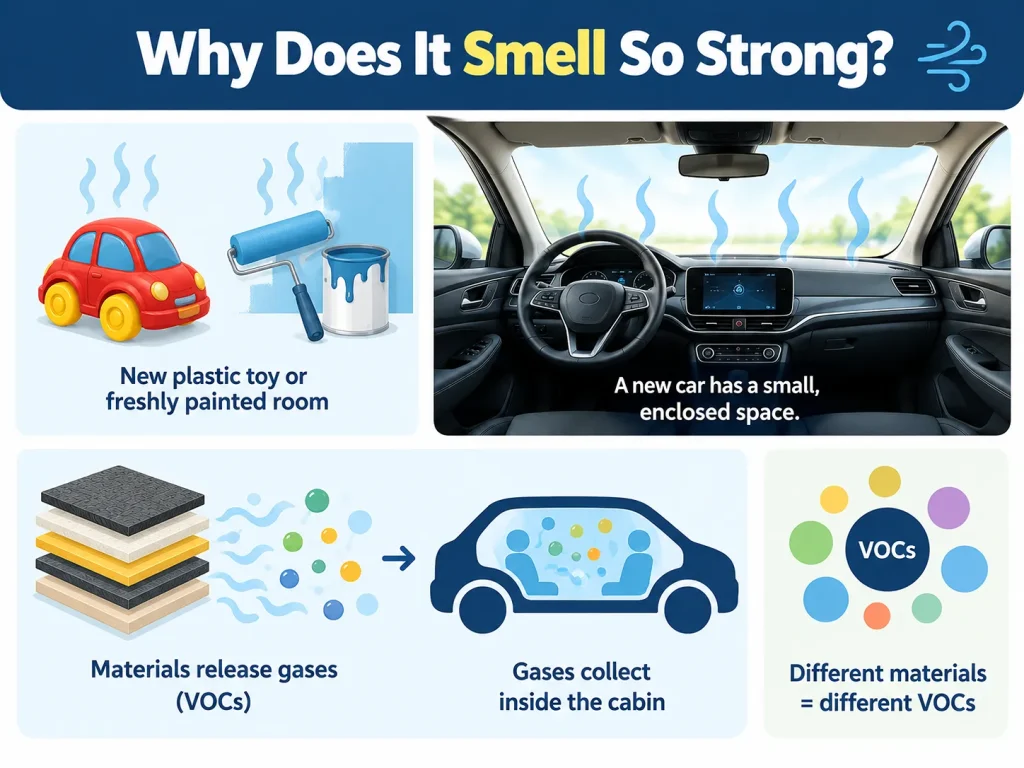
Think about opening a brand-new plastic toy or a freshly painted room. You may notice a strong smell because chemicals are being released into the surrounding air.
Something similar happens inside a new car.
A car’s cabin is a relatively small enclosed space. This means gases released by its materials can collect in the air around passengers.
The exact mixture is different from one vehicle to another because manufacturers use different materials and construction methods. Research has found that vehicle interiors can contain many different VOCs.
Are VOCs Dangerous?
This is where things become important.
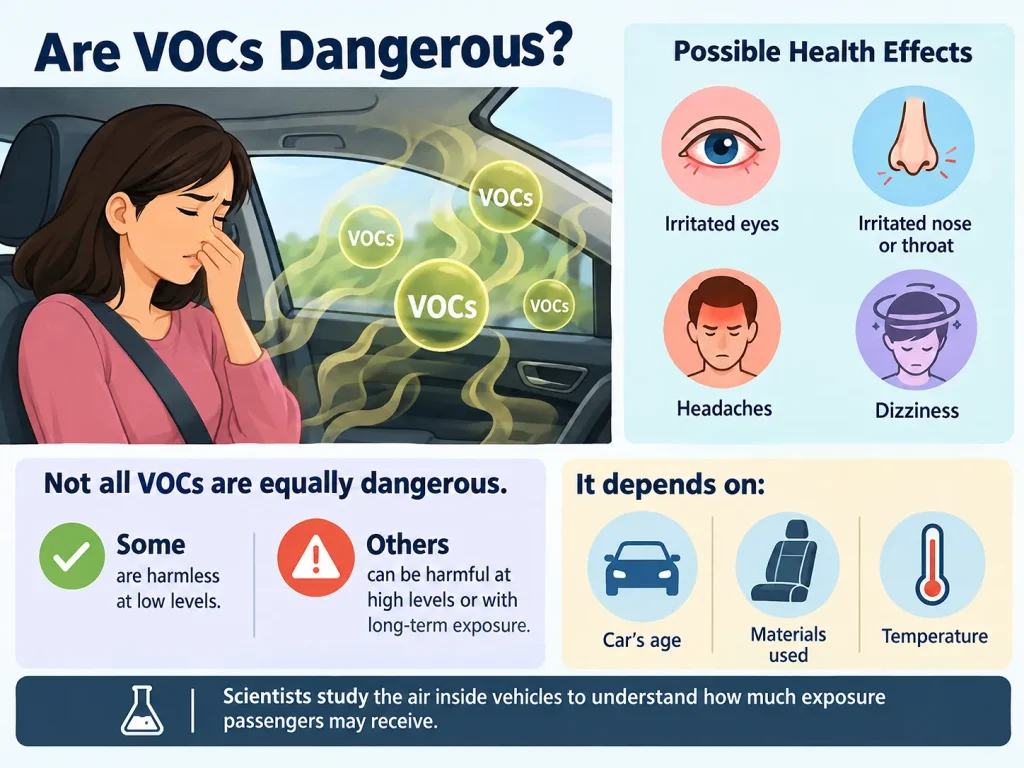
Not every VOC is equally dangerous.
Some VOCs are harmless at the amounts normally encountered, while others can cause health problems at sufficiently high concentrations or with long-term exposure.
Certain chemicals associated with vehicle interiors, such as formaldehyde and some other organic compounds, can irritate the eyes, nose or throat. High exposure to chemicals can also cause symptoms such as headaches or dizziness.
Scientists therefore study the air inside vehicles to understand how much exposure passengers may receive.
The amount of chemicals in the air can depend on factors such as the car’s age, the materials used, and the temperature.
Does Hot Weather Make It Worse?
Yes, temperature can make a difference.
Have you ever noticed that the inside of a parked car can become extremely hot on a sunny day?
Heat can increase the rate at which some materials release VOCs into the air. Scientific research has found that higher temperatures can increase VOC emissions from vehicle interiors.
This means a brand-new car that has been sitting in strong sunshine may have a stronger smell when you first open the door.
That’s one reason ventilation is useful.

Does the Smell Last Forever?
No.
The new car smell generally becomes weaker as the vehicle gets older.
This happens because many of the chemicals released most readily escape during the early period of the car’s life. Research has found that concentrations of some VOCs can decrease substantially over time.
However, the process is not necessarily identical for every chemical. Some substances can continue to be released from interior materials for much longer.
So, the smell may disappear, but that does not mean every chemical has completely vanished.
Can the Smell Make You Feel Unwell?
Some people are more sensitive to strong smells and chemical vapours than others.
Exposure to certain VOCs can be associated with symptoms such as:
- Headaches
- Irritation of the eyes, nose or throat
- Dizziness
- Nausea
- Tiredness
Research on vehicle cabin air quality has found associations between VOC exposure and several potential symptoms. However, the effects depend on the specific chemicals, their concentrations, and the duration of exposure.
If someone feels unwell inside a new car, it is sensible to tell an adult and get some fresh air.
What Can You Do About New Car Smell?
You do not need to panic if a car smells new.
There are simple ways to improve ventilation.
Let Fresh Air In
Opening the windows when it is safe to do so allows fresh air to circulate through the vehicle.
Keep the Interior Ventilated
Using the vehicle’s ventilation system can help replace stale cabin air with fresher air.
Avoid Sitting in a Very Hot Car
A hot vehicle can have higher levels of some airborne chemicals. Allowing the car to cool and ventilating it before a journey can help make the cabin more comfortable.
Follow the Manufacturer’s Instructions
Cars are designed with ventilation systems to manage cabin air. Using them correctly is an important part of keeping the interior comfortable.

Is New Car Smell the Same as Petrol Smell?
No!
New car smell comes mainly from chemicals released by interior materials.
Petrol and exhaust fumes are different sources of air pollution and can contain substances that are harmful to breathe.
You should never deliberately breathe petrol or exhaust fumes.
If you ever notice a strong smell of fuel or exhaust inside a car, tell an adult because the vehicle may need to be checked.
What Are Car Manufacturers Doing?
Car manufacturers are interested in making vehicle interiors comfortable and safe.
Engineers can choose different materials and adhesives and can test the air inside vehicles.
Scientists are also researching ways to reduce unwanted chemical emissions from vehicle interiors.
Some modern vehicles are designed with materials and ventilation systems intended to improve cabin air quality.

So, Is the “New Car Smell” Toxic?
The best answer is:
The new car smell comes from chemicals, including VOCs, and some of those chemicals can be harmful at high enough levels. But the smell itself does not tell you exactly how dangerous the air is.
Different cars emit different mixtures of chemicals, and exposure varies with temperature, ventilation, and time. Researchers have also reached different conclusions about the significance of the health risk under ordinary conditions.
So there is no need to be frightened simply because a car smells new.
Good ventilation is a sensible way to reduce exposure to airborne chemicals, particularly in a brand-new vehicle or during hot weather.
The Science Behind an Everyday Smell
The “new car smell” is a great example of how chemistry is happening all around us.
Something as ordinary as sitting inside a car involves dozens of different materials interacting with the air. Some release tiny amounts of gases that our noses can detect.
Scientists study these gases to understand what they are, where they come from and how they might affect people.
So, the next time you smell a new car, remember that you are actually experiencing a little bit of chemistry!

Quick Facts
New car smell: Comes from a mixture of chemicals released by interior materials.
VOCs: Volatile organic compounds that can evaporate into the air.
Heat: Can increase the release of some VOCs.
Ventilation: Fresh air can help reduce airborne chemical concentrations.
Time: Many of the compounds responsible for the strongest new-car smell decrease as the vehicle gets older.
Science: Researchers continue to study vehicle cabin air quality.
Conclusion
The famous new car smell is not a magical fragrance. It is mainly the result of gases released by materials such as plastics, adhesives, foam and fabrics inside a newly manufactured vehicle.
Some of these chemicals can be harmful at high concentrations or after prolonged exposure, so scientists take vehicle air quality seriously. At the same time, the presence of a new-car smell does not mean that simply sitting in the car is automatically dangerous.
Fresh air and good ventilation are simple ways to improve cabin air quality.
So the next time you climb into a new car, you can enjoy the excitement of the shiny interior — while also remembering the fascinating chemistry taking place all around you!
For more interesting articles, please visit www.kidzherald.com