
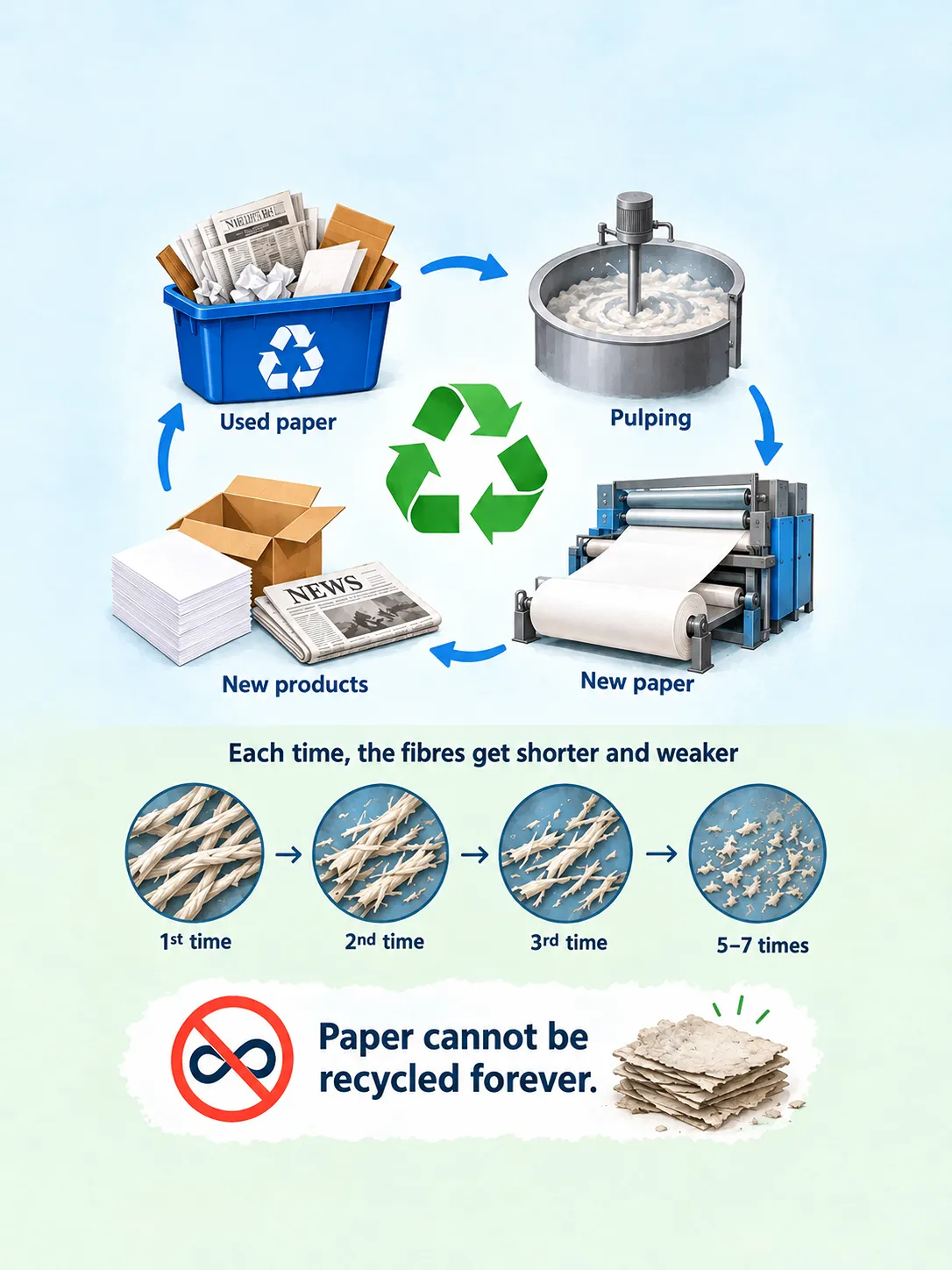
Have you ever wondered what happens to a piece of paper after you put it into a recycling bin?
Perhaps an old newspaper becomes a new newspaper. A used cardboard box may become another box. It sounds as though paper could simply be recycled again and again forever.
But there is a surprising problem:
Paper cannot be recycled forever.
Paper fibres become shorter and weaker each time they go through recycling. In practice, fibres can generally be recycled around five to seven times before they become too degraded to make good-quality paper.
So, what happens to paper during recycling, and why does it eventually reach a limit?
What Is Paper Made From?
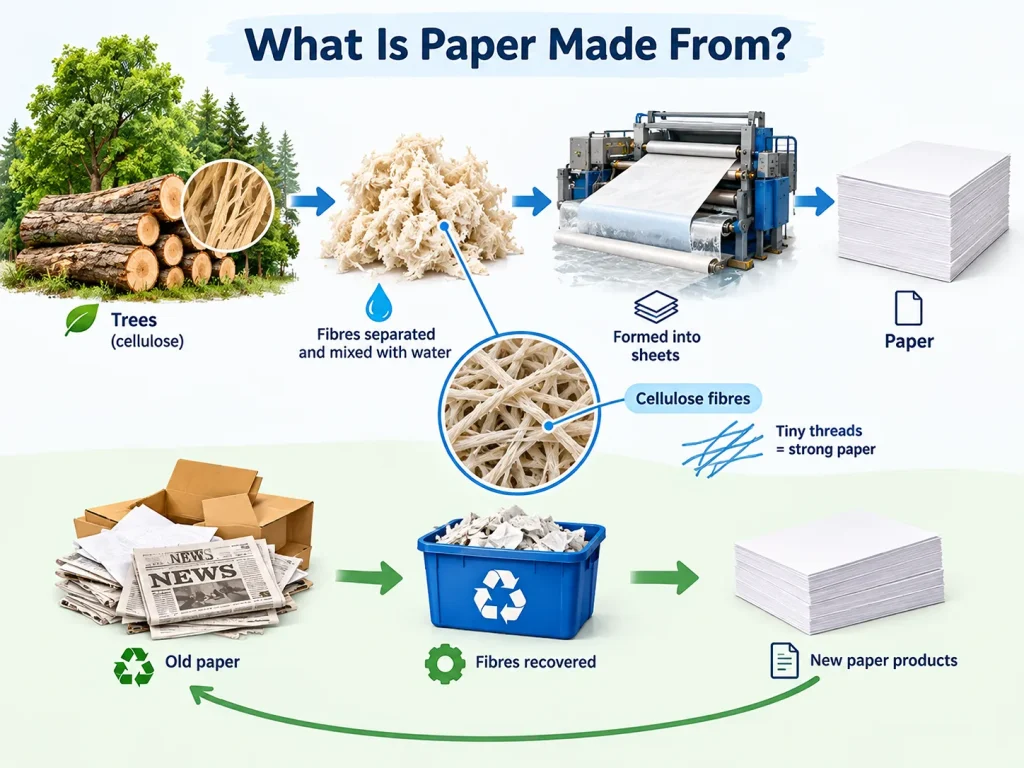
Most ordinary paper is made mainly from cellulose fibres.
Cellulose is a natural material found in plants, including trees. During papermaking, these fibres are separated, mixed with water and formed into sheets.
Think of cellulose fibres as lots of tiny threads. When many of these threads are pressed and dried together, they form a strong sheet of paper.
These fibres are the reason paper can be recycled.
When people collect old paper, they can recover the fibres and use them to make new paper products.
How Is Paper Recycled?
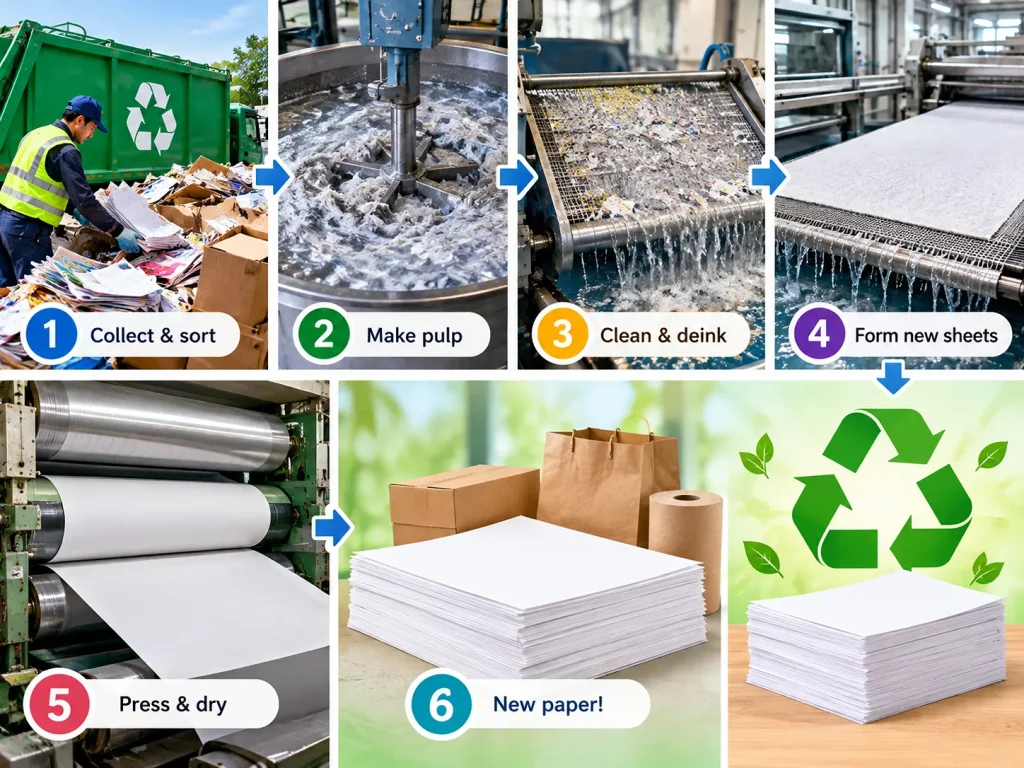
Paper recycling involves several stages.
First, collectors collect used paper and sort it. Different types of paper and cardboard may need different treatments.
The paper is then mixed with water and broken down into a wet mixture called pulp or slurry. Screens and other equipment help remove unwanted materials. In some processes, ink is also removed in a process called deinking.
The cleaned fibres can then be mixed with water again and formed into new sheets.
The new paper is pressed and dried.
And there you have it — old paper has become new paper!
Why Can’t It Continue Forever?
Here is the clever — and slightly frustrating — part.
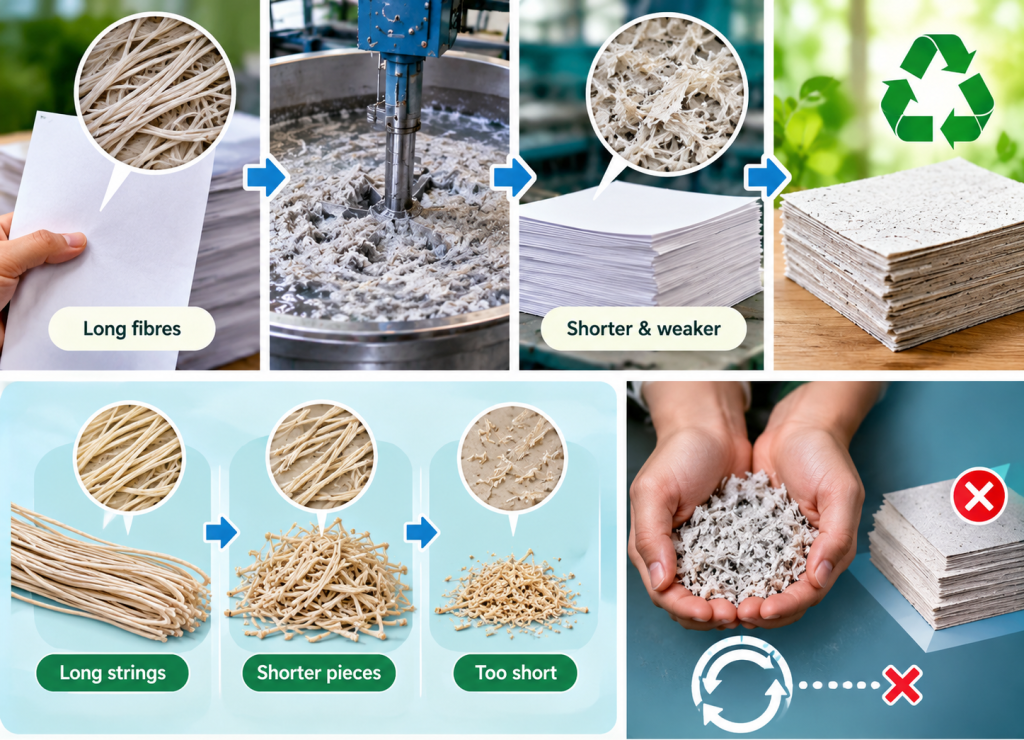
Every time paper is recycled, its fibres experience some physical damage.
The long cellulose fibres can become shorter and weaker as they are processed repeatedly.
Imagine having a pile of long pieces of string.
Long strings can easily overlap and hold together.
Now imagine cutting those strings into smaller pieces.
Eventually, the pieces become too short to hold together as strongly.
Something similar happens with paper fibres.
After several recycling cycles, some fibres become too short to produce strong, high-quality paper.
That is why the paper recycling cycle cannot continue forever.
Does This Mean Recycling Paper Is Pointless?
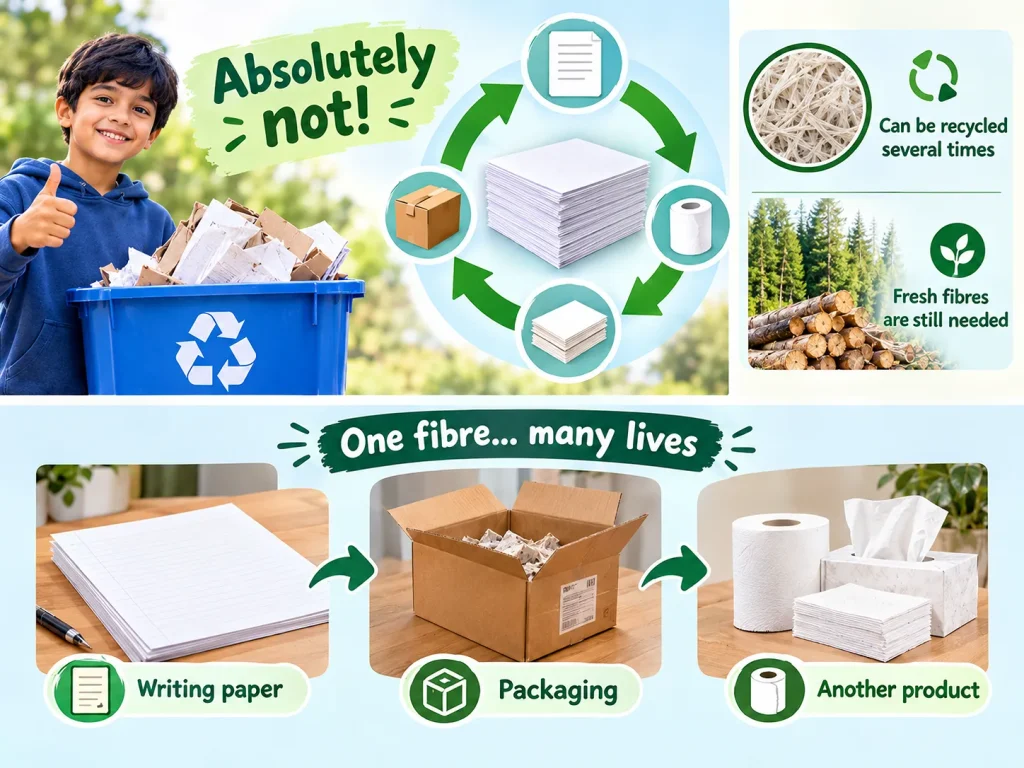
Absolutely not!
Paper recycling is still extremely useful.
Recycling allows many paper fibres to be used more than once instead of being thrown away after a single use.
The European Paper Recycling Council explains that fibres can be recycled several times, although not indefinitely. Fresh fibres are continually needed to keep the paper cycle going.
So, even though one particular fibre cannot be recycled forever, recycling can give it several useful lives.
For example, a fibre might begin in a sheet of writing paper, later become part of packaging, and eventually be used in another paper product.
Why Do We Need New Fibres?
If recycled paper fibres eventually become too short, where do new fibres come from?
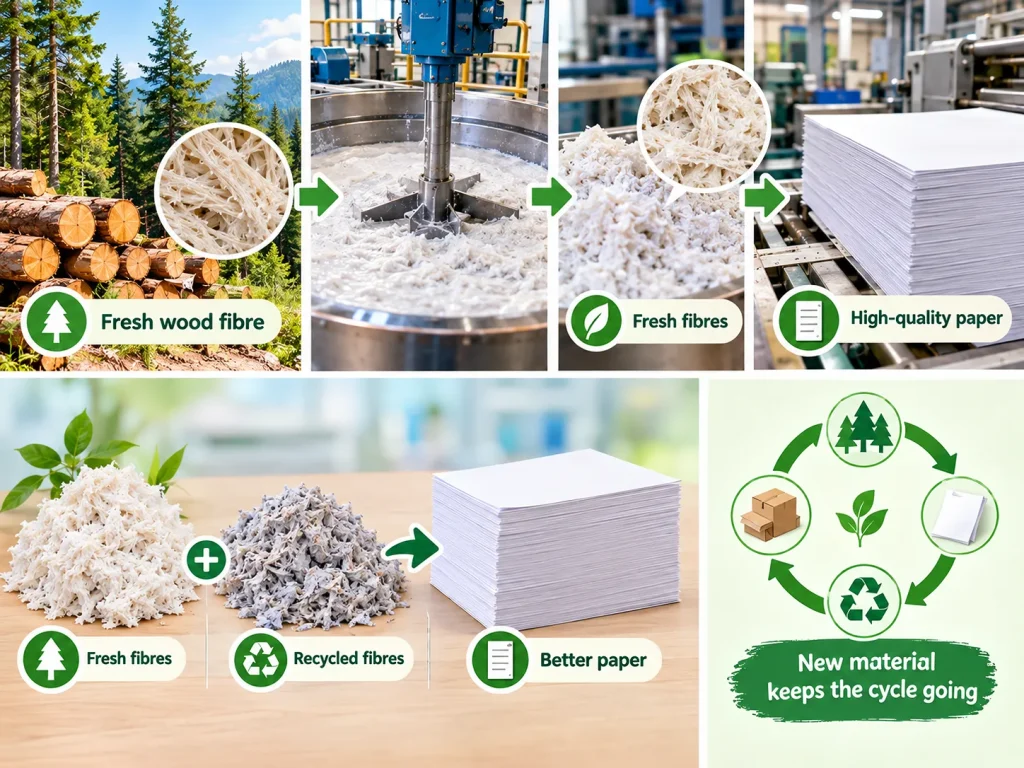
One important source is fresh wood fibre.
Trees provide cellulose fibres that have not previously gone through the paper recycling process. These fresh fibres can be added to recycled fibres to help maintain the strength and quality of new paper.
The paper industry therefore uses a mixture of recycled and fresh fibres. The Confederation of Paper Industries explains that fresh fibres are necessary to keep the paper cycle going because recycled fibres gradually lose their papermaking qualities.
This does not mean that recycling has failed.
It means that the paper system is more like a cycle with new material entering it, rather than a perfect circle that goes round forever.
What Happens to Very Short Fibres?
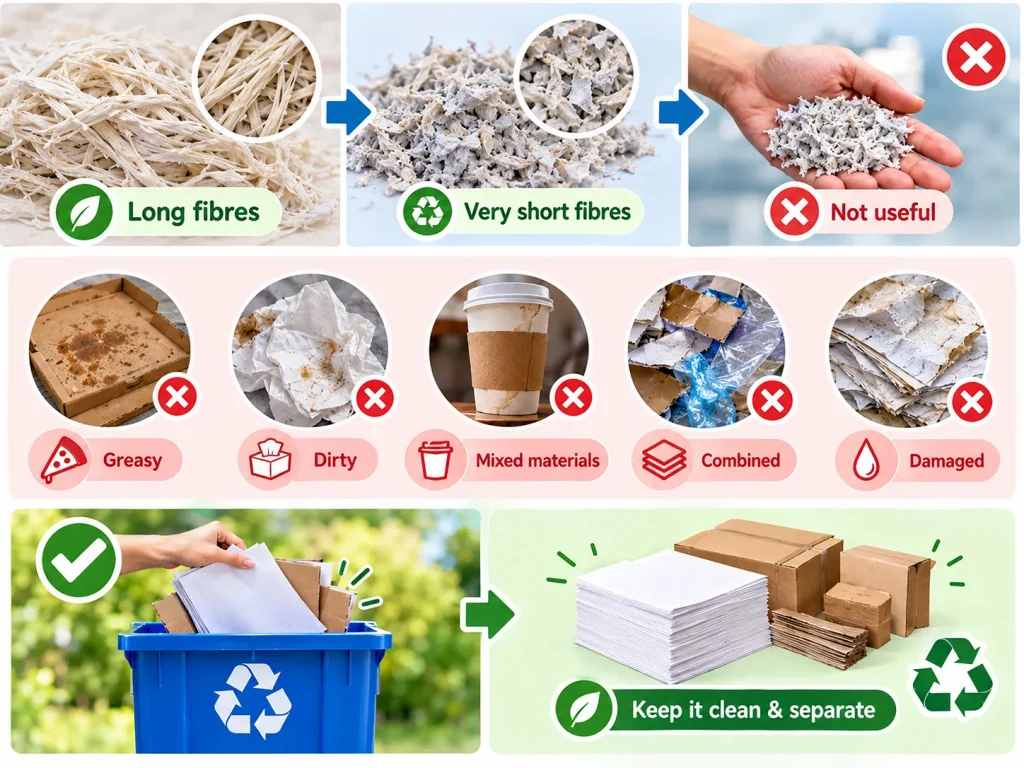
When fibres become too short or unsuitable for making certain paper products, they may no longer be useful for producing new paper in the same way.
Some paper products can also be difficult or impossible to recycle because they have been contaminated, combined with other materials or damaged during use.
For example, some paper products are not recyclable through ordinary paper recycling systems because they have become too dirty or have been combined with materials that are difficult to separate.
That is why it is important to put suitable, clean paper and cardboard in the correct recycling collection.
Does Every Piece of Paper Get Recycled Five to Seven Times?
Not necessarily.
The often-mentioned five-to-seven-times figure is a useful general estimate of how many times paper fibres can be recycled before they become too degraded. Still, it is not a strict rule for every individual sheet.
Different types of paper have different fibres and are used in different ways. Recycling systems also lose some fibres during collection, sorting and processing.
Recent research also shows that the exact number depends on the fibre type and how gently it is processed.
So, it is better to think of five to seven times as a rough practical range, rather than a countdown timer attached to every sheet of paper.
Why Is Recycling Still Important?
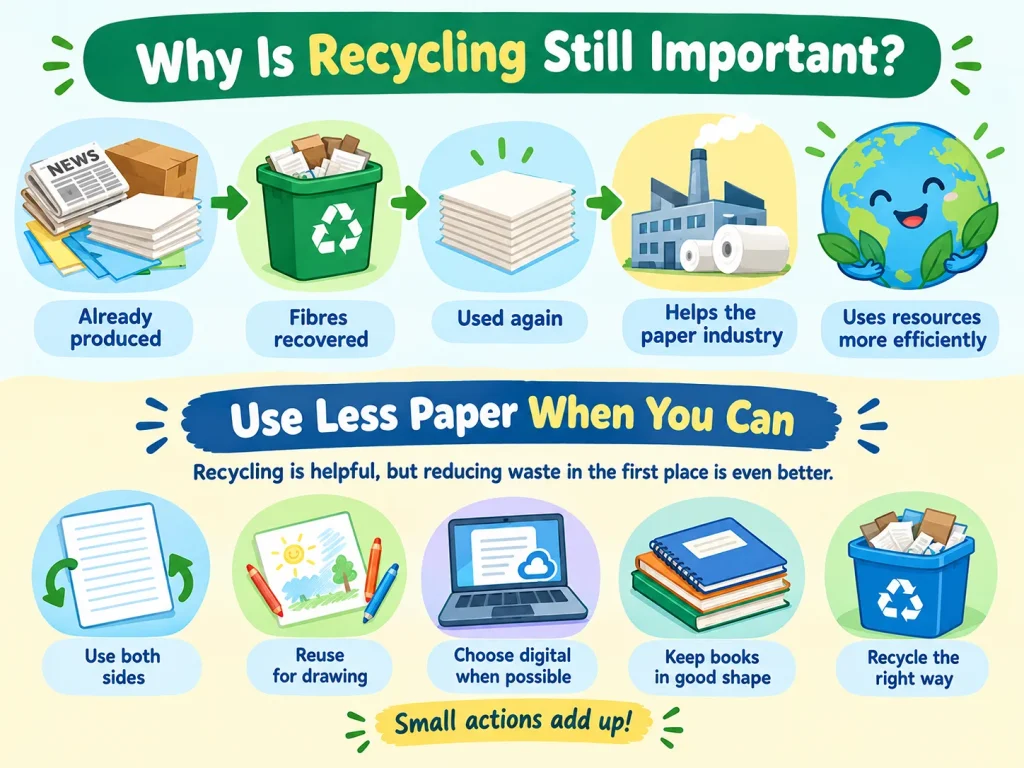
Recycling paper helps make better use of a material that has already been produced.
Instead of treating a newspaper, cardboard box or sheet of paper as useful only once, recycling allows its fibres to be recovered and used again.
It also means that the paper industry can use recovered fibres as an important raw material. For example, the US Environmental Protection Agency tracks paper and paperboard recycling as a major part of waste management.
Recycling is therefore one important part of using resources more efficiently.
But there is another useful habit:
Use Less Paper When You Can
Recycling is helpful, but reducing waste in the first place is even better.
You can:
- Use both sides of a sheet of paper.
- Reuse paper for drawing or practising.
- Choose digital documents when appropriate.
- Keep notebooks and books in good condition.
- Put suitable used paper into the correct recycling bin.
Small actions can add up when millions of people do them.
The Big Idea
So, can paper be recycled forever?
No. Paper fibres gradually become shorter and weaker during recycling, meaning they cannot be reused indefinitely. A common estimate is that fibres can be recycled about five to seven times, although the exact number varies depending on the type of paper and recycling process.
But that does not make recycling unimportant.
Quite the opposite!
Recycling gives paper fibres several useful lives and keeps valuable materials in use longer. Fresh fibres are then added to replace fibres that have become too weak.
So, the paper recycling cycle is not a perfect circle.
It is more like a circle with new fibres joining the journey along the way.
The next time you place a piece of paper in the recycling bin, remember that you may be giving its tiny fibres another chance to become something useful!
For more interesting articles, please visit www.kidzherald.com