
When you think about noisy animals, you might imagine a roaring lion, a barking dog or perhaps a huge whale singing underwater.
But what if we told you that one of the loudest animals on Earth is a tiny shrimp?
It sounds impossible. How could a little sea creature, only a few centimetres long, make a noise louder than some enormous animals?
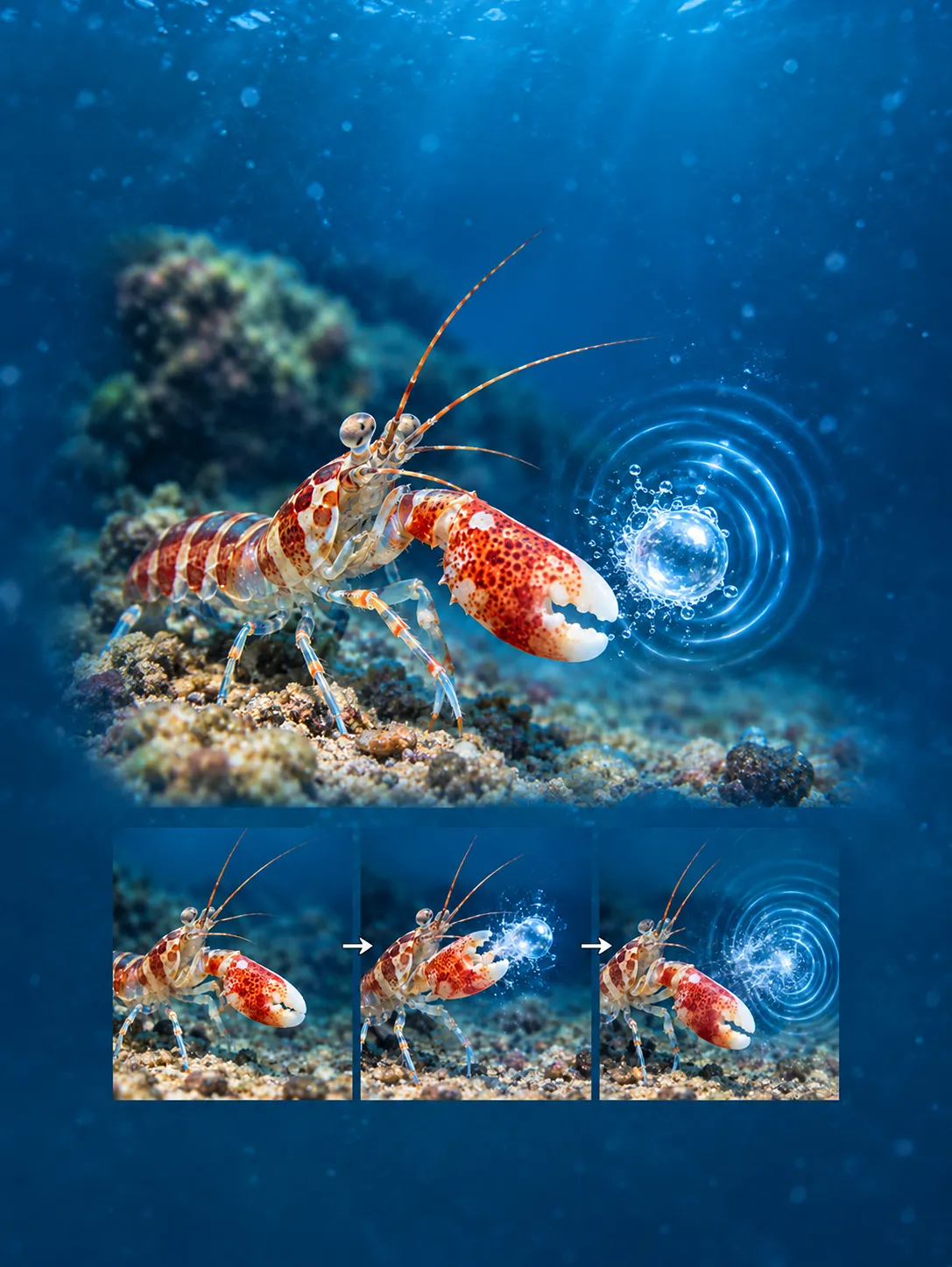
The surprising answer is the pistol shrimp, also known as a snappingshrimp. Some species can produce an incredibly loud snapping sound with one claw. The snap is so powerful that it can create a tiny bubble in the water, and when that bubble collapses, it produces an intense burst of sound and pressure.
Let’s dive beneath the waves and discover how this tiny animal makes such a gigantic noise!
Meet the Pistol Shrimp
Pistol shrimp belong to a family of crustaceans called Alpheidae.
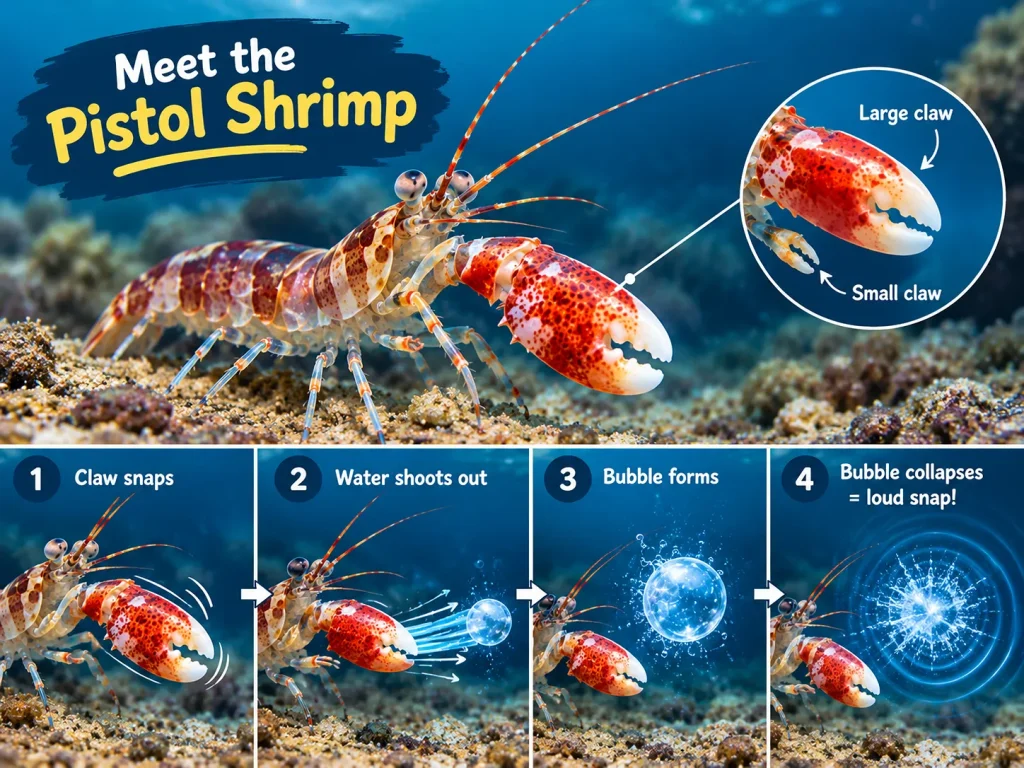
Many species of snapping shrimp live in oceans around the world. They are generally small, but they have a very unusual feature: one claw is much larger than the other.
The large claw isn’t used only to grab food.
It acts more like a tiny underwater weapon.
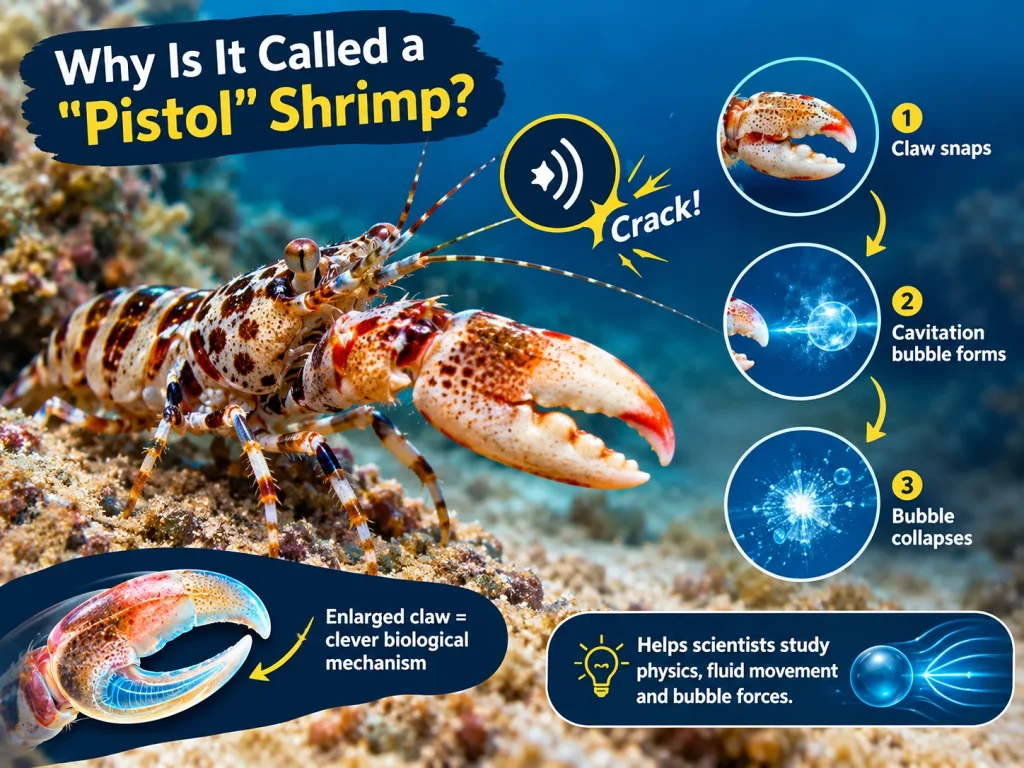
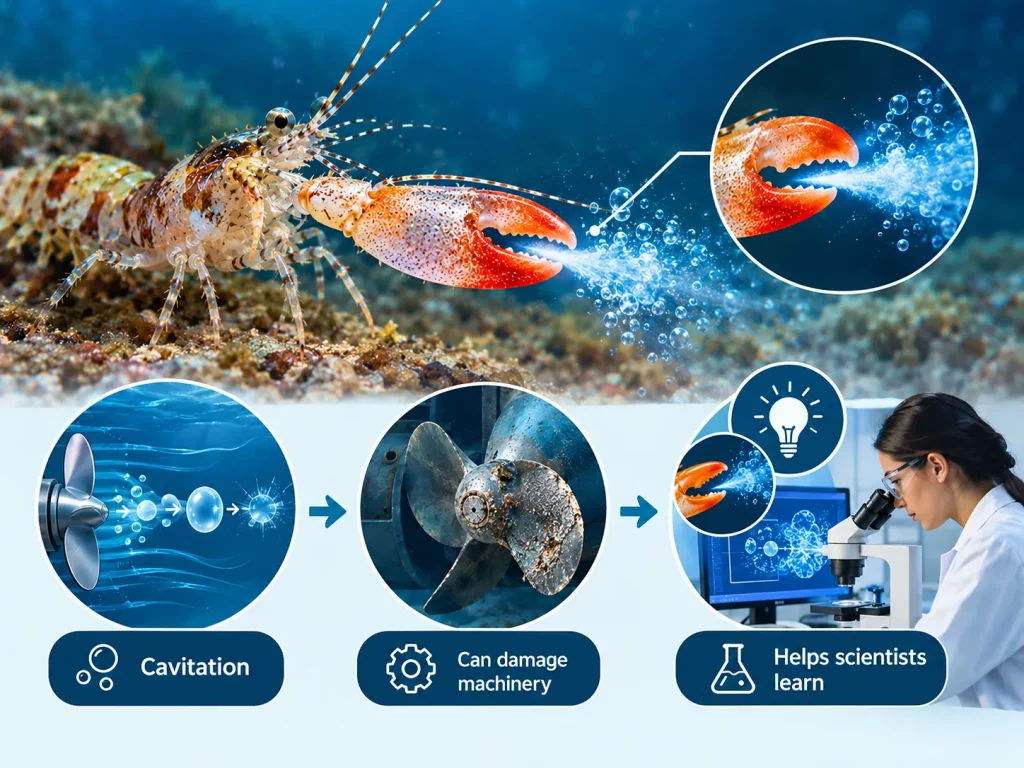
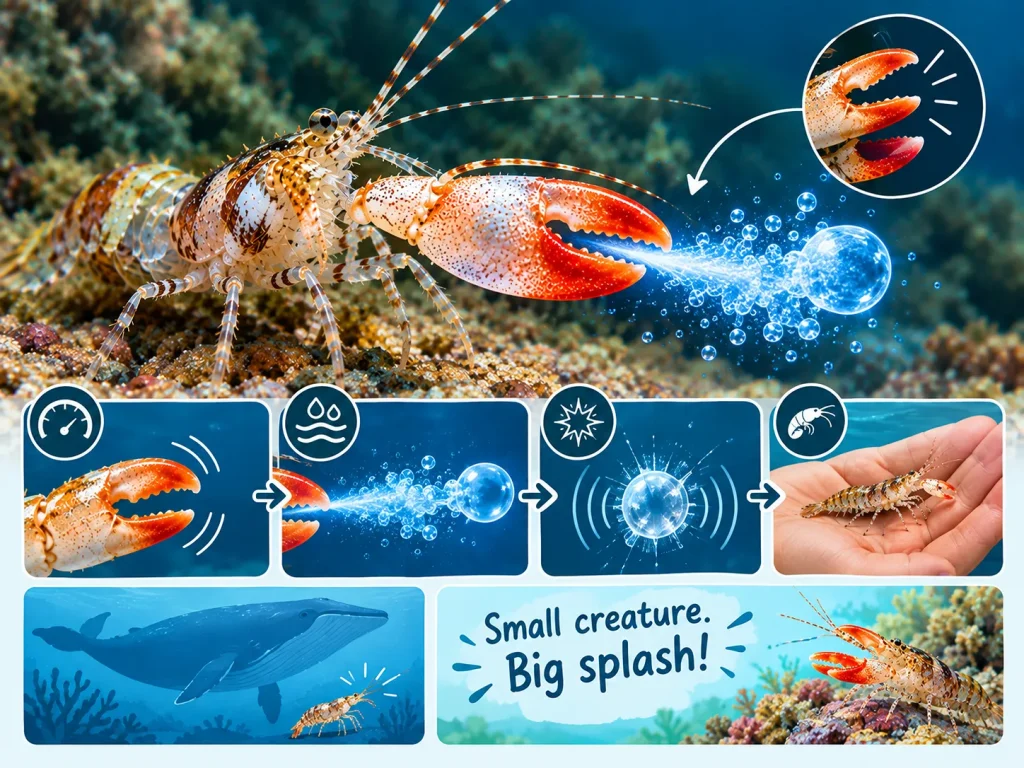
When the shrimp rapidly closes this specialised claw, it pushes water out at extremely high speed. This creates a low-pressure area and forms a small bubble in the water.
Then something extraordinary happens.
The bubble collapses.
And that is where the enormous sound comes from.
How Can a Claw Make Such a Loud Bang?
The pistol shrimp does not make its famous sound by rubbing its claw together.
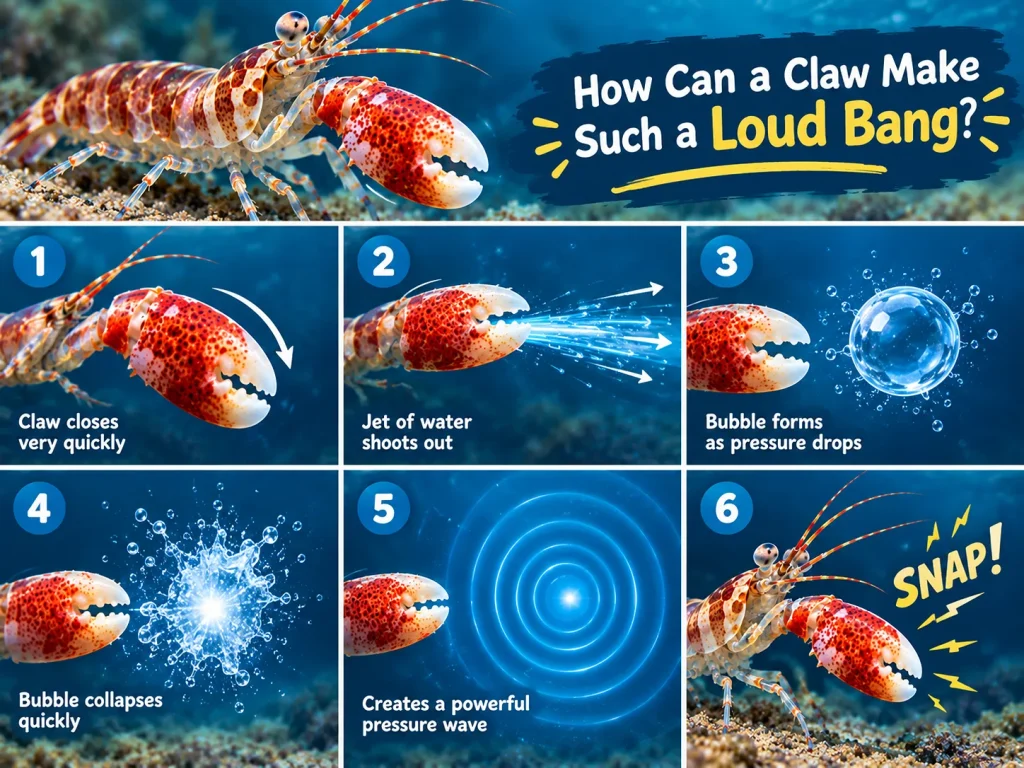
Instead, it uses a process called cavitation.
Imagine rapidly moving your hand through water. You push water out of the way.
The pistol shrimp does something similar, but its specialised claw moves incredibly quickly.
As the claw closes, a jet of water shoots out. The pressure around this fast-moving jet drops, forming a bubble.
The bubble does not last long.
It quickly collapses, producing a powerful pressure wave.
This creates the sharp “snap!” that gives these shrimps their name.
The Sound Can Be Extremely Loud
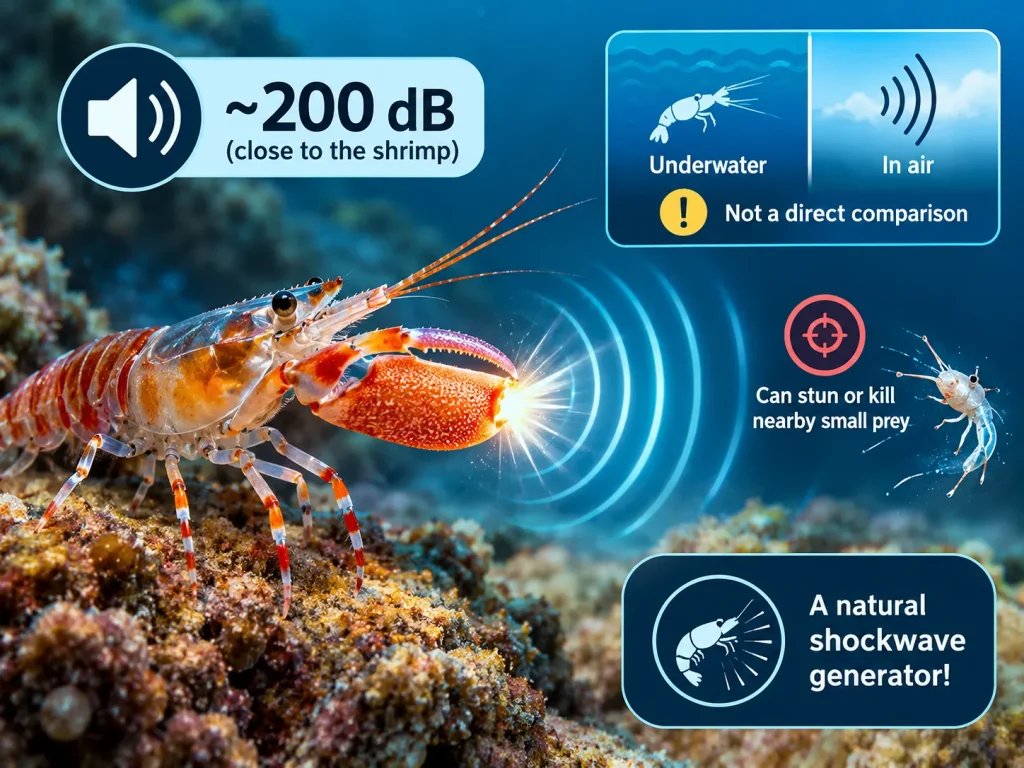
The snapping sound produced by some pistol shrimp can reach around 200 decibels when measured very close to the shrimp underwater. That number needs some explanation.
Decibels measure sound intensity, but sound behaves differently underwater and in air. So,comparing an underwater sound directly with a sound measured in air can be misleading.
Nevertheless, the snap is extremely powerful for such a tiny animal.
It can also create a strong pressure wave that may stun or kill nearby small prey.
So, this little shrimp has effectively developed a natural shockwave generator!
The Shrimp Doesn’t Actually Need to Touch Its Prey
This is perhaps the strangest part.
The pistol shrimp can use its snap without directly grabbing its prey.
Suppose a small creature is nearby.
The shrimp aims its enlarged claw towards the target and snaps it shut.
The resulting water jet creates the cavitation bubble.
When the bubble collapses, the pressure wave can travel through the surrounding water.
The shrimp can therefore use this powerful effect to help catch prey.
It is a little like having an invisible underwater punch!
Why Is It Called a “Pistol” Shrimp?
The name comes from the shrimp’s remarkable snapping ability.
The sharp sound can resemble the crack of a small pistol.
However, the shrimp does not actually fire anything.
Its enlarged claw is a clever biological mechanism.
Scientists have studied these shrimps because the way they create cavitation can teach us more about physics, fluid movement and the forces produced by collapsing bubbles.
Pistol Shrimp Are Not the Same as Mantis Shrimp
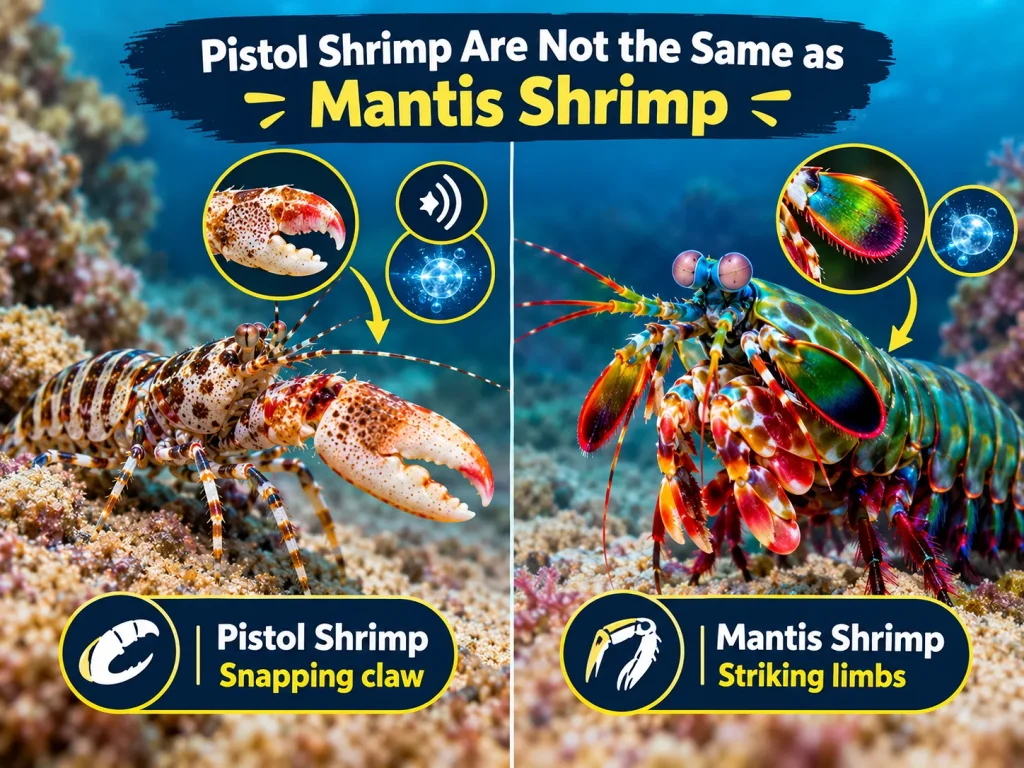
Another fascinating crustacean is sometimes confused with pistol shrimp: the mantis shrimp.
Mantis shrimp are completely different animals.
Some species, including the peacock mantis shrimp, have powerful front limbs that they use to strike prey. Their strikes can be incredibly fast and can also create cavitation bubbles.
The peacock mantis shrimp, scientifically known as Odontodactylus scyllarus, is famous for its colourful appearance and powerful striking appendages.
So, both animals can produce amazing physical effects in water, but they do it with different body parts.
Pistol shrimp: uses a specialised snapping claw.
Mantis shrimp: uses powerful striking limbs.
Both are excellent examples of how evolution can produce surprising solutions to problems.
What Exactly Is a Shrimp?
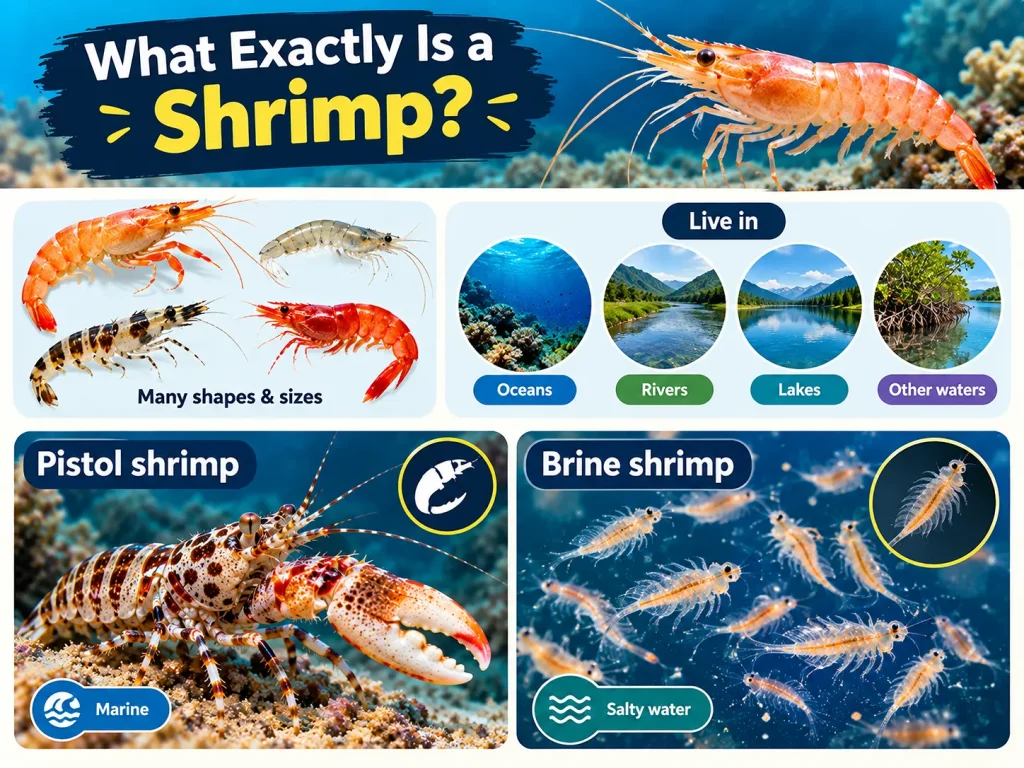
The word shrimp refers to many different small aquatic crustaceans.
Shrimp are not all closely related, and they come in many shapes and sizes. They can live in oceans, rivers, lakes and other aquatic environments.
Pistol shrimp are marine crustaceans belonging to the Alpheidae family.
Brine shrimp are another type of shrimp. These tiny animals belong to the genus Artemia and are adapted to living in salty water.
So, the word “shrimp” describes a broad group of animals rather than one single species.
What About Brine Shrimp?
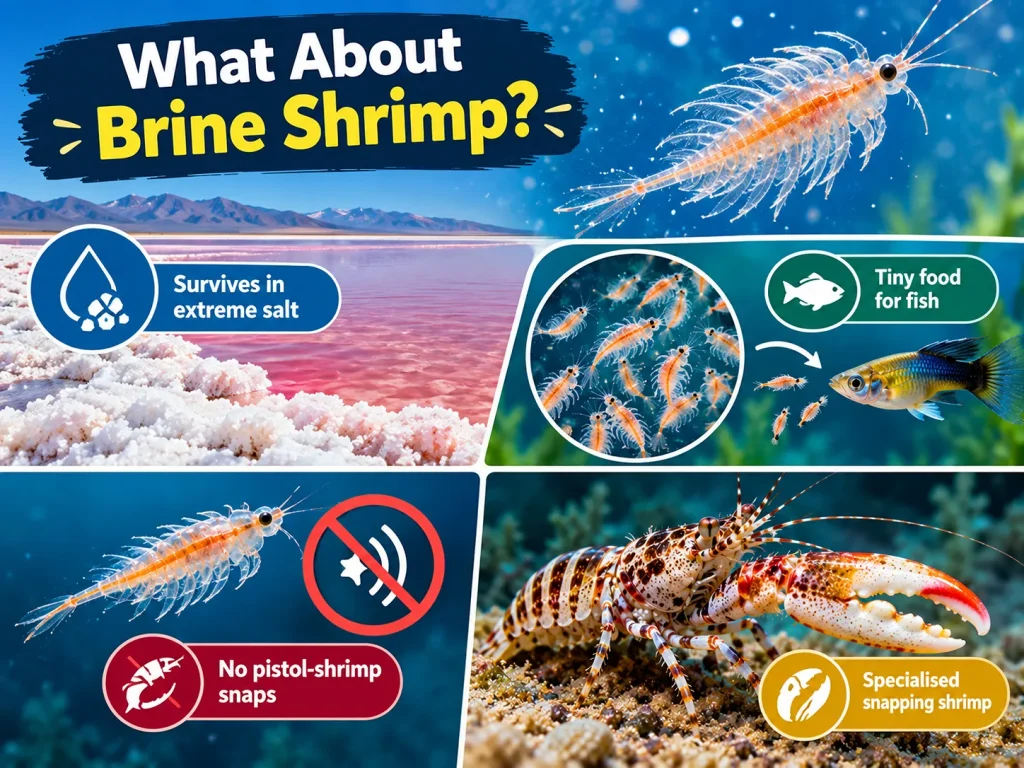
Brine shrimps are particularly interesting because they can survive in extremely salty environments.
They are tiny aquatic crustaceans commonly used as food for fish and other aquatic animals.
But they are not famous for producing pistol-shrimp-style snaps.
Specialised snapping shrimp, such as members of the Alpheidae family, have that amazing ability.
A Tiny Animal with a Huge Impact
Pistol shrimp may be small, but they can have a surprisingly big effect on their surroundings.
Their snapping sounds can contribute to the underwater noise of coral reefs and other marine habitats.
In fact, groups of snapping shrimp can create such a loud underwater background that scientists have used their sounds to study marine environments.
Their clicks and snaps can become part of the natural “soundscape” of the ocean.
Imagine swimming underwater and hearing thousands of tiny creatures snap loudly around you!
It would be like entering a giant underwater percussion concert.
Could the Snap Hurt the Shrimp?
You might wonder how the shrimp can repeatedly create such powerful bubbles without hurting itself.
The shrimp’s body and claw are specially adapted for producing this effect.
The snapping claw is an amazing piece of natural engineering. Its muscles and structures allow it to store and release energy rapidly.
The shrimp also controls claw movement with great precision.
This is a wonderful example of adaptation — a feature that helps an organism survive in its environment.
Why Is This Important to Scientists?
Pistol shrimp are interesting not just because they are loud.
Their snapping behaviour helps scientists study cavitation, which is important in physics and engineering.
Cavitation can occur when rapidly moving water creates bubbles that later collapse. This can sometimes damage machinery such as ship propellers and pumps.
By studying animals that have evolved to create cavitation deliberately, researchers can learn more about how these bubbles form and collapse.
Nature can sometimes provide ideas that help humans understand difficult scientific problems.
So, Is the Pistol Shrimp Really the Loudest Animal?
The answer depends on how researchers measure and compare sound.
Calling an animal “the loudest” can be complicated because sound behaves differently in water and air, and decibel measurements depend on the measurement conditions.
Still, pistol shrimp are among the most remarkable sound-producing animals known, especially considering their tiny size.
They show that you do not need to be enormous to make an enormous noise.
The Big Idea
The pistol shrimp is one of nature’s most amazing little creatures.
It has a specially adapted claw that snaps shut at incredible speed. The movement creates a high-speed jet of water and a tiny cavitation bubble. When the bubble collapses, it produces a powerful pressure wave and a loud snapping sound.
So, while a pistol shrimp may be small enough to fit comfortably in your hand, its underwater snap can be remarkably powerful.
The next time you hear someone say that the biggest animals make the biggest noises, remember the tiny pistol shrimp.
Sometimes, the smallest creatures can make the biggest splash!
For more interesting articles, please visit www.kidzherald.com


