

Have you ever wondered why the hair on your head can grow quite long, while your eyelashes, eyebrows and arm hair usually stay much shorter?
You might think hair keeps growing until we cut it. But that is not what happens. Every hair has its own growth cycle, which determines how long it can grow.
In fact, the secret is not about how fast your hair grows. It is mainly about how long each hair stays in its growing stage.
Let’s explore the fascinating science behind it!
Hair Grows From Under Your Skin
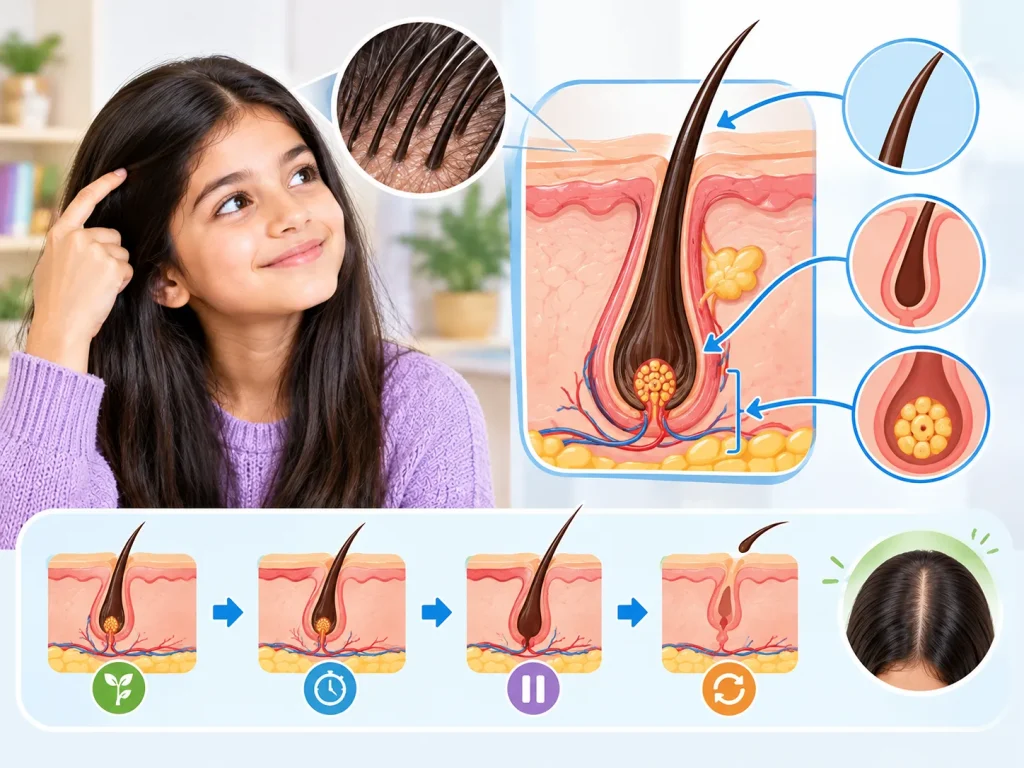
The part of your hair that you can see is called the hair shaft. It is produced by a tiny structure underneath your skin called a hair follicle.
At the bottom of the follicle is a structure called the hair bulb. Cells inside the bulb multiply and become hardened hair cells. As new cells are produced, they push older cells upwards, causing the hair to grow longer.
Scalp hair grows at roughly 1 centimetre per month, although the exact rate can vary between people.
So why doesn’t it grow forever?
The answer is the hair growth cycle.
The Three Main Stages of Hair Growth
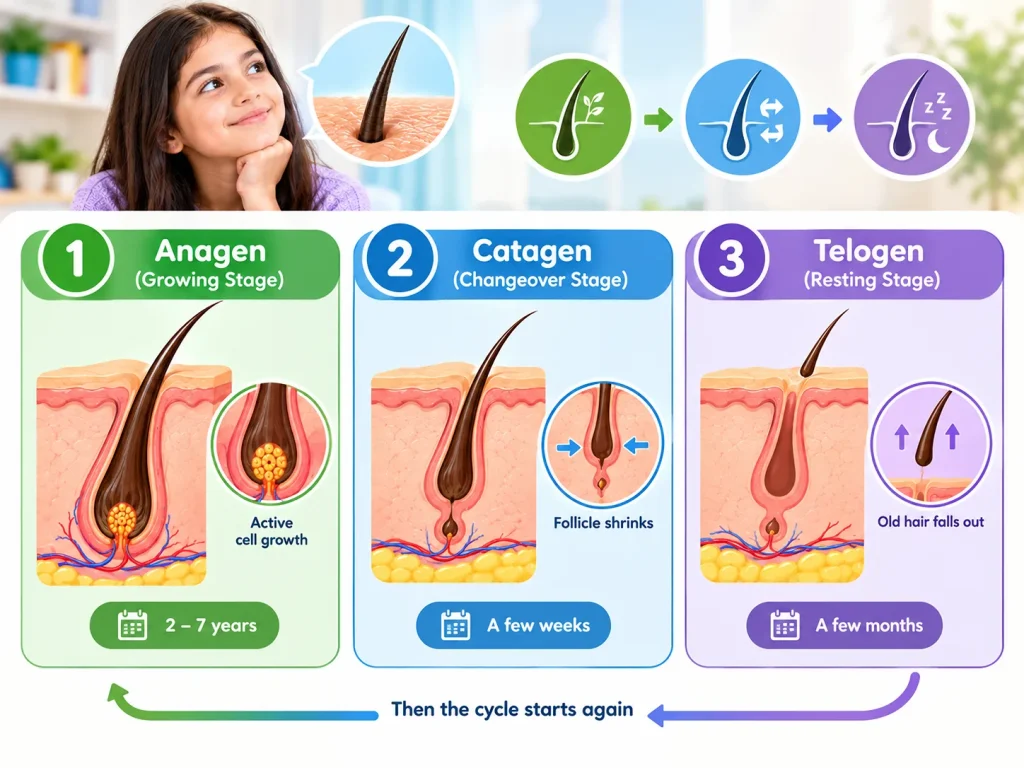
Each hair follicle goes through several stages. The three main ones are called anagen, catagen and telogen.
Think of them as three chapters in the life of a hair.
1. Anagen – The Growing Stage
The anagen phase is when the hair is actively growing.
Cells in the hair follicle are busy producing new hair. The longer this stage lasts, the longer the hair has time to grow.
For scalp hair, this growing stage can last for several years. Different sources give slightly different ranges, but it typically lasts around 2 to 7 years, depending on the person and the individual follicle.
This is the most important stage in determining how long your hair can grow.
2. Catagen – The Changeover Stage
After prolonged growth, the follicle enters the catagen phase.
This is a short transitional stage. The follicle shrinks, and the hair’s active growth stops.
The catagen phase usually lasts only a few weeks.
3. Telogen – The Resting Stage
Next comes the telogen phase.
During this stage, the hair is resting rather than actively growing. After a period of rest, the old hair eventually falls out, and the follicle can begin producing a new hair.
Then the cycle starts again.
The Length Depends on the Growing Time
Here is the most important idea:
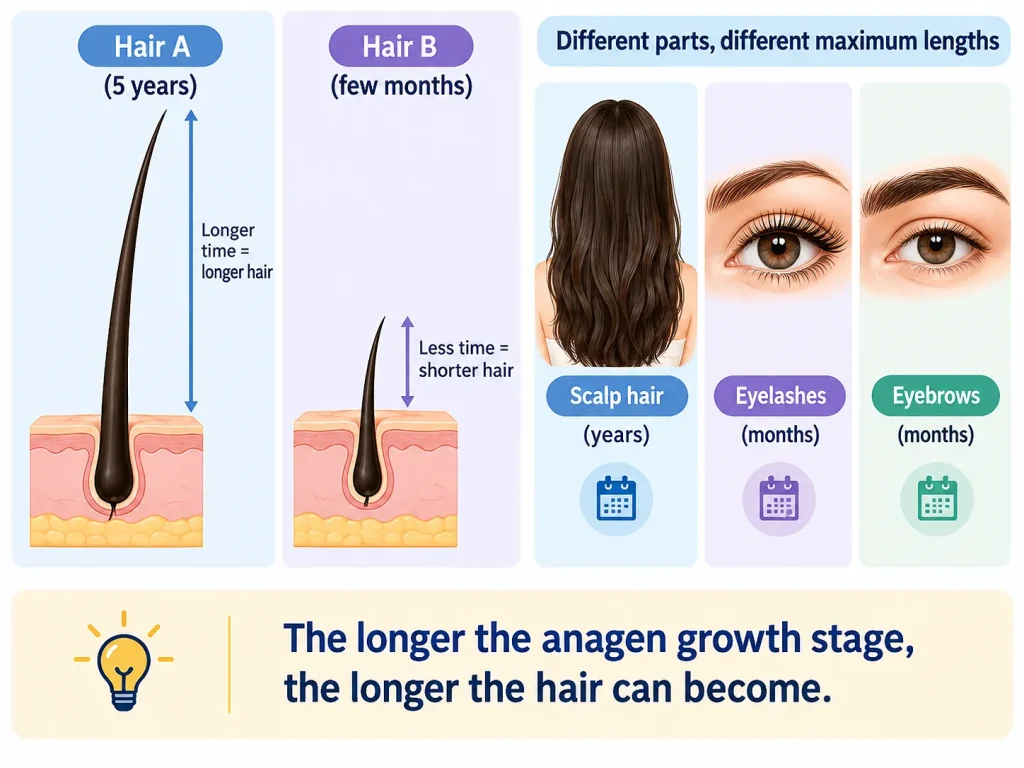
The longer a hair stays in the anagen growth stage, the longer it can become.
Imagine two hairs.
Hair A grows for five years.
Hair B grows for only a few months.
Even if both grow at the same speed, Hair A has much more time to become long.
This is why the hairs on different parts of your body have different maximum lengths.
For example, the growing phase of scalp hair can last for years, while the growth phase of eyelashes and eyebrows is much shorter. That is why you do not normally end up with eyelashes several metres long!
Why Doesn’t Every Person Have the Same Hair Length?
You may have noticed that some people can grow very long hair, while others find that their hair reaches a certain length and then stays there.
One major reason is that hair follicles do not all have the same growth cycle.
The length of the anagen phase varies between people and between different areas of the body. Scientists have found that the duration of the growth phase is the main factor controlling the maximum natural length of a hair.
This means two people can have similar hair growth rates but very different maximum hair lengths.
Is Hair Really Stopping?
If you stop cutting your hair, it may look as though your hair has stopped growing.
But that does not necessarily mean that every hair has stopped growing at the same time.
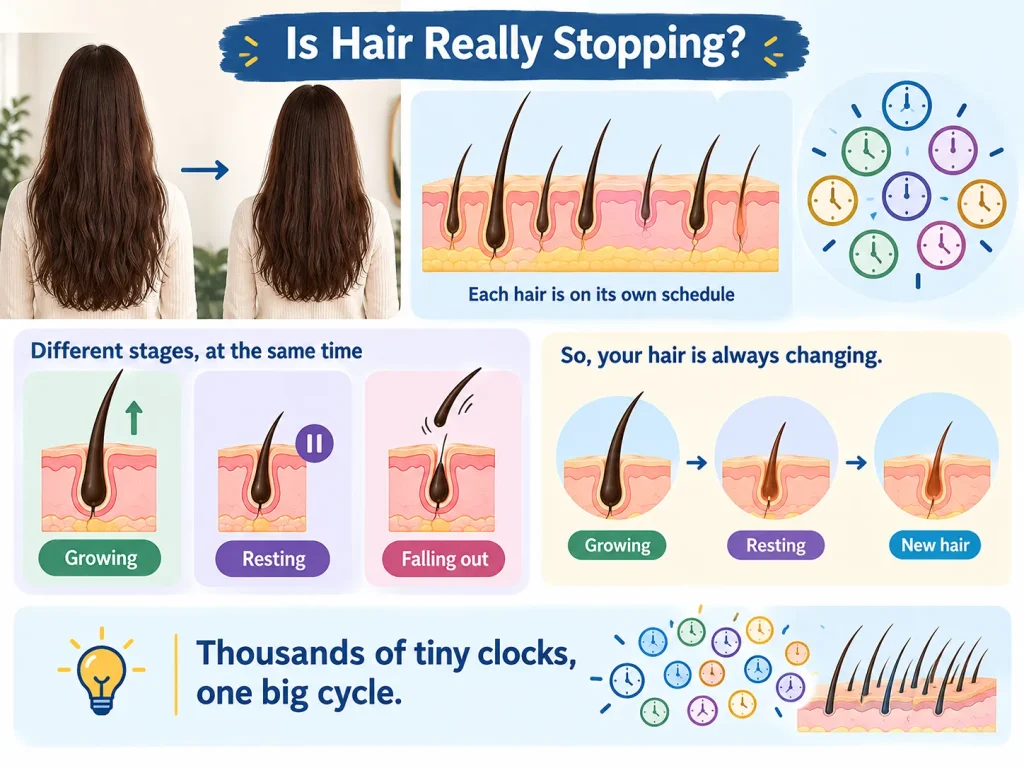
Your scalp contains many thousands of individual follicles, and they are not all at the same point in their cycles. While some hairs are growing, others may be resting or preparing to fall out.
So, your hair is constantly changing.
One hair might be growing.
Another might be resting.
Another might fall out and eventually be replaced by a new hair.
It is like having thousands of tiny clocks, each running on its own schedule!
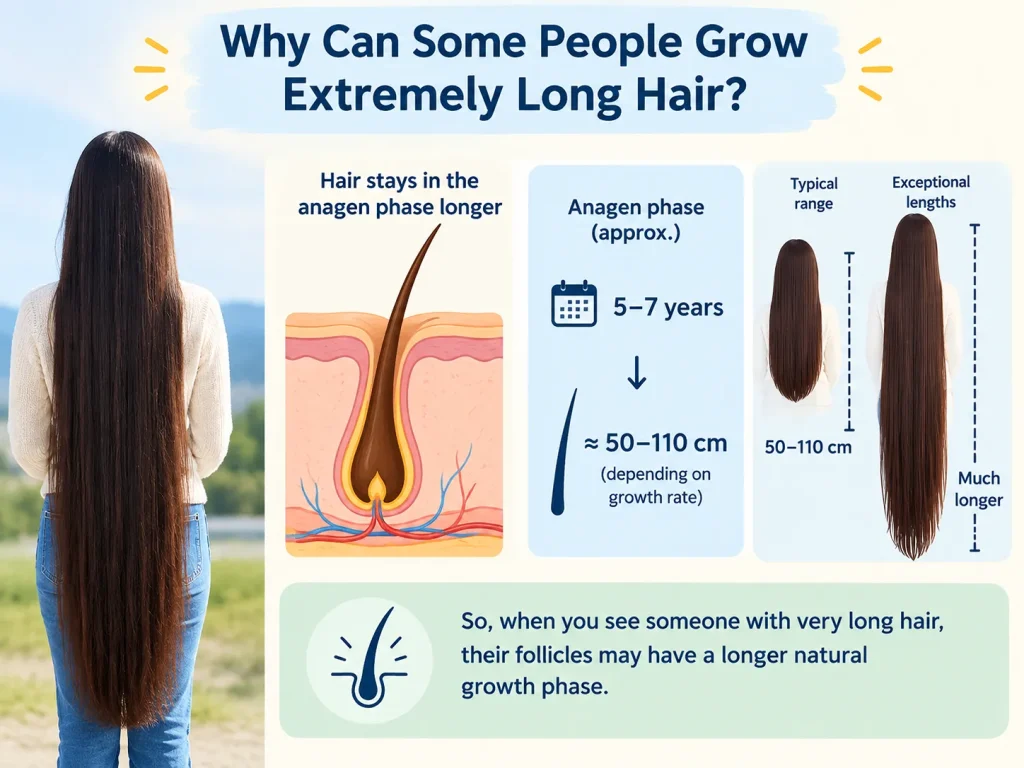
Why Can Some People Grow Extremely Long Hair?
Some people can grow their scalp hair to an impressive length.
This happens when their hair follicles remain in the anagen phase for a particularly long time.
A recent scientific review notes that the scalp anagen phase, lasting around 5–7 years, can produce hair roughly 50–110 centimetres long, depending on the growth rate. Exceptional individuals can grow hair much longer than this.
So, when you see someone with very long hair, their follicles may have a longer natural growth phase.
Does Cutting Hair Make It Grow Faster?
This is a common question.
No, cutting the ends of your hair does not make the hair follicle grow faster.
The hair grows from the follicle underneath your skin. Cutting the visible part does not affect the growth cycle occurring inside the follicle.
However, trimming damaged ends can make hair look neater and can prevent split ends from travelling further up the hair shaft.
So, cutting can change the length you can see, but it does not reset the follicle’s biological growth timer.
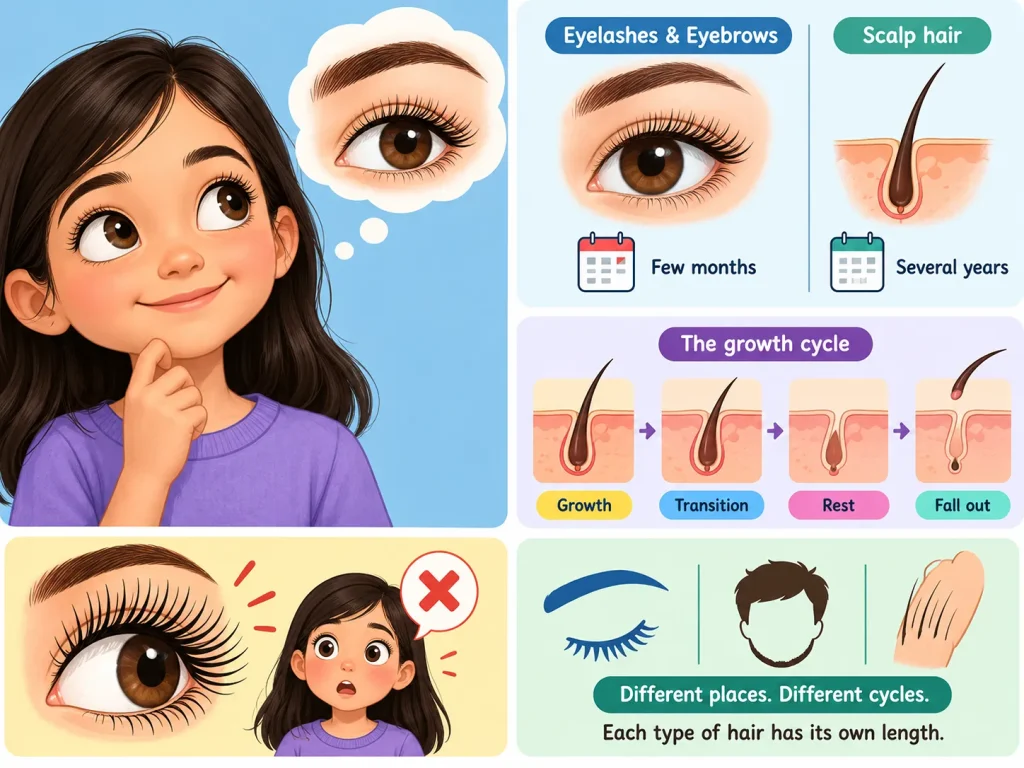
What About Eyebrows and Eyelashes?
Have you ever wondered why your eyelashes do not keep getting longer?
It is because their growth phase is much shorter than that of scalp hair.
The growth phase of eyelashes and eyebrows lasts only a few months, rather than several years. Once the growth stage ends, the follicle enters its next phases, and the hair eventually falls out.
This is actually very useful.
Imagine if your eyelashes grew for several years without stopping!
They could become very inconvenient.
Our bodies have evolved distinct growth cycles for hair in different places, giving each type of hair a typical length.
Why Does Hair Fall Out?
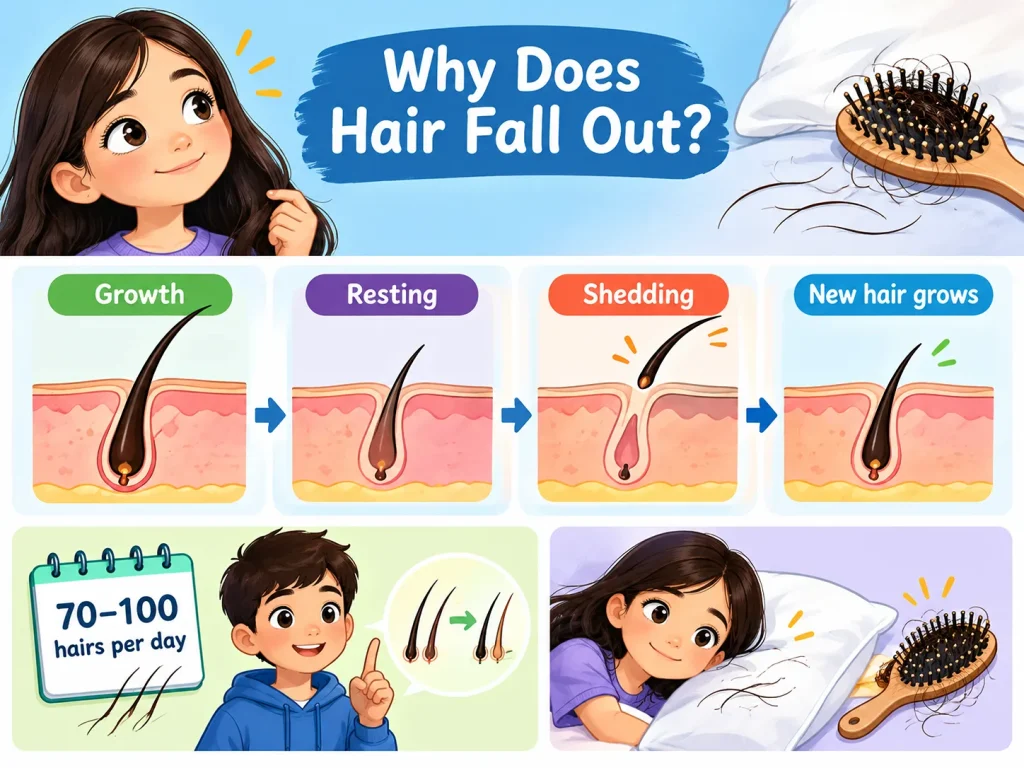
Hair falling out might sound worrying, but losing some hair is a normal part of the hair cycle.
As old hairs enter the resting and shedding stages, they are eventually released from their follicles.
A new hair can then begin growing from the same follicle.
A healthy adult can naturally lose around 70–100 scalp hairs each day, while new hairs are continually growing to replace them.
So finding a few hairs on your pillow or hairbrush does not necessarily mean something is wrong.
Can Hair Grow Forever?
Not usually.
A particular hair normally has a limited period during which it actively grows. Once its anagen phase ends, it enters the next stages of the cycle.
The maximum length is therefore largely determined by how long the growth phase lasts and how quickly the hair grows during that time.
This explains why hair seems to have a natural “maximum length”.
The Big Idea
So, why does hair only grow to a certain length?
The answer is surprisingly simple: each hair has a growth timer.
Hair grows while its follicle is in the anagen phase. When that phase ends, the follicle enters a transition and then a resting period. Eventually, the old hair is shed, and a new hair begins its own cycle.
Scalp hair can grow for several years, allowing it to become quite long. Eyebrows, eyelashes and many other body hairs have much shorter growth phases, so they remain shorter.
So, the next time you wonder why your hair seems to stop growing at a certain length, remember:
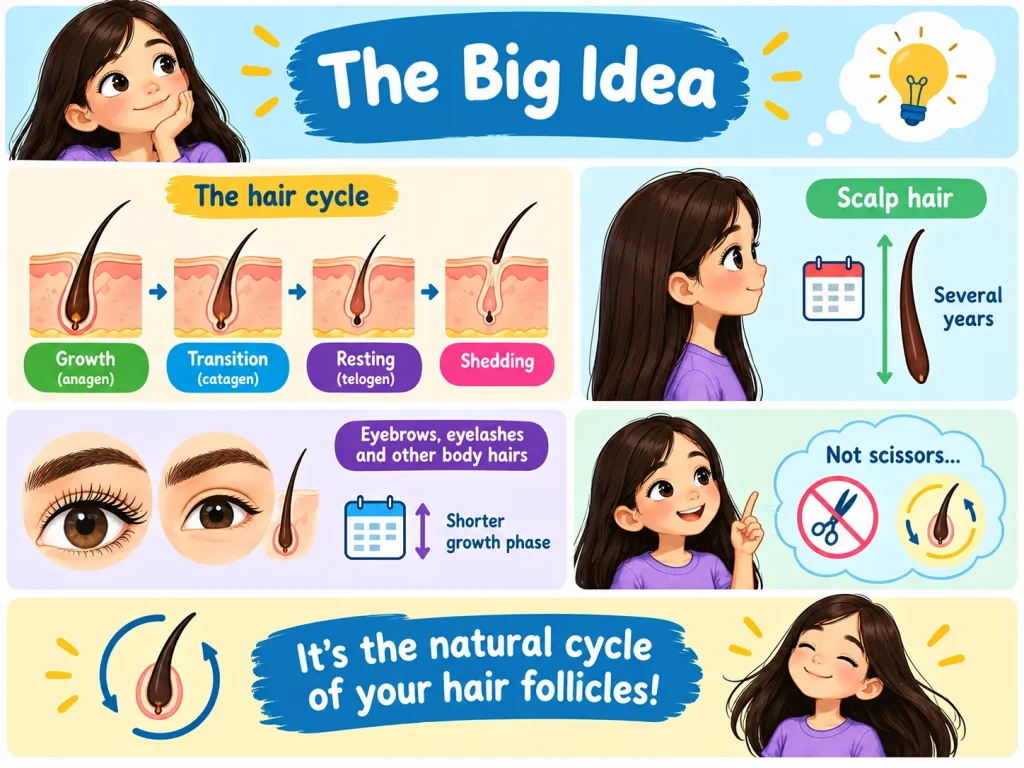
It is not necessarily the scissors stopping your hair — it is the natural cycle of your hair follicles!
For more interesting articles, please visit www.kidzherald.com