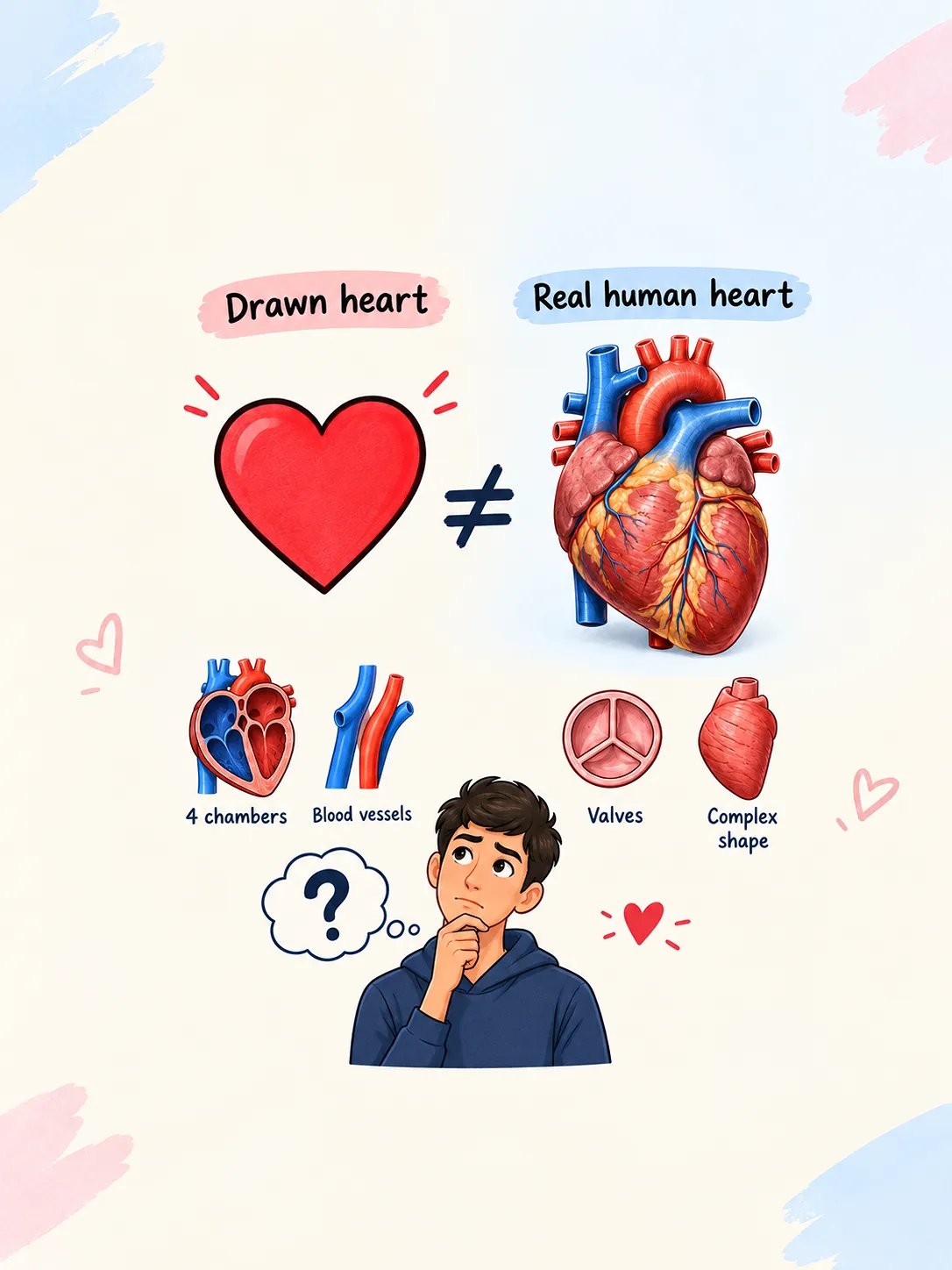
Have you ever drawn a heart to show love or friendship? You probably made something like or. It is simple: two rounded bumps at the top, a point at the bottom, and a little dip in the middle.
But there is one funny thing about this familiar symbol: it does not really look like the human heart inside your chest!
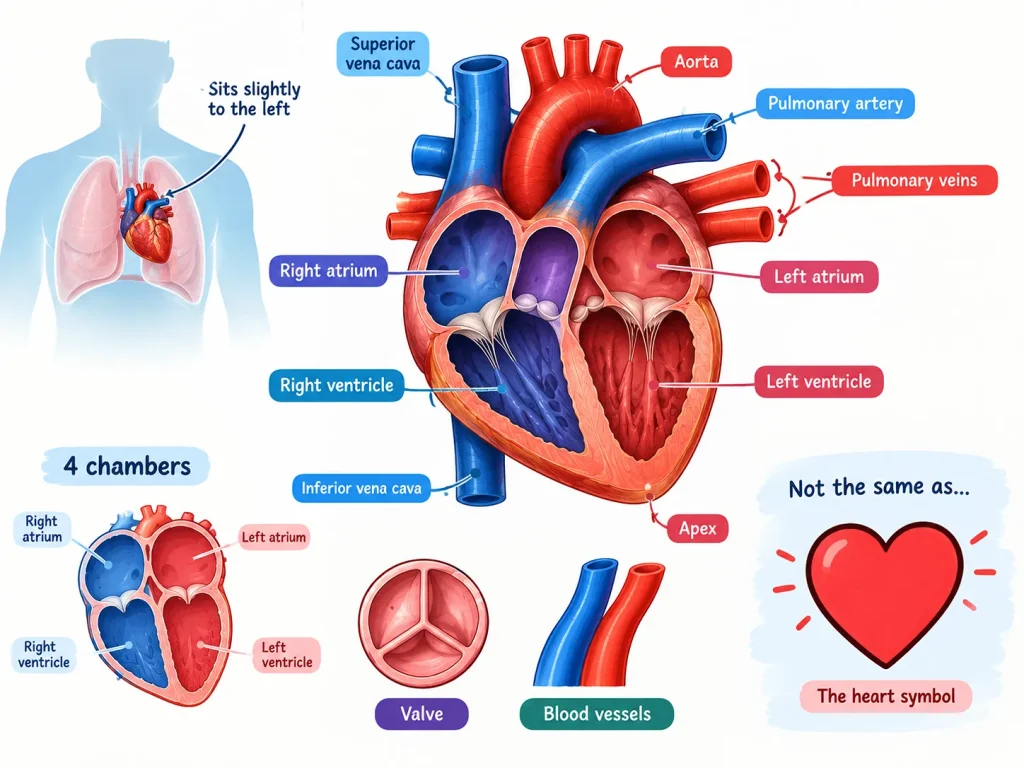
A real human heart is a complicated organ with four chambers, several large blood vessels, valves and many other structures. It is more like a slightly uneven, muscular, cone-shaped organ than a neat red symbol.
So, why did people start drawing hearts this way?
What Does a Real Heart Look Like?
Before looking at the symbol, let’s think about the real thing.
Your heart is a strong muscular organ that pumps blood around your body. It sits in your chest between your lungs, with most of it slightly to the left. It has a pointed lower part called the apex and a broader upper part where several major blood vessels connect.
Inside the heart are four main chambers:
- Two upper chambers called atria.
- Two lower chambers called ventricles.
Some valves help blood move in the correct direction. Large blood vessels carry blood to and from the heart and lungs.
If you asked an artist to draw a realistic heart, you would probably get a picture with lots of curves, tubes and details.
That certainly does not look like it!
So Where Did the Heart Symbol Come From?
The exact origin of the familiar heart symbol is not completely known.
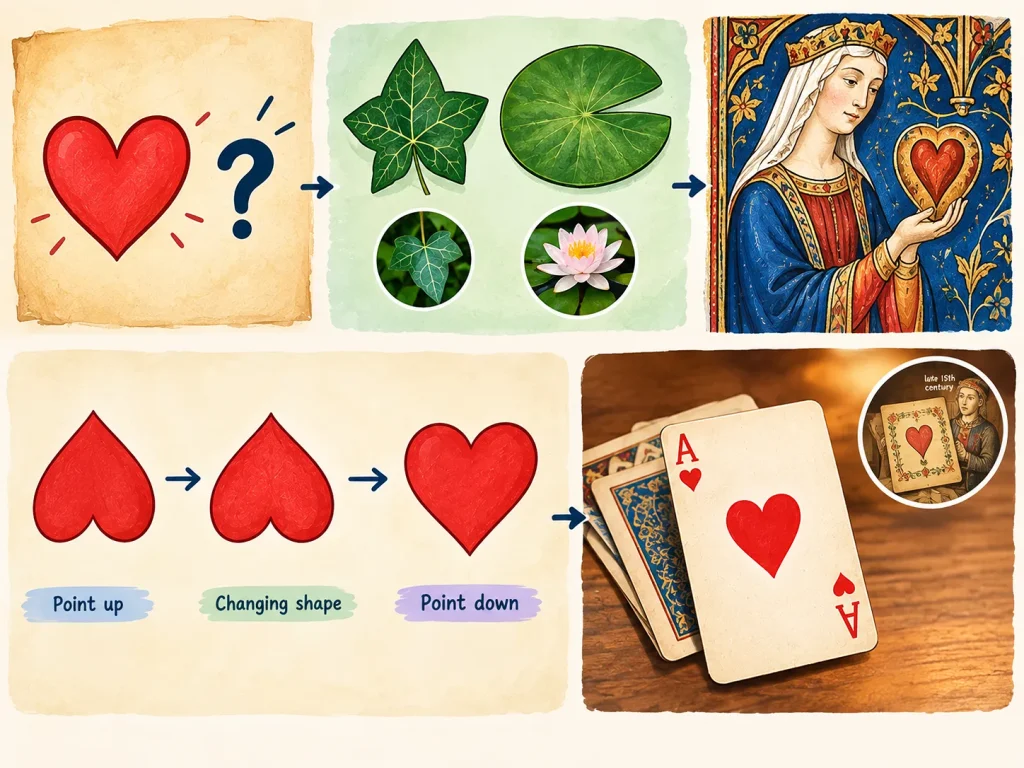
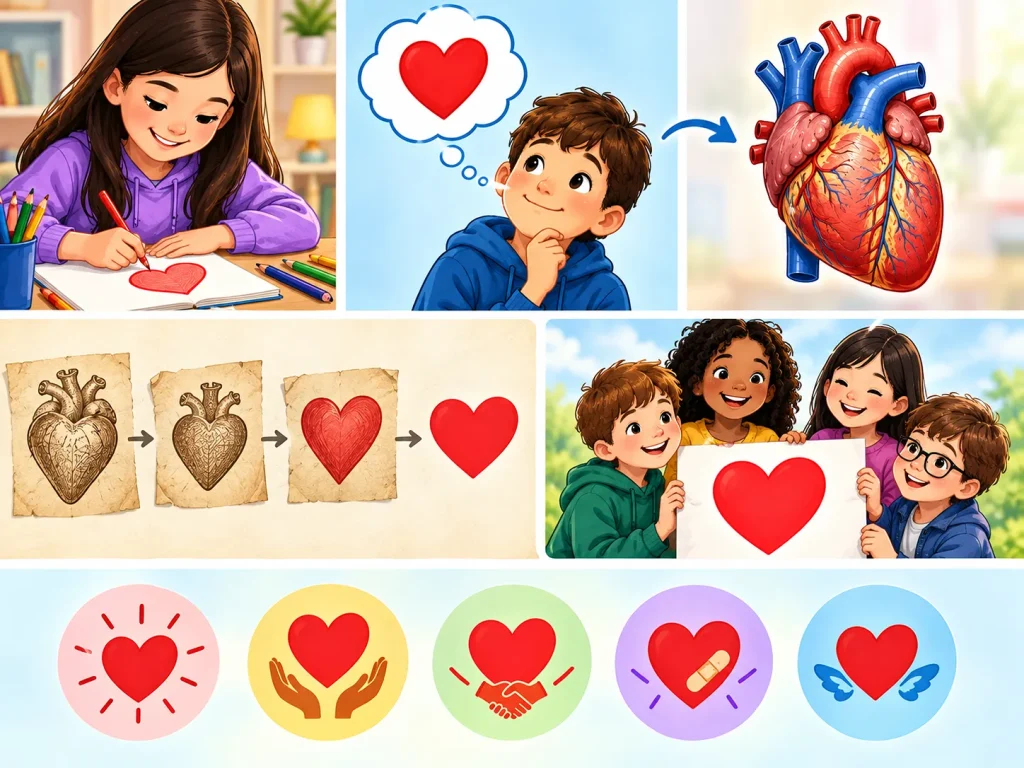
The shape developed over a very long period, particularly in Europe during the Middle Ages. Interestingly, some of the earliest heart-like shapes were not actually drawings of human hearts at all. Similar shapes appeared in artwork representing leaves, including ivy and water-lily leaves.
By the Middle Ages, however, artists began using heart-like shapes to represent the human heart in pictures and stories.
Early drawings did not always look exactly like today’s symbol. Some showed the point facing upwards. Over time, the shape changed, and eventually the point was usually placed at the bottom.
By around the late 15th century, a modern-looking heart symbol was also being used on playing cards.
Artists Were Not Trying to Be Scientists
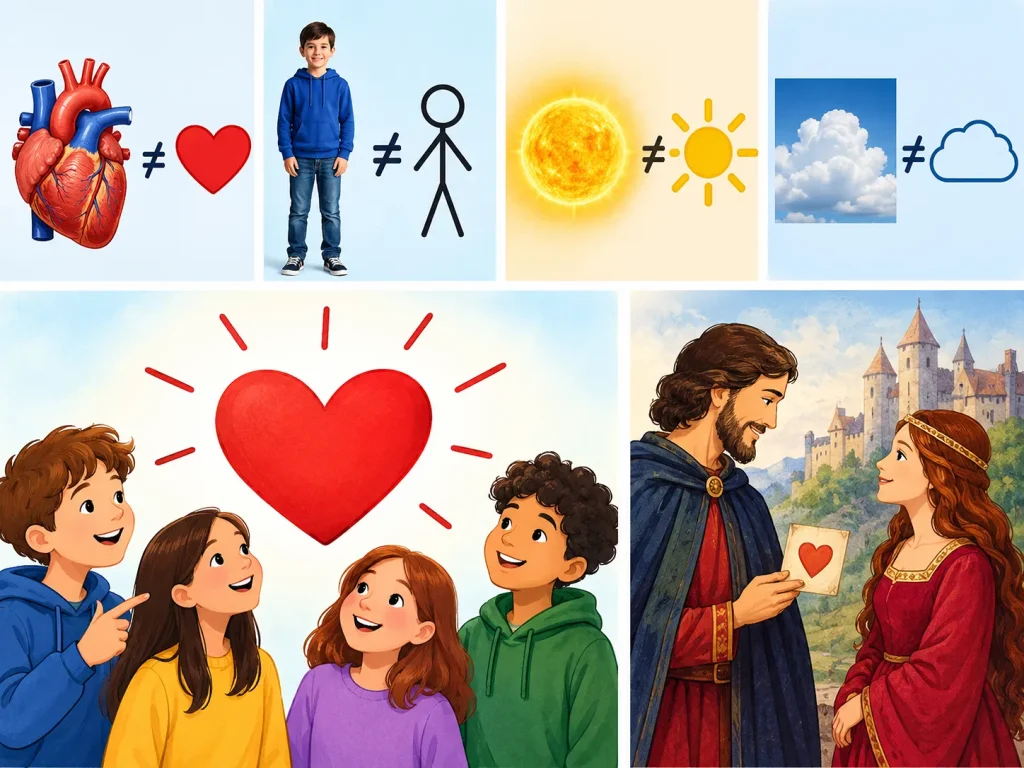
One important thing to remember is that the heart symbol was created as a symbol, not as a scientific diagram.
A symbol does not need to look exactly like the real thing it represents.
For example, a stick figure does not look like a real human being.
A simple drawing of a sun does not look exactly like the giant ball of hot gas in space.
And a simple cloud symbol does not look like every real cloud in the sky.
The heart symbol works in the same way.
It is a quick and easy shape that people can recognise. When someone sees it, they usually understand that it represents love, affection or caring.
The shape became especially associated with love in the late Middle Ages and grew increasingly popular in Europe during the 15th and 16th centuries.
Why Is It So Simple?
Imagine having to draw a detailed anatomical heart every time you wanted to send a message saying, “I care about you.”
It would take quite a while!
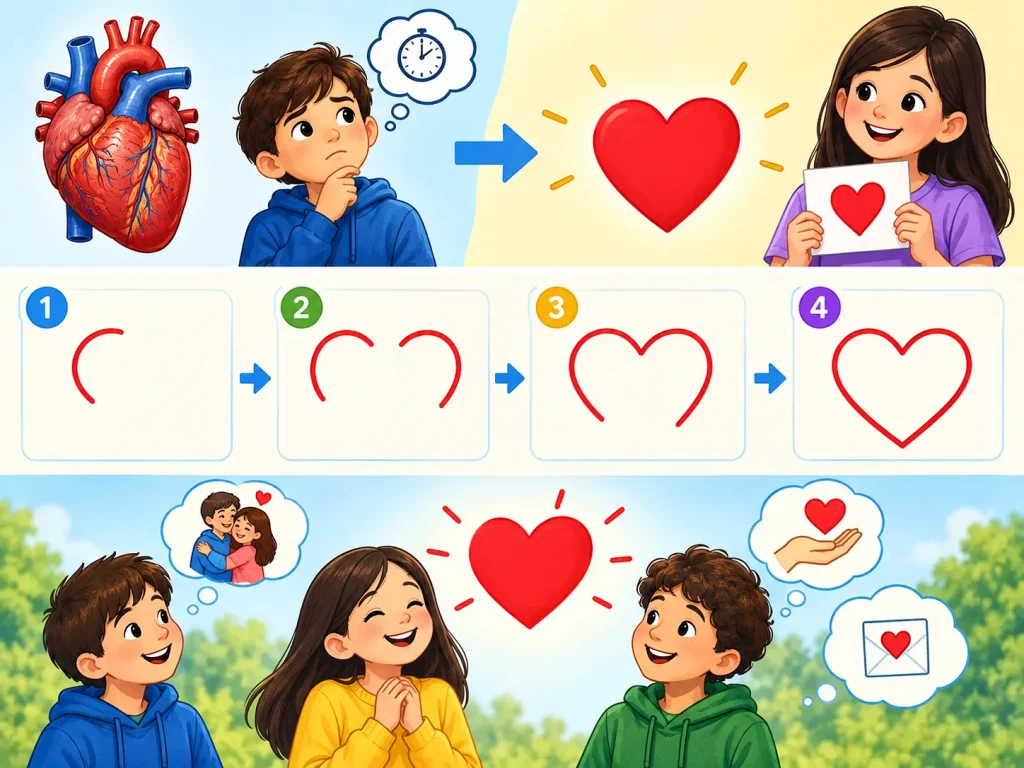
The heart symbol is much easier. You can draw it with just a few lines:
- Make a rounded bump on one side.
- Make another bump on the other side.
- Join them at the top.
- Bring the sides down to a point.
Done!
Because the shape is simple and symmetrical, people can recognise it very quickly.
This is one reason symbols are so useful. They communicate an idea without needing lots of words.
Why Does It Mean Love?
For thousands of years, people have connected the heart with feelings and emotions.
We sometimes say things such as:
- “Listen to your heart.”
- “Follow your heart.”
- “She has a kind heart.”
- “He poured his heart into his work.”
These expressions are not saying that the heart literally contains your thoughts or feelings. Instead, the heart became a metaphor for emotions such as love, kindness, courage and affection.
Eventually, the simple heart shape became one of the world’s most recognisable symbols for love.
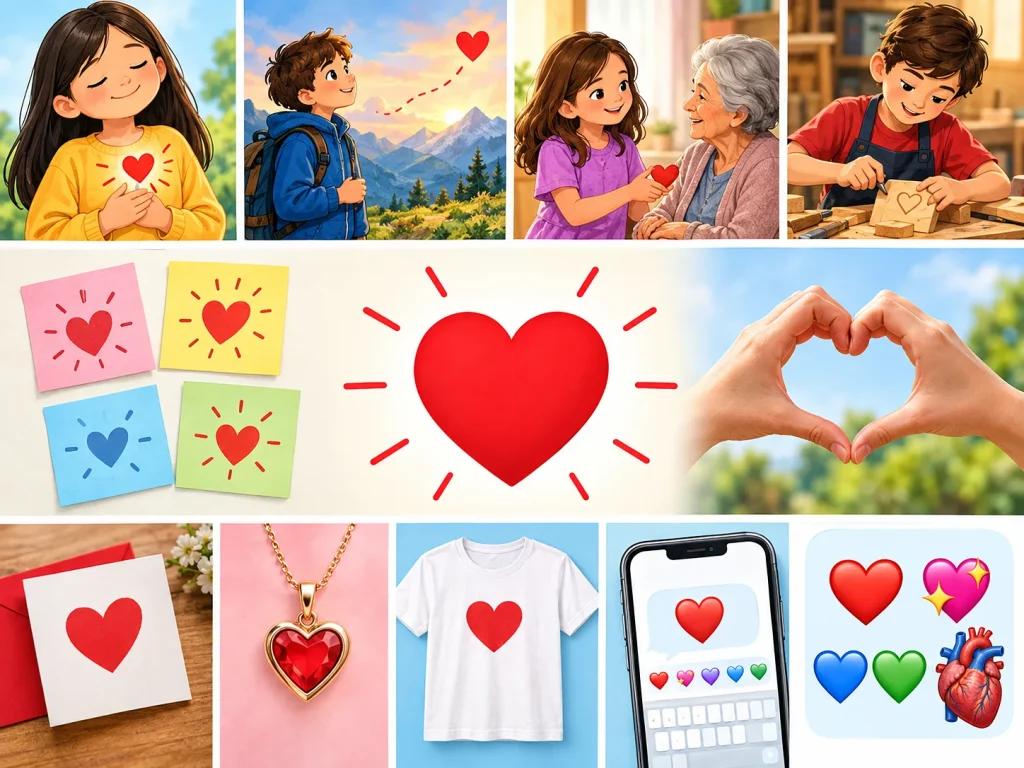
Today, you can see it on cards, signs, jewellery, clothing, websites and messages.
There are even many heart emojis, including and. There is also a separate emoji showing an anatomical heart:
Why Doesn’t Anyone Change the Symbol?
You might wonder: if we know what a real heart looks like, why don’t we make the symbol more realistic?
The answer is simple: the symbol already works!
People around the world recognise the classic heart shape immediately.
Changing it into a detailed picture of the real organ would make it less useful as a simple symbol.
Think about road signs. They often use very simple pictures instead of detailed drawings because simple shapes can be recognised quickly.
The same idea applies to the heart.
The symbol is not meant to teach you anatomy. It is meant to communicate an idea.
A Symbol Can Be More Famous Than the Real Thing
The funny part is that many people learn to draw before they ever see a proper diagram of a human heart.
The symbol is so familiar that we rarely stop to ask where it came from.
And that is what makes it interesting.
The real heart is an amazing biological machine that works continuously, pumping blood around your body. The heart symbol, meanwhile, is a simple shape created and changed by people over hundreds of years.
They look completely different, but they are connected by one powerful idea: the heart has become a symbol of love and emotion.
The Big Idea
So, why do drawn hearts look nothing like real hearts?
Because the familiar heart shape was never intended to be an accurate anatomical drawing.
It developed as a symbol. Artists and societies gradually shaped it into a simple, recognisable design. Over time, the symbol became strongly connected with love and affection.
The next time you draw a heart, remember that you are using a symbol with a very long history.
Your little may not look much like the organ beating inside your chest, but it has become one of the most recognisable symbols in the world!
For more interesting articles, please visit www.kidzherald.com