
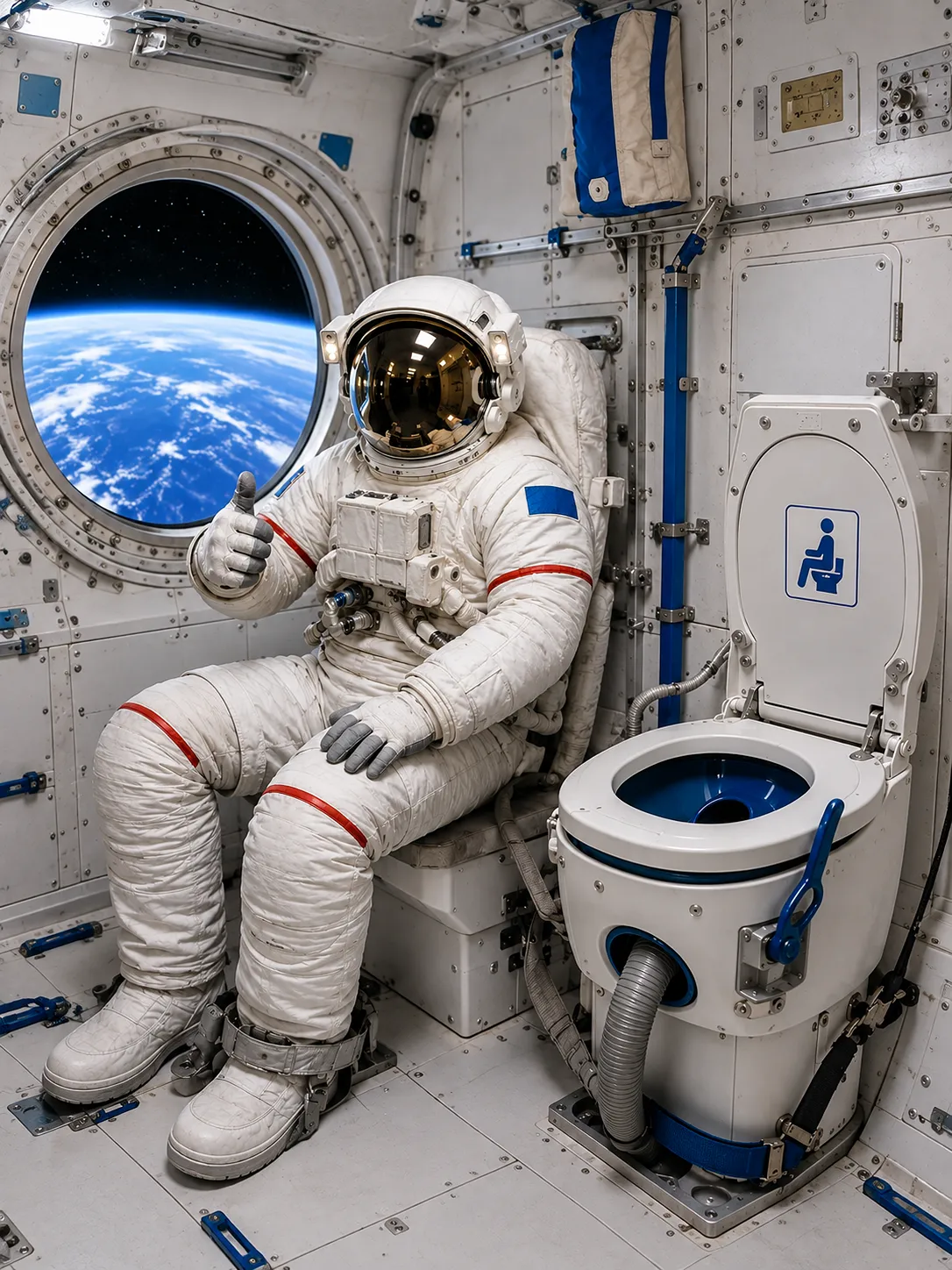
Going to the bathroom is something we normally do without giving it much thought. On Earth, gravity helps everything move in the right direction. But what happens when astronauts travel into space, where they experience microgravity?
They cannot simply use an ordinary toilet!
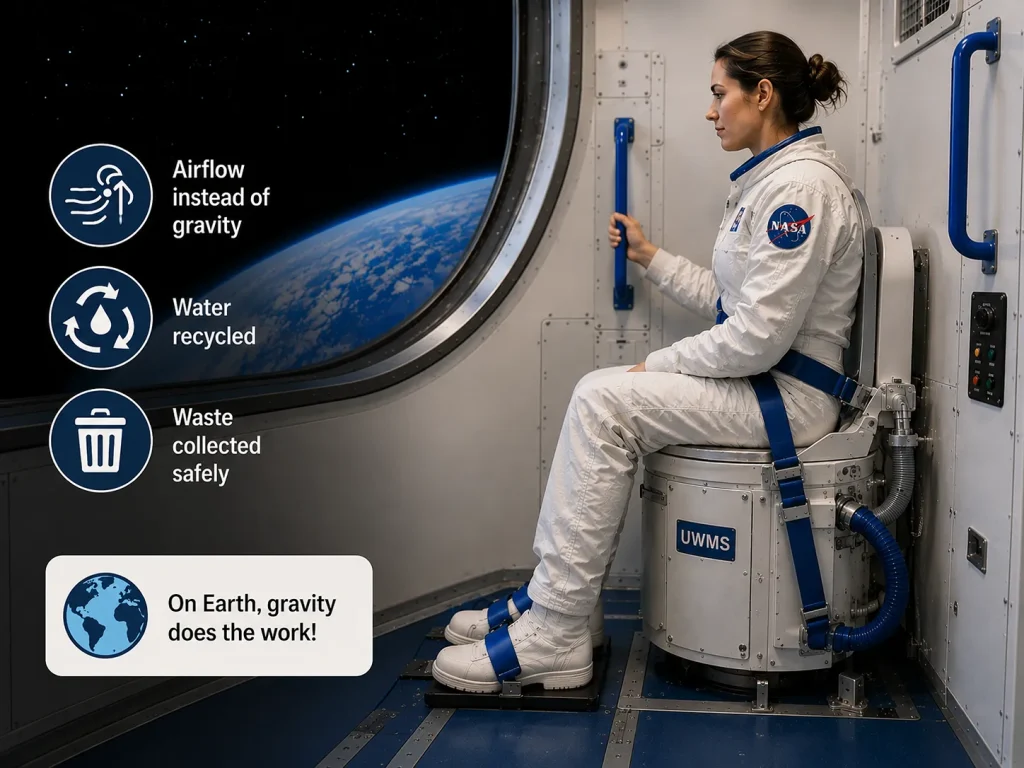
A normal toilet depends partly on gravity to move waste downwards. In space, there is very little apparent weight, so astronauts need a specially designed toilet that uses airflow and suction instead.
It might sound unusual, but space toilets are a brilliant example of science and engineering solving an everyday problem.
Why Can’t Astronauts Use a Normal Toilet?
On Earth, when you flush a toilet, gravity helps water and waste flow through the pipes.
In space, things do not naturally fall downwards in the same way.
If an astronaut tried to use an ordinary toilet without a special system, the waste would not simply drop into the bowl. It could float around the spacecraft, which would obviously be a serious problem!
Space toilets therefore use carefully controlled airflow to move waste into the correct collection system.
How Does a Space Toilet Work?
The basic idea is surprisingly clever.
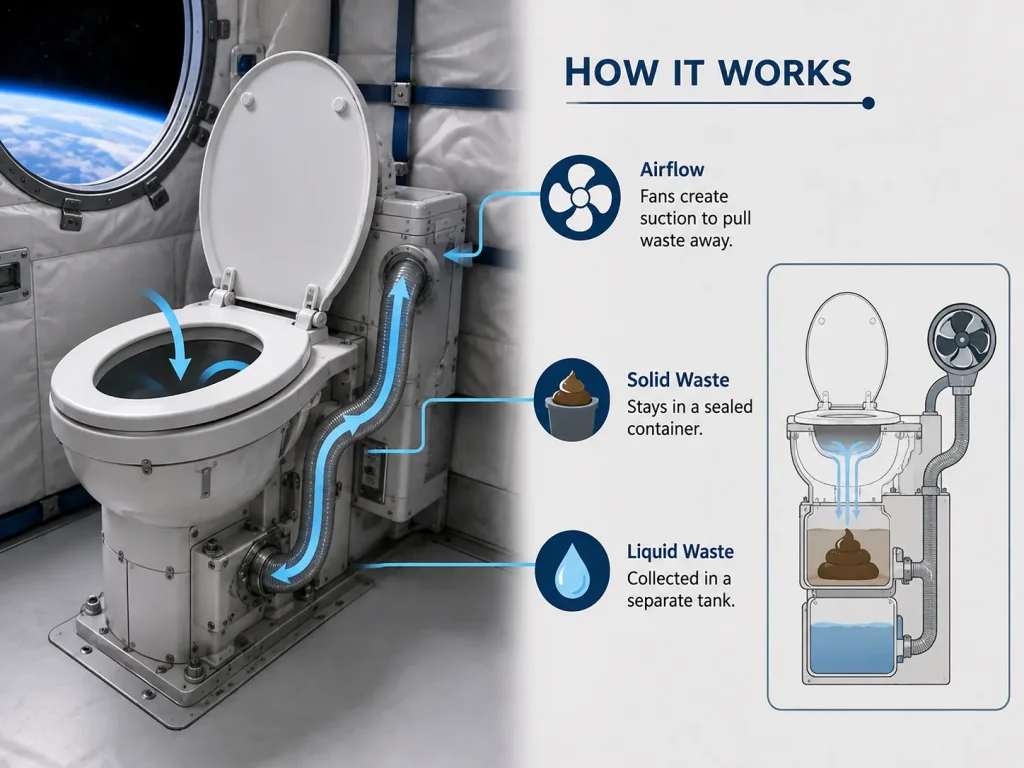
Instead of relying on gravity, fans create an airflow that carries waste away from the astronaut.
Think of it like a very carefully controlled vacuum cleaner. The airflow helps direct waste into the correct container rather than letting it float around.
Space toilets have separate systems for liquid and solid waste.
This makes the system more complicated than the toilet you might have at home, but it is essential for keeping the spacecraft clean and safe.
What Happens to Liquid Waste?
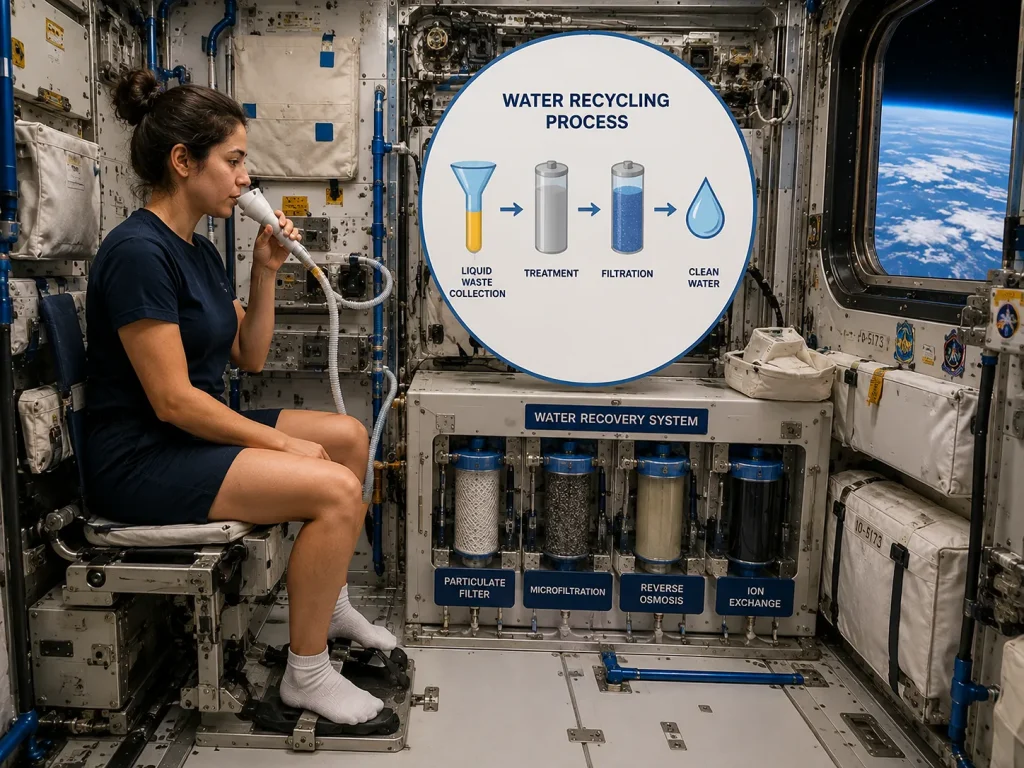
Liquid waste is collected using a specially designed funnel connected to a hose.
Airflow pulls the liquid into the collection system.
On the International Space Station, urine can be processed as part of the station’s water-recycling system. NASA says the station recycles about 90% of its water-based liquids, including urine and sweat.
The liquid undergoes a series of treatment and filtration processes so that the recovered water can be used safely again.
It may sound strange, but this is actually an excellent example of recycling.
In space, astronauts cannot simply receive endless supplies of fresh water from Earth. Every kilogram of material sent into orbit requires a spacecraft launch, so recycling is extremely important.
What Happens to Solid Waste?
Solid waste is collected separately.
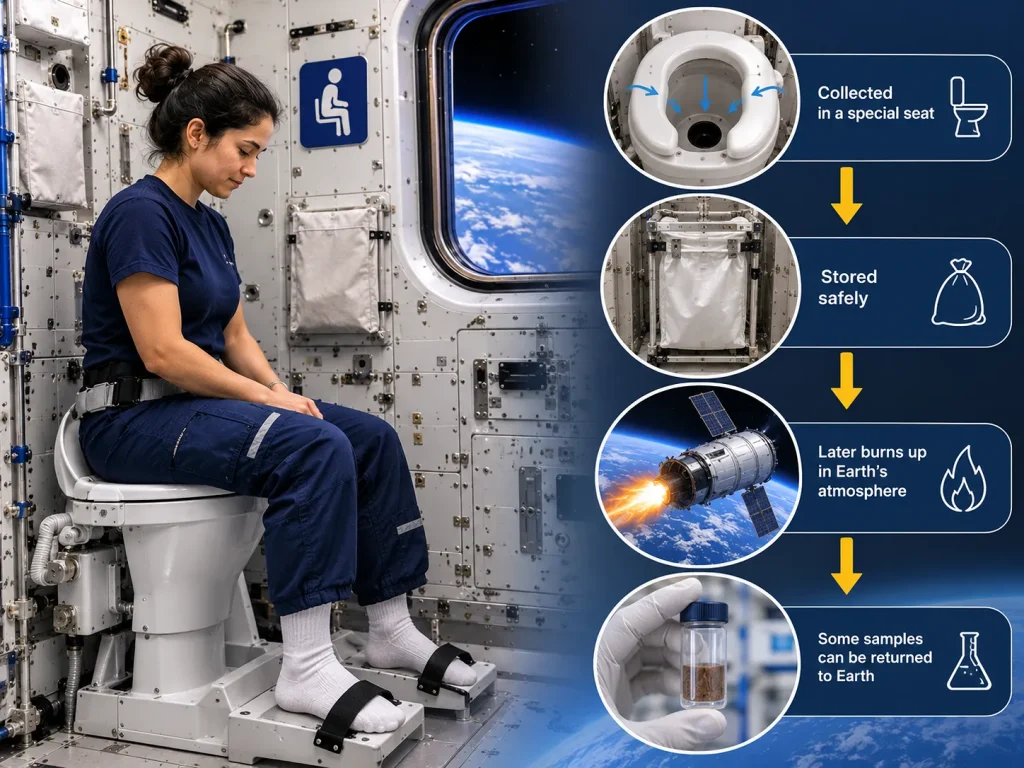
A specially designed seat and collection system help guide it into a container. Fans and airflow help move it into the collection bag.
The waste is then stored safely.
On the International Space Station, much of the stored waste is eventually placed aboard an uncrewed cargo spacecraft. That spacecraft can later burn up when it re-enters Earth’s atmosphere.
Some samples can also be returned to Earth for scientific study.
How Do Astronauts Stay in Position?
There is another problem that you might not have considered.
If astronauts are floating around, how do they stay in the right position?
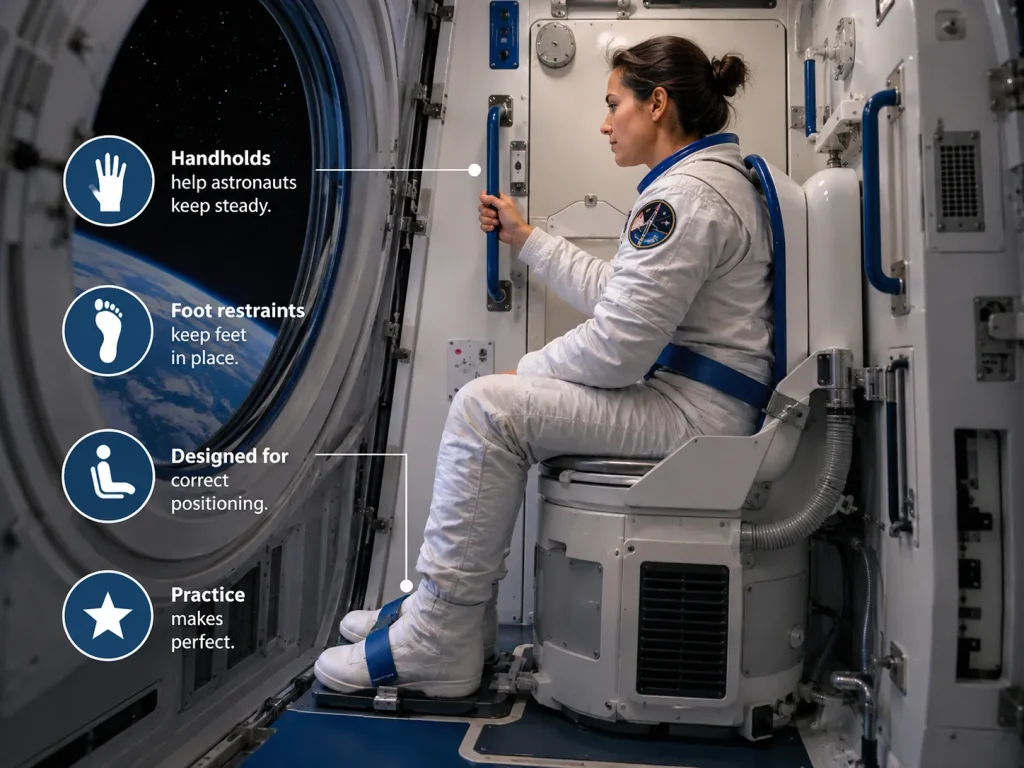
Space toilets have foot restraints and handholds to help astronauts stay in place.
The toilet is also designed to help astronauts position themselves correctly while using it.
This is important because the airflow system requires that the astronaut and the toilet be positioned properly.
Astronauts practise using the equipment before going into space, so they know what to do in orbit.
NASA’s Newer Space Toilet
NASA developed a modern system called the Universal Waste Management System, or UWMS.
It was designed to be more comfortable and easier to integrate with spacecraft systems. NASA says the newer toilet is about 65% smaller and 40% lighter than the toilet previously used on the International Space Station.
Making equipment smaller and lighter is extremely important for space missions.
Every spacecraft has limited room, weight and resources. Engineers therefore try to make every piece of equipment as efficient as possible.
Why Is Water Recycling So Important?
Imagine having to carry every drop of water you would ever need for a long journey.
That would require an enormous amount of storage space and would make spacecraft much heavier.
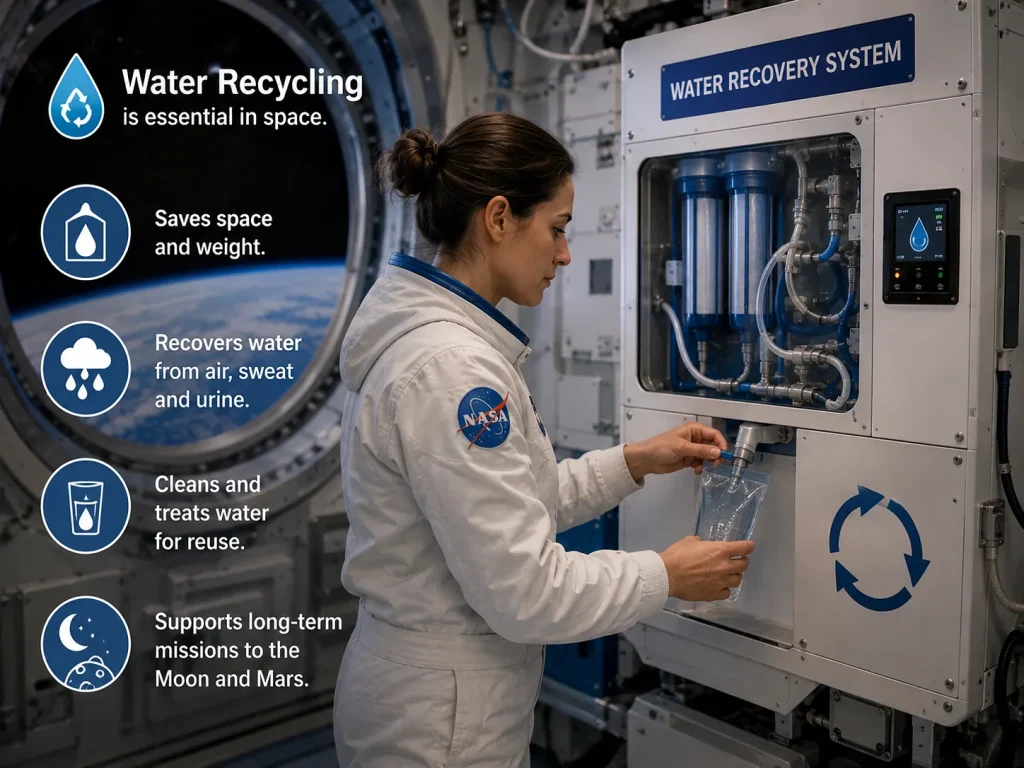
Instead, astronauts recycle as much water as possible.
The International Space Station uses systems that recover water from different sources, including moisture in the cabin air and astronauts’ sweat and urine. The treated water is cleaned and processed before being returned to the water supply.
This helps astronauts live for long periods in space without needing constant deliveries from Earth.
It also teaches scientists useful lessons about how future astronauts might survive on the Moon or Mars.
What About Missions to the Moon and Mars?
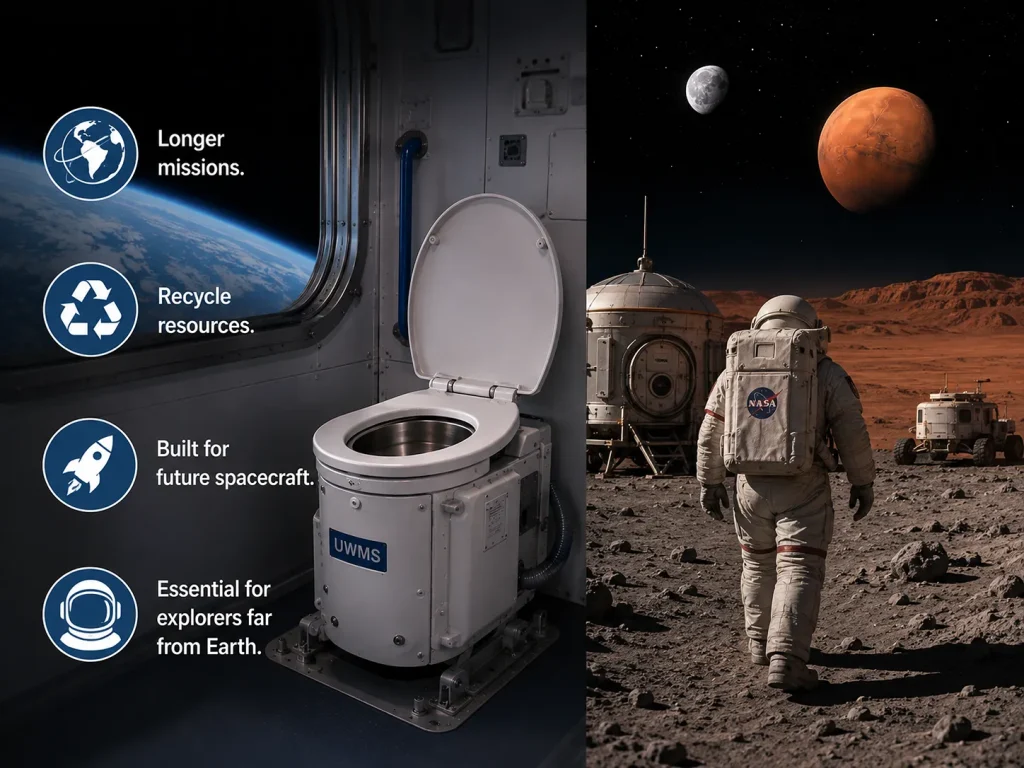
Space toilets become even more important during longer missions.
A trip to the International Space Station is very different from a future journey to Mars. The farther astronauts travel from Earth, the more important it becomes to recycle resources.
NASA designed the UWMS to work with different spacecraft and life-support systems. NASA also planned a version for the Orion spacecraft for missions beyond the Moon.
Future explorers may spend weeks, months or even longer away from Earth, so reliable waste-management systems will be essential.
Space Toilets Have Come a Long Way
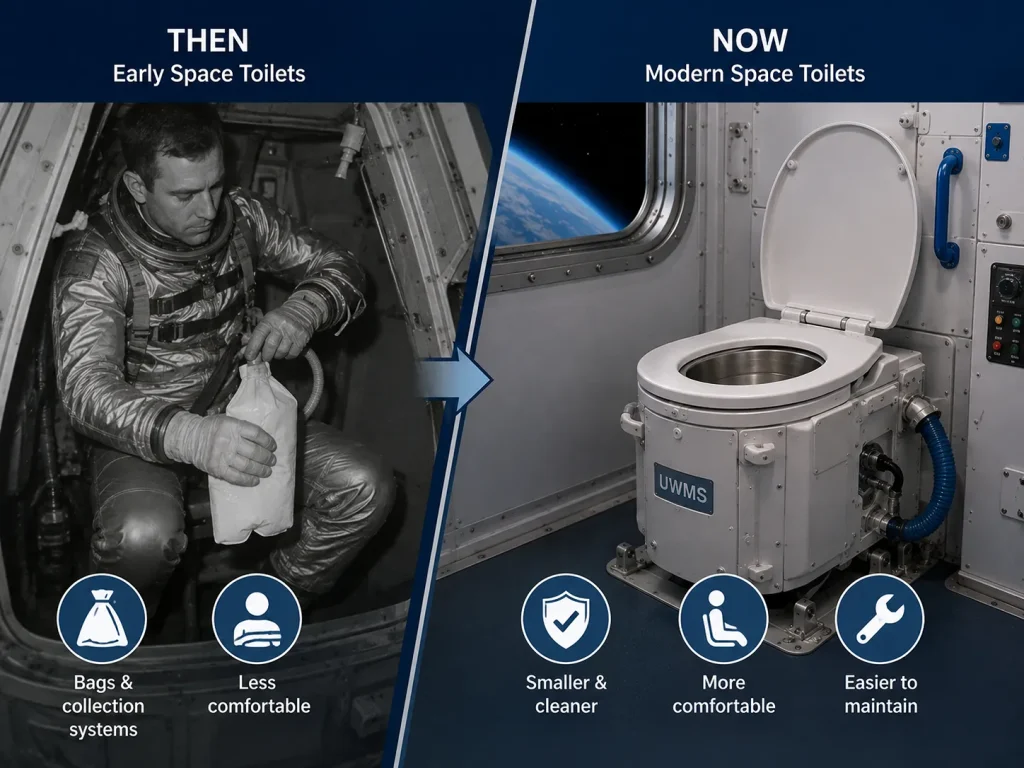
The toilets used by early astronauts were much less comfortable and convenient than modern systems.
During some early space missions, astronauts used specially designed bags and other collection systems rather than the sophisticated toilets found on today’s space stations.
Engineers have gradually improved space toilets by learning from astronauts and designing systems that are smaller, cleaner, more comfortable and easier to maintain.
This shows an important part of science: technology improves when people learn from experience.
Fun Facts About Space Toilets
No ordinary flushing: Space toilets cannot depend on Earth’s gravity.
Air does the job: Fans and airflow help move waste into collection systems.
Water is precious: NASA recycles a large amount of water on the International Space Station.
Spacecraft have limited room: Engineers make toilets compact and lightweight.
Astronauts need training: Crew members learn how to use and maintain their equipment before travelling to space.
Recycling is essential: Recovering water reduces the amount of supplies that must be launched from Earth.
Why Is This Important?
A space toilet might sound like a funny subject, but it is actually an important piece of technology.
Astronauts need food, air, water and a safe way to manage waste. Without reliable systems, long-duration space missions would be extremely difficult.
Engineers have to think about problems that we rarely notice on Earth because gravity, running water and sewage systems normally do the work for us.
Space exploration forces scientists to ask an interesting question:
How can we take something that works on Earth and redesign it for space?
The answer is often a clever combination of physics, engineering and technology.
Conclusion
So, how do astronauts go to the bathroom in space?
They use specially designed toilets that replace gravity with airflow and suction. Liquid waste can be collected and processed for water recovery, while solid waste is safely collected and stored for disposal. Astronauts use restraints and handholds to remain in position while using the equipment.
It may seem like a small problem compared with travelling to the Moon or exploring Mars, but solving everyday problems is one of the most important parts of space exploration.
The next time you use an ordinary toilet on Earth, remember, gravity is doing a lot of the work for you!
For more interesting articles, please visit www.kidzherald.com


