
Space exploration is one of the most exciting fields of science. Every time a rocket launches into the sky, people around the world watch with excitement and wonder. Two of the most famous space agencies are NASA and ISRO.
Both organisations help us learn more about Earth, the Moon, Mars and the vast Universe beyond. However, they differ in many ways, including their history, goals, budgets, and achievements.
Let’s explore the fascinating differences between NASA and ISRO in an easy-to-understand way.
What Is NASA?
NASA is the space agency of the United States. It was created in 1958, during the early years of the Space Age.
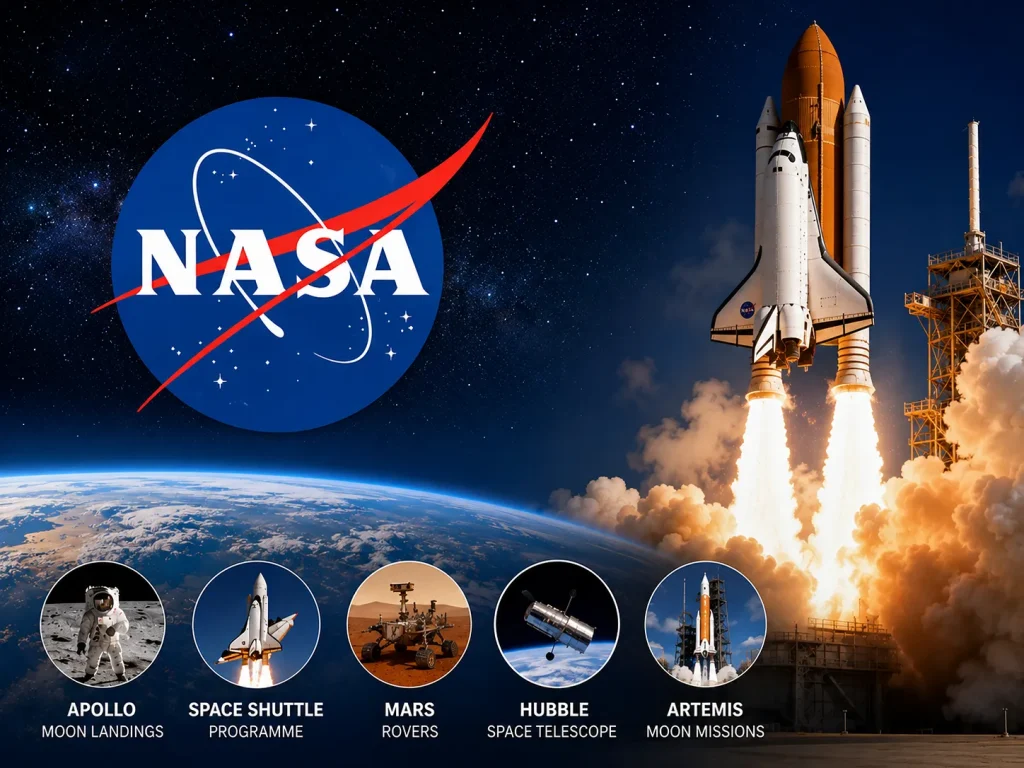
NASA is responsible for many famous space missions, including:
- The Apollo Moon landings
- The Space Shuttle programme
- Mars rovers
- The Hubble Space Telescope
- Artemis Moon missions
NASA’s main goal is to explore space, conduct scientific research and develop new technologies that benefit humanity.
What Is ISRO?
ISRO is the space agency of India. It was established in 1969.
ISRO began with limited resources but achieved remarkable success through innovation and careful planning. Today, it is one of the world’s most respected space agencies.
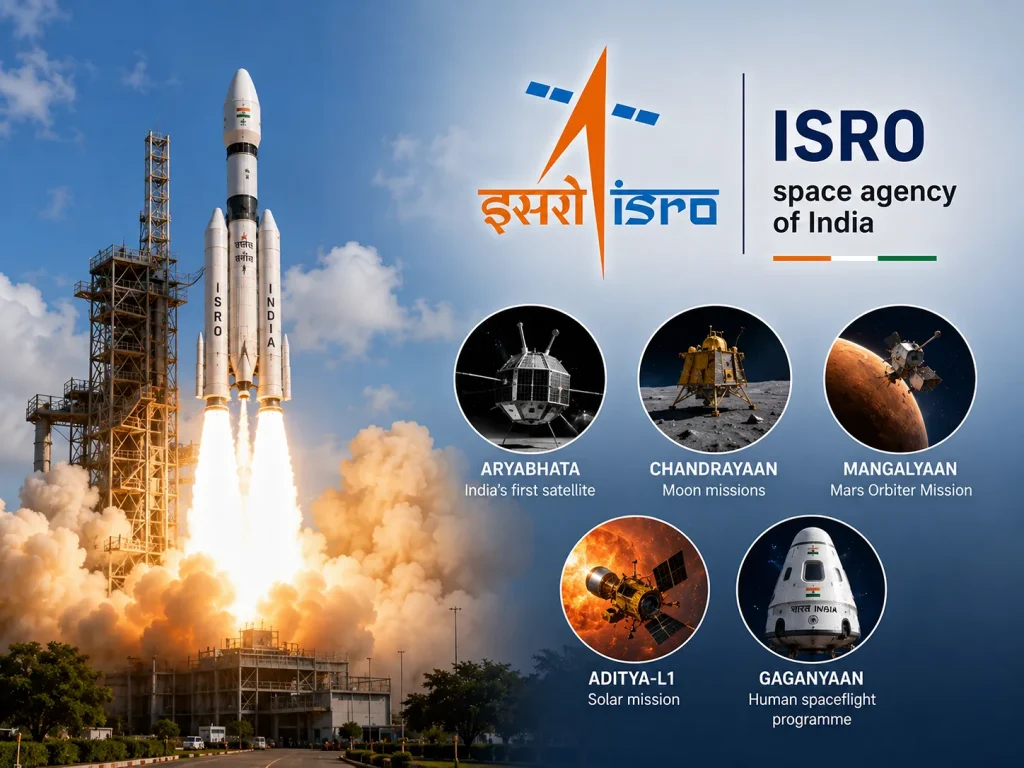
Some famous ISRO missions include:
- Aryabhata, India’s first satellite
- Chandrayaan Moon missions
- Mangalyaan (Mars Orbiter Mission)
- Aditya-L1 solar mission
- Gaganyaan human spaceflight programme
ISRO focuses on using space technology to help people through communication, weather forecasting, navigation and scientific exploration.
A Quick Comparison
| Feature | NASA | ISRO |
| Country | United States | India |
| Founded | 1958 | 1969 |
| Full Name | National Aeronautics and Space Administration | Indian Space Research Organisation |
| Headquarters | Washington, D.C. | Bengaluru |
| Main Focus | Space exploration and scientific research | Space technology and exploration |
| Famous Mission | Apollo 11 Moon Landing | Chandrayaan-3 Moon Landing |
Although both agencies explore space, they often approach challenges differently.
Budget: Big Difference, Same Ambition
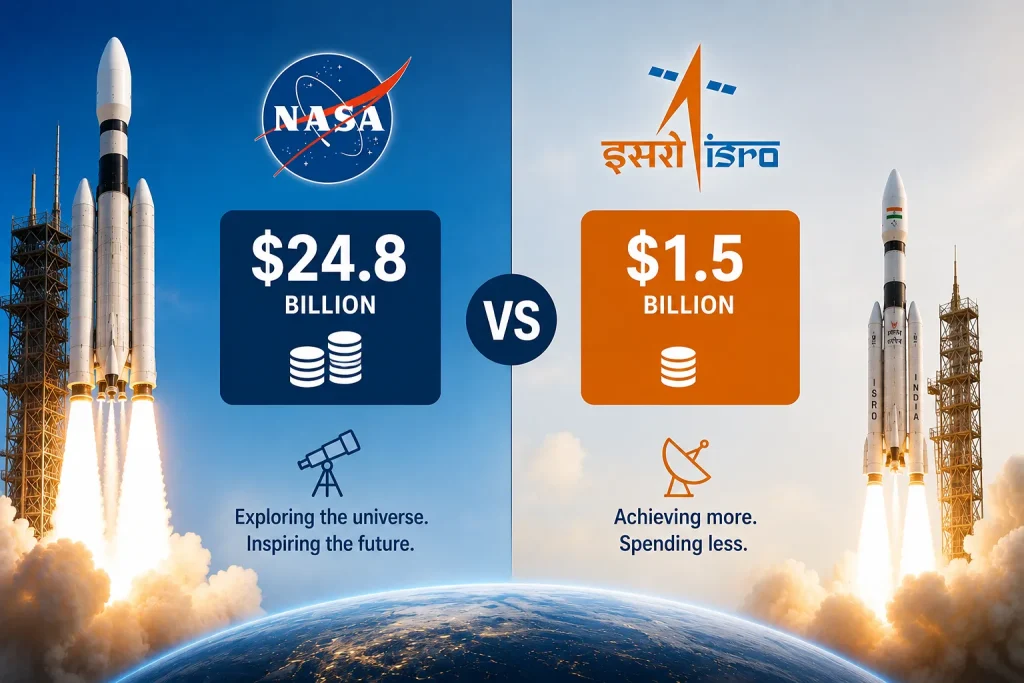
One of the biggest differences between NASA and ISRO is their budget.
NASA receives one of the largest space budgets in the world. This allows it to build giant rockets, send robotic missions across the Solar System and prepare for future human missions to the Moon and Mars.
ISRO operates with a much smaller budget. Despite this, it has gained worldwide recognition for completing missions at relatively low cost.
Because of this, many people admire ISRO’s ability to achieve impressive results while carefully managing expenses.
Moon Missions
The Moon has always fascinated humans.
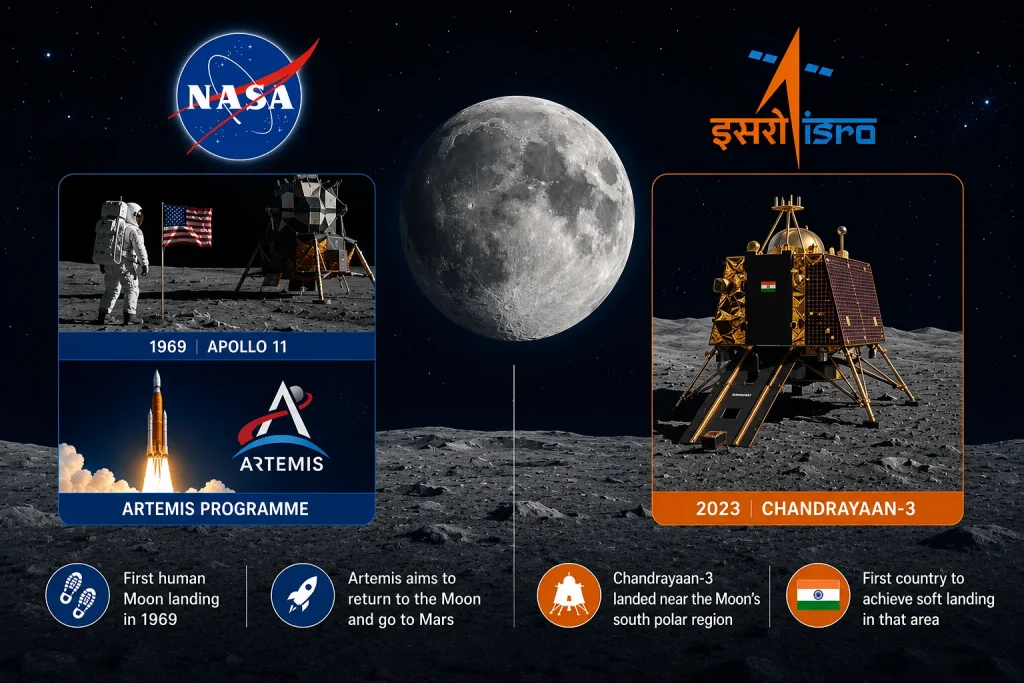
NASA made history in 1969 when Neil Armstrong became the first person to walk on the Moon during the Apollo 11 Moon Landing.
More recently, NASA has been developing the Artemis programme, which aims to return astronauts to the Moon and eventually help humans travel to Mars.
ISRO has also achieved major successes on the Moon. In 2023, the Chandrayaan-3 mission successfully landed near the Moon’s south polar region, making India the first country to achieve a soft landing in that area.
Mars Exploration
Both NASA and ISRO have explored Mars.
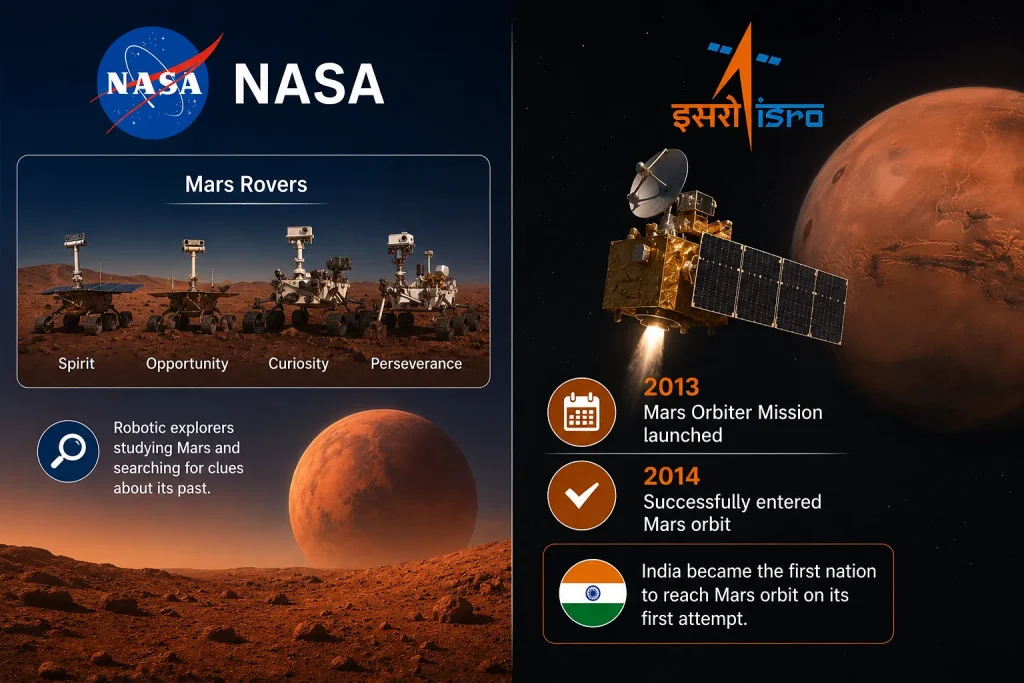
NASA has sent several rovers to the Red Planet, including:
- Spirit
- Opportunity
- Curiosity
- Perseverance
These robotic explorers study Mars and search for clues about its past.
ISRO launched the Mars Orbiter Mission in 2013. The spacecraft successfully entered Mars orbit in 2014.
This achievement was especially impressive because India became the first nation to reach Mars orbit on its first attempt.
Human Spaceflight
Another major difference involves astronauts.
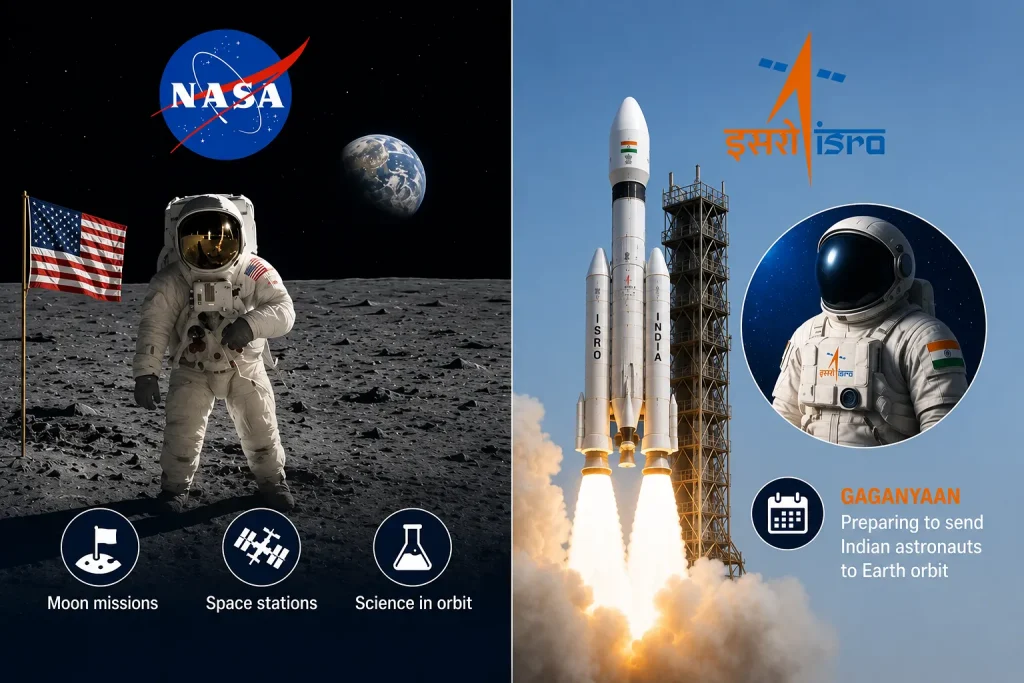
NASA has decades of experience sending humans into space. American astronauts have visited the Moon, worked aboard space stations and conducted scientific experiments in orbit.
ISRO has not yet launched its own astronauts into space, but it is preparing for the Gaganyaan mission. This programme aims to send Indian astronauts into Earth orbit using an Indian spacecraft and rocket.
Many people in India are excited about this important step.
Helping People on Earth
Space agencies do much more than explore distant planets.
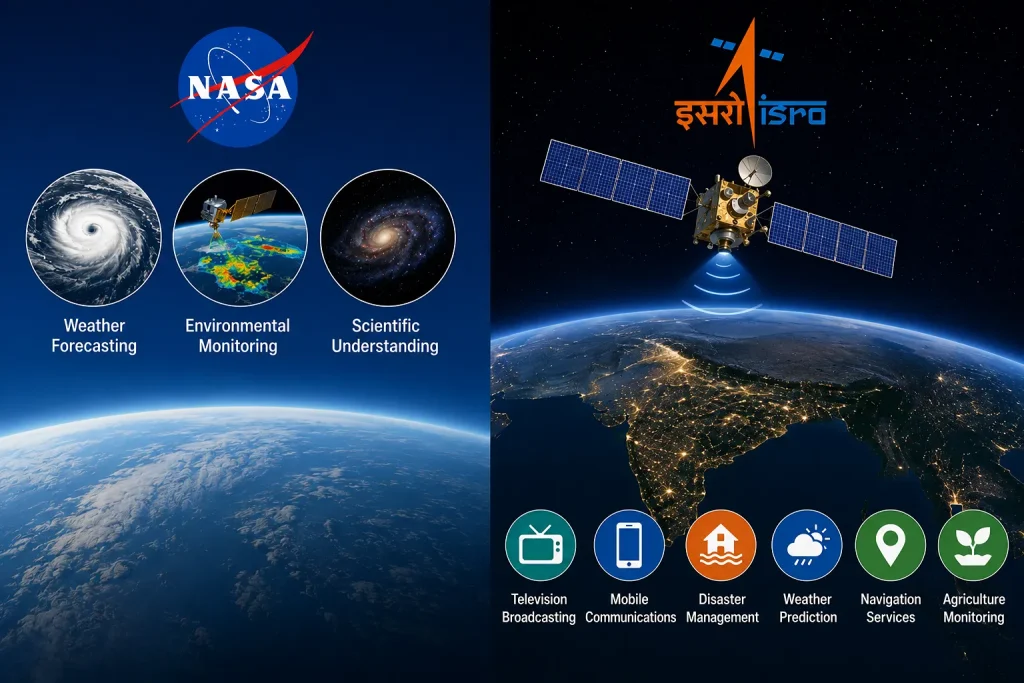
NASA develops technologies that improve weather forecasting, environmental monitoring and scientific understanding.
ISRO uses satellites to help millions of people across India by supporting:
- Television broadcasting
- Mobile communications
- Disaster management
- Weather prediction
- Navigation services
- Agriculture monitoring
This practical use of space technology has been one of ISRO’s greatest strengths.
Working Together
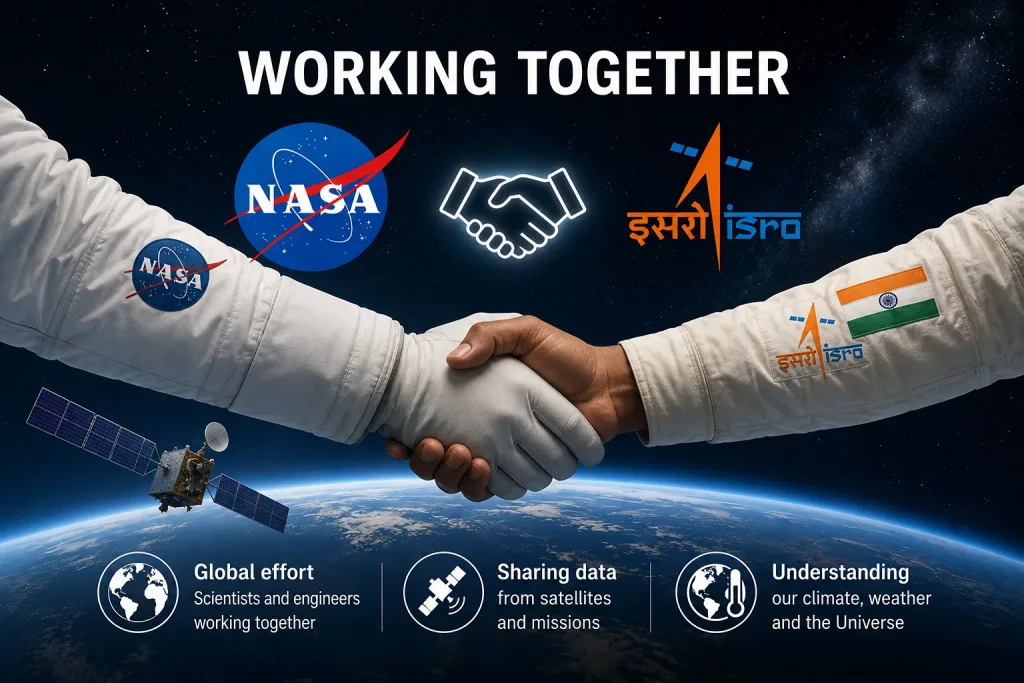
Although NASA and ISRO are based in different countries, they often collaborate on scientific projects.
Space exploration is a global effort. Scientists and engineers from many nations share information and work together to solve difficult problems.
For example, data from satellites and space missions can help researchers better understand climate, weather and the Universe.
Which Agency Is Better?
This is a question many young space fans ask.
The truth is that NASA and ISRO are excellent in different ways.
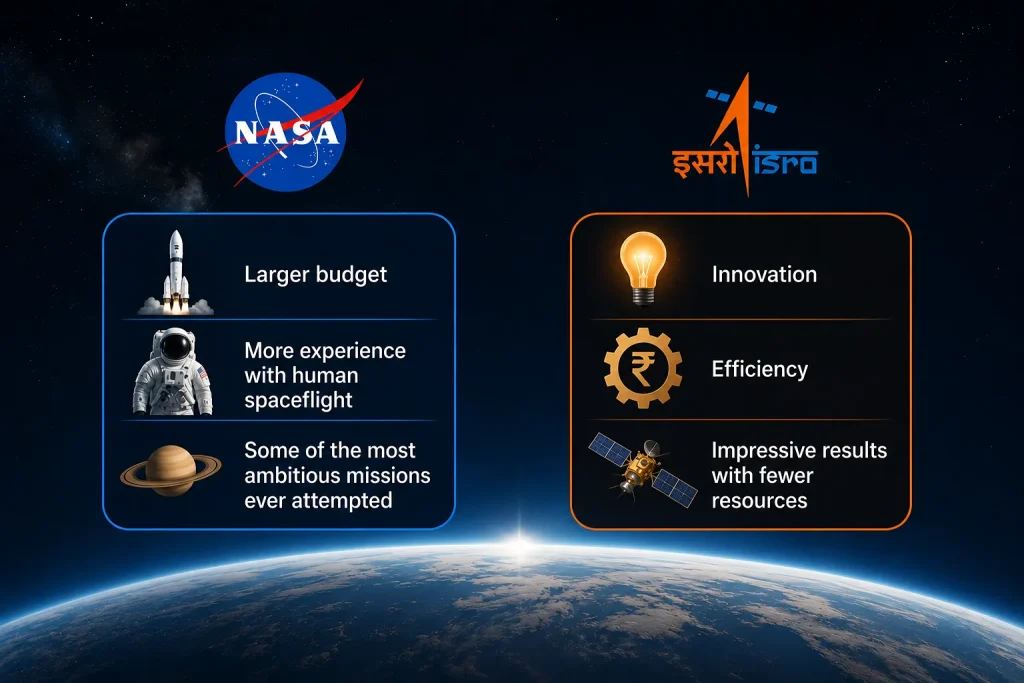
NASA has a larger budget; more experience with human spaceflight and some of the most ambitious missions ever attempted.
ISRO is known for innovation, efficiency and achieving impressive results with fewer resources.
Instead of competing, both organisations contribute valuable discoveries that help humanity learn more about space.
Fun Facts
NASA astronauts have walked on the Moon.
ISRO was founded eleven years after NASA.
India’s Chandrayaan-3 landed near the Moon’s south pole.
NASA’s Mars rovers have travelled many kilometres across the Martian surface.
ISRO’s Mars mission reached orbit on its very first attempt.
Both agencies inspire millions of children to study science and engineering.
Conclusion
NASA and ISRO are two of the most important space agencies in the world. NASA is famous for its Moon landings, Mars rovers and ambitious exploration programmes. ISRO is celebrated for its cost-effective missions, lunar achievements and technology that helps people every day.
While they differ in size, budget and history, both organisations share the same dream: to explore space and expand human knowledge.
As new missions head towards the Moon, Mars and beyond, NASA and ISRO will continue inspiring future scientists, engineers and astronauts. Perhaps one day, some of today’s young readers will even help build the next great space mission!
For more interesting articles, please visit www.kidzherald.com